
Finance Questions
What Credit Score Do I Need to Buy a Car?
There is no single credit score required to buy a car. While a higher credit score can help you qualify for lower interest rates and more favorable loan terms, customers with fair credit, poor credit, limited credit history, or even past credit challenges may still have financing options available. Lenders look at more than just the number on your credit report-they may also consider your income, employment history, down payment, existing debt, vehicle choice, and overall ability to repay the loan. That means you shouldn't assume you can't get approved simply because your credit score isn't where you'd like it to be.
At Chuck Anderson Ford in Excelsior Springs, Missouri, our experienced finance department works with a wide range of banks and lending partners to help customers find financing that fits their individual situation. We pride ourselves on having one of the strongest finance teams in the area, helping customers from Liberty, Kearney, Smithville, Richmond, Kansas City, and surrounding Missouri communities explore options whether they have excellent credit, are rebuilding their credit, or are buying their first vehicle. While no dealership can guarantee approval for every applicant, our team can get financing arranged for a wide variety of credit situations-and we'll work hard to find a path forward rather than simply focusing on your credit score.
How Much Should I Put Down on a Car Loan?
Putting money down on a car loan can have several benefits, including lowering the amount you need to finance, reducing your monthly payment, decreasing the total interest paid over the life of the loan, and potentially improving your chances of approval. A larger down payment can also help reduce the risk of owing more on the vehicle than it is worth. However, putting too much money down can leave you with less cash available for emergencies or other expenses, and in some cases a customer may prefer to keep that money in savings if the available financing rate is especially low. At Chuck Anderson Ford in Excelsior Springs, Missouri, our finance team can help you compare different down-payment amounts and financing options so you can choose the structure that makes the most sense for your budget and financial goals.
The answer: As much as you're comfortable with.
The answer: As much as you're comfortable with.
Dealer Financing vs. Bank Financing
Financing through your own bank or credit union can be a good option, particularly if you already have a strong relationship with that institution and want to arrive at the dealership with a pre-approved rate. The downside is that you're typically comparing an offer from just one lender. Dealer financing can provide considerably more flexibility because the dealership may have access to multiple banks, credit unions, manufacturer-backed programs, and specialty lenders at the same time. Instead of requiring you to contact several financial institutions individually, an experienced dealership finance department can work to identify competitive loan terms based on your credit profile, vehicle, down payment, and desired monthly payment.
At Chuck Anderson Ford in Excelsior Springs, Missouri, one of the biggest advantages we can offer is the lending relationships our finance department has built over many years. Because we regularly work with a broad network of lenders through indirect automotive financing, our team understands which lenders may be the best fit for different customers and can advocate for competitive rates, terms, and approval structures on their behalf. Those relationships can be particularly valuable when a customer's situation doesn't fit neatly into a bank's standard lending guidelines. Whether you're coming from Liberty, Kearney, Smithville, Richmond, Kansas City, or another surrounding community, it's worth giving the Chuck Anderson Ford finance team an opportunity to compare available financing options-even if you already have an approval from your own bank. In many cases, having multiple lenders compete for the opportunity to finance your vehicle can help produce an excellent financing package.
Incentivized Rates Financing vs. Rebate
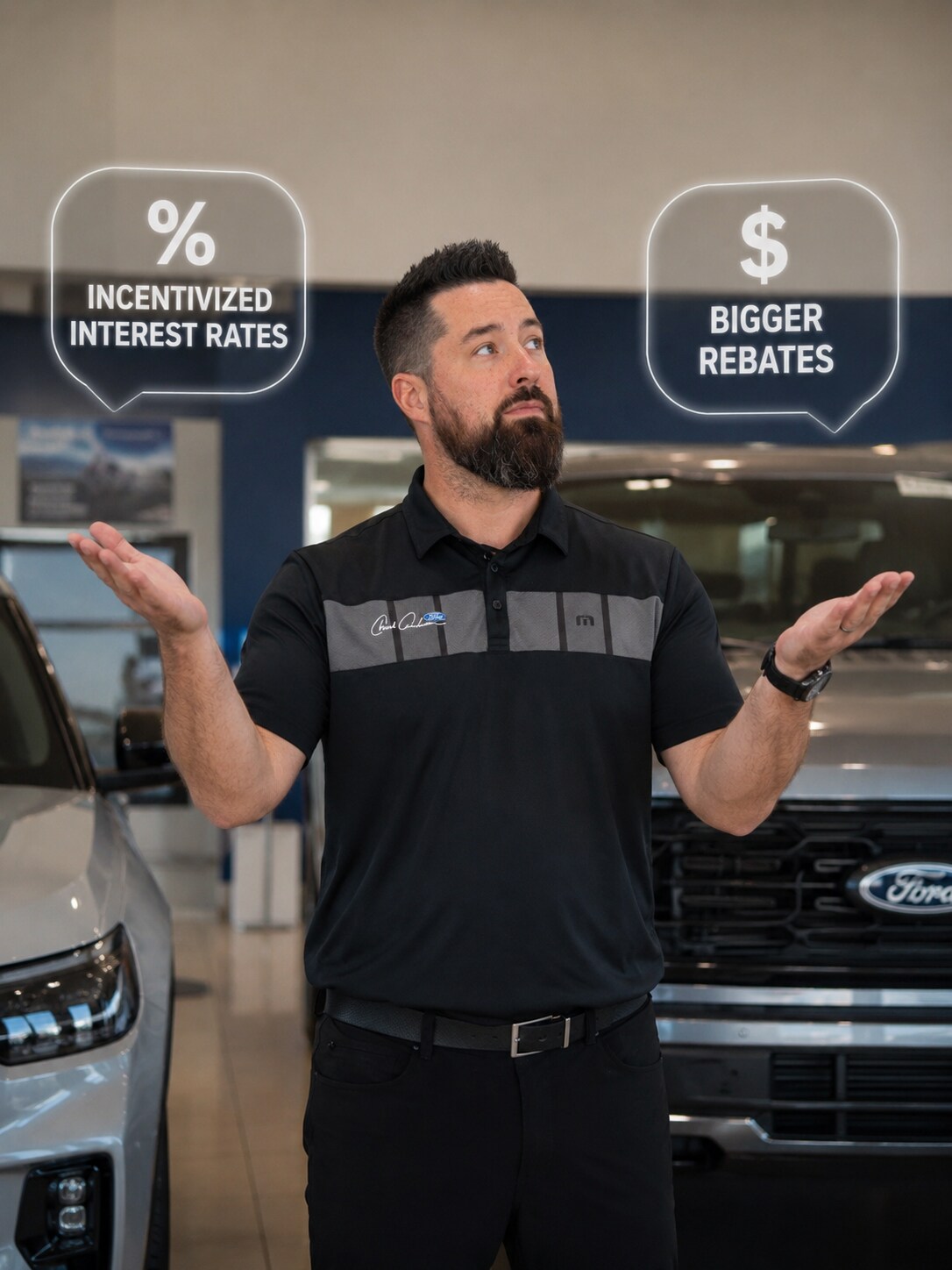
When buying a new vehicle, manufacturers will sometimes offer a choice between a lower promotional interest rate with fewer rebates or a slightly higher interest rate with more cash incentives. The lower-rate option can be attractive because it reduces the amount of interest you pay over the life of the loan and may result in a lower monthly payment, especially when financing a larger amount for a longer term. This option can be particularly valuable for buyers who plan to keep the vehicle and make payments for the full length of the loan. On the other hand, choosing the larger rebate reduces the vehicle's purchase price immediately, which may lower the amount financed and can sometimes create additional sales-tax savings depending on how incentives are treated in your state.
The best option depends on the specific numbers involved, including the vehicle price, rebate difference, interest rates, loan term, down payment, and how long you expect to keep the loan. In some cases, giving up part of the rebate for a much lower interest rate saves thousands of dollars over time; in others, taking the larger rebate and accepting a modestly higher rate produces the lower total cost. At Chuck Anderson Ford in Excelsior Springs, Missouri, our finance team can calculate both options side by side for customers from Liberty, Kearney, Smithville, Richmond, Kansas City, and surrounding areas so you can see the actual monthly payment and total cost of each choice before deciding which incentive structure makes the most financial sense.
72 Months vs. 84 Months
Choosing between 72-month and 84-month financing usually comes down to balancing a lower monthly payment against the total amount of interest you will pay. For example, financing $50,000 at 6% interest for 72 months would result in a payment of approximately $829 per month, with about $9,662 in total interest paid over the life of the loan. Stretching the same $50,000 loan to 84 months would lower the payment to approximately $730 per month, saving about $98 per month, but total interest would increase to roughly $11,356. In other words, the 84-month loan provides more monthly budget flexibility, but costs about $1,694 more in interest if both loans are carried to maturity. The right choice depends on whether keeping the monthly payment lower or minimizing the overall cost of borrowing is more important to your budget.
Does Applying for a Vehicle Loan Hurt Your Credit?
Applying for financing to buy a new car can cause a small, temporary impact to your credit score because lenders typically perform a hard credit inquiry when reviewing your application. For most customers, that impact is relatively minor and usually fades over time. Credit scoring models also generally recognize that consumers shop around for auto loans, so multiple auto-loan inquiries made within a short shopping window are often treated as a single rate-shopping event rather than separate negative marks. Your overall credit profile, payment history, credit utilization, and existing debt typically have a much greater effect on your score than one auto-loan application.
At Chuck Anderson Ford in Excelsior Springs, Missouri, our finance team works with a broad network of lenders to help customers compare financing options efficiently without unnecessarily dragging out the process. Once financing is approved and the loan is opened, making your payments on time can actually help strengthen your credit history over the long term. For customers from Liberty, Kearney, Smithville, Richmond, Kansas City, and surrounding communities, our goal is to make the financing process clear, straightforward, and focused on finding the best available terms for your individual situation.