
Ranger Raptor vs Ranger: what's the difference?
``` Ford Ranger Comparison
Ranger Raptor vs. Ranger: What's the Difference?
Ranger Raptor is much more than a Ranger with a larger engine and aggressive appearance. It adds a 405-horsepower 3.0L EcoBoost V6, standard 4x4, locking front and rear axles, FOX Live Valve shocks, specialized rear suspension and off-road drive modes. A conventional Ranger is the better choice for many buyers who prioritize towing, value and everyday truck use.
```
``` Quick Answer: Ranger Is the Better All-Around Truck; Raptor Is the Better Performance Off-Roader
Choose a conventional Ranger XL, XLT or Lariat if towing, daily driving, value and general truck capability are your main priorities.
Those Rangers can tow up to 7,500 pounds when properly equipped, offer available 4x4 and FX4 capability, and let you choose between the standard 2.3L EcoBoost and the available 2.7L EcoBoost V6 on applicable XLT and Lariat models.
Choose Ranger Raptor if the performance hardware itself is why you want the truck.
Raptor exclusively gets the 405-horsepower 3.0L EcoBoost V6, standard four-wheel drive, locking front and rear axles, 2.5-inch FOX Live Valve shocks, a Watts-link rear suspension and specialized drive modes including Baja.
Ranger Raptor is substantially more capable off road, but its maximum towing rating drops to 5,510 pounds.
Everyday Use
Ranger
XL, XLT and Lariat focus more heavily on normal truck ownership.
Off-Road Performance
Raptor
FOX suspension, lockers and a specialized chassis set it apart.
Maximum Towing
Ranger
Up to 7,500 lbs versus 5,510 lbs for Ranger Raptor.
Horsepower
Raptor
405 hp from its exclusive 3.0L EcoBoost V6.
```
``` 2026 Ranger Raptor vs. Conventional Ranger
The biggest differences are underneath the truck—not just in the grille, wheels or badges.
| Category | Ranger XL / XLT / Lariat | Ranger Raptor | Advantage |
|---|---|---|---|
| Primary Mission | Everyday midsize truck capability | High-performance off-road driving | Depends on use |
| Standard Engine | 2.3L EcoBoost I-4 | 3.0L EcoBoost V6 | Raptor for performance |
| Standard Horsepower | 270 hp | 405 hp | Raptor |
| Standard Torque | 310 lb-ft | 430 lb-ft | Raptor |
| Available Conventional V6 | 2.7L EcoBoost: 315 hp / 400 lb-ft on applicable XLT/Lariat | Not applicable | Ranger offers another choice |
| Drivetrain | 4x2 standard; 4x4 available | 4x4 standard | Depends on use |
| Maximum Available Towing | 7,500 lbs | 5,510 lbs | Ranger |
| Rear Suspension | Leaf-spring rear suspension | Raptor-specific Watts-link rear suspension | Different missions |
| Shocks | Standard gas shocks or available FX4 off-road-tuned shocks | 2.5-inch FOX Live Valve shocks | Raptor |
| Rear Locker | Available electronic-locking rear differential | Locking rear axle capability | Raptor standardizes more hardware |
| Front Locker | Not part of conventional FX4 package | Locking front axle capability | Raptor |
| FX4 Package | Available on compatible 4x4 XL, XLT and Lariat | Raptor has its own specialized hardware | Different approaches |
| Best Buyer | Work, towing, commuting, camping and moderate trails | Buyer specifically seeking advanced off-road performance | Depends on use |
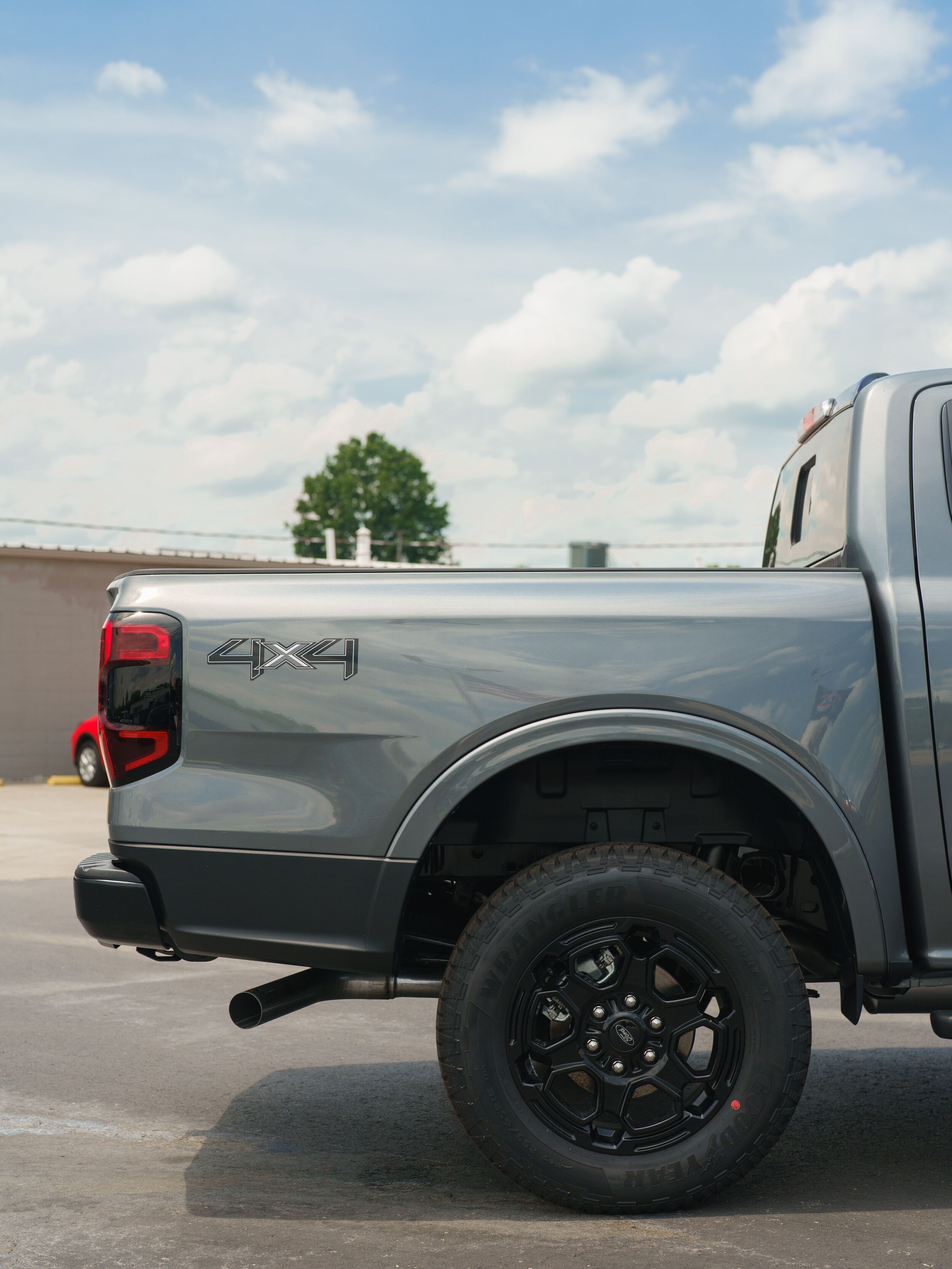
Ranger Raptor is not simply the trim above Lariat. XL, XLT and Lariat move progressively through value, technology and comfort. Raptor changes the mission of the truck around specialized off-road performance.
``` 
``` Engine Difference
Ranger Raptor Gets Its Own 405-HP Engine
The conventional Ranger lineup begins with Ford's 2.3L EcoBoost, producing 270 horsepower and 310 lb-ft of torque.
Applicable XLT and Lariat 4x4 models can step up to the 2.7L EcoBoost V6, producing 315 horsepower and 400 lb-ft of torque.
Ranger Raptor then makes a much larger jump.
Its exclusive 3.0L EcoBoost V6 produces 405 horsepower and 430 lb-ft of torque.
That is 135 more horsepower than the standard Ranger engine and 90 more horsepower than the available 2.7L V6.
Compare Ranger Engines
```
``` But the Engine Is Not the Biggest Raptor Difference
If Ford simply installed a 405-horsepower engine in a Ranger Lariat, it still would not create a Ranger Raptor.
The Raptor's defining changes involve the suspension, axles, chassis tuning and drivetrain systems designed to manage demanding terrain.
That hardware changes how the truck behaves off road much more dramatically than a horsepower number alone can explain.
Ranger Raptor Adds:
- 2.5-inch FOX Live Valve shocks
- Raptor-specific Watts-link rear suspension
- Locking front axle capability
- Locking rear axle capability
- Standard four-wheel drive
- Raptor-specific chassis tuning
- Seven selectable drive modes
- Baja performance mode
- Heavy-duty underbody protection
```
``` Do You Need Raptor, or Is a Ranger With FX4 Enough?
For many buyers, this is the more useful question.
Ranger With FX4
Ford offers the FX4 Off-Road Package on compatible 4x4 Ranger XL, XLT and Lariat models.
Current FX4 equipment includes an electronic-locking rear differential, off-road-tuned shocks, underbody protection, additional selectable terrain modes and Trail Control.
That can be more than enough for hunting property, gravel roads, camping, muddy access roads, trails and winter driving.
Ranger Raptor
Raptor takes the concept much farther.
It combines locking front and rear axle capability with FOX Live Valve dampers, a different rear suspension design, significantly more horsepower and chassis calibration intended for aggressive off-road driving.
Buy Raptor when those components are the reason you are shopping for the truck.
```
``` For Normal Trails and Outdoor Use, FX4 May Be the Better Value
You do not need Ranger Raptor simply because you leave pavement.
An FX4-equipped Ranger can already provide real off-road hardware, including underbody protection, an electronic-locking rear differential, off-road-tuned shocks and Trail Control.
If your normal use is camping, hunting, muddy roads, gravel, moderate trails or rural property access, an XL, XLT or Lariat 4x4 with FX4 may provide everything you actually use.
Raptor becomes easier to justify when you specifically want the additional suspension travel, front locker, 405-horsepower engine and much more aggressive off-road calibration.
```
``` The Suspension Is Where Ranger Raptor Separates Itself
Conventional Ranger models use independent front suspension and a traditional leaf-spring rear suspension.
The FX4 Package upgrades the shock tuning for off-road use but retains the conventional Ranger's basic mission.
Ranger Raptor uses a substantially different rear suspension architecture with a Watts link and coils, paired with electronically controlled FOX Live Valve dampers.
Why That Matters
- Greater control over rough terrain
- Better response during rapid suspension movement
- More specialized high-speed off-road capability
- Improved ability to manage repeated bumps and impacts
- A driving character fundamentally different from a standard Ranger
Raptor's suspension is not simply a comfort upgrade. It is a core part of what defines the truck.
```
``` Traction
Ranger Raptor Adds Locking Capability at Both Ends
A conventional Ranger 4x4 can be equipped with an electronic-locking rear differential, and FX4 includes that feature.
Ranger Raptor goes farther with locking front and rear axle capability.
Locking differentials help keep wheels turning together when traction becomes uneven.
That can be especially useful when climbing, crossing rocks, traveling through deep ruts or working through situations where one wheel begins to unload.
For ordinary snow and gravel-road use, that extra hardware may be unnecessary. On difficult terrain, it becomes one of Raptor's major advantages.
```
``` Ranger Raptor Also Gets More Specialized Drive Modes
Ranger Raptor provides seven selectable drive modes that alter vehicle behavior for different surfaces and driving styles.
The most distinctive is Baja Mode, which is designed around aggressive high-performance off-road operation.
Conventional Ranger models can also gain terrain-oriented settings through FX4, including Mud/Ruts and Sand modes along with Trail Control.
The difference is one of degree: FX4 helps a Ranger handle difficult terrain; Raptor's entire powertrain and chassis are calibrated around going much farther into the performance end of off-road driving.
```
``` Regular Ranger Actually Tows More Than Ranger Raptor
This is one of the clearest examples of why more horsepower does not automatically mean more truck capability.
Properly equipped Ranger XL, XLT and Lariat models can tow up to 7,500 pounds.
Ranger Raptor is rated for up to 5,510 pounds.
That gives the conventional Ranger a 1,990-pound maximum towing advantage.
Why Does Raptor Tow Less?
- Different suspension architecture
- Different chassis mission
- Off-road-focused tires
- Raptor-specific drivetrain hardware
- Different weight and vehicle configuration
Ranger Raptor is designed around off-road performance rather than maximizing conventional trailer weight.
Ranger Towing Guide ```
``` Choose Conventional Ranger for Towing
If you regularly pull a boat, camper, enclosed trailer or equipment, the conventional Ranger's 7,500-pound maximum towing capability may be more useful than Raptor's additional horsepower.
A 2.7L EcoBoost XLT or Lariat is particularly interesting because it combines 400 lb-ft of torque with the conventional Ranger's maximum available 7,500-pound tow rating.
Choose Raptor for Performance
If your trailer falls comfortably below 5,510 pounds and specialized off-road capability matters far more than maximum towing, Raptor's lower tow rating may not matter to you.
Buy the truck whose capability matches what you actually do.
``` 
``` Daily Driving
Is Ranger Raptor Good for Everyday Driving?
Yes. Ranger Raptor is still a street-legal five-passenger Ranger with a 10-speed automatic transmission, modern infotainment, driver-assistance technology and everyday convenience equipment.
But you will still live with its specialized nature every day.
Its off-road tires, wider stance, suspension calibration and performance-oriented hardware create a different experience than a conventional Ranger.
If most of your driving is commuting and errands, a Ranger XLT or Lariat may be the more rational truck.
If you actively enjoy the Raptor's personality even when driving to work, then its extra capability is part of the appeal rather than a drawback.
```
``` Ranger Lariat vs. Raptor: Luxury or Performance?
Lariat and Raptor sit near the top of the Ranger lineup, but they arrive there from different directions.
Ranger Lariat is the premium conventional Ranger. It emphasizes comfort, technology and everyday usability while retaining access to 7,500 pounds of properly equipped towing.
Lariat includes features such as a 12-inch center display, 12-inch digital instrument cluster, 360-Degree Camera and Adaptive Cruise Control with Speed Sign Recognition.
Ranger Raptor is the performance Ranger. Its value is concentrated in the 405-horsepower engine, FOX suspension, locking axles and specialized off-road chassis.
Choose Lariat if you want your extra money to buy comfort and technology. Choose Raptor if you want it to buy performance hardware.
```
``` Raptor vs. 2.7L Ranger: How Much Faster Is the Powertrain?
The available 2.7L EcoBoost V6 makes a conventional Ranger much stronger without turning it into a Raptor.
The 2.7L produces 315 horsepower and 400 lb-ft of torque.
Raptor's 3.0L produces 405 horsepower and 430 lb-ft.
That is a 90-horsepower advantage for Raptor, but only a 30-lb-ft difference in peak torque.
The Bigger Difference Is Still the Truck Around the Engine
A 2.7L XLT or Lariat remains a conventional Ranger with traditional Ranger suspension architecture.
Raptor combines its additional power with different suspension, locking axles, standard 4x4 and specialized terrain-management systems.
Buyers should not treat the 3.0L merely as the next engine option above the 2.7L.
```
``` Ranger Raptor Also Includes Useful Everyday Equipment
Being performance-focused does not mean Raptor is stripped of practical Ranger features.
Pro Power Onboard
Current 2026 Ranger Raptor equipment includes 400 watts of Pro Power Onboard through in-cab and in-bed power outlets.
That can be useful for campsites, small electronics, charging equipment and outdoor recreation.
360-Degree Camera
Ranger Raptor includes a 360-Degree Camera, useful both for maneuvering in parking lots and positioning the truck around obstacles off road.
Similar camera technology is available or included on certain conventional Ranger configurations depending on trim and package.
```
``` Who Should Buy Ranger Raptor?
Raptor makes the most sense when you specifically value the things that make Raptor expensive and different.
Serious Off-Road Driver
You regularly encounter terrain where FOX suspension, locking front and rear axles and specialized drive modes can actually be used.
Performance Buyer
You want the most powerful Ranger and specifically value the 405-horsepower 3.0L EcoBoost.
Adventure Buyer
Your weekends involve trails, remote camping, rough access roads and recreational driving where additional chassis capability matters.
Enthusiast Buyer
You simply want the Raptor experience and are comfortable paying for capability that may exceed what normal daily driving requires.
```
``` Who Should Buy a Conventional Ranger?
For many truck shoppers, XL, XLT or Lariat is the better answer.
You still get a fully boxed truck frame, available 4x4, available FX4, strong EcoBoost power and up to 7,500 pounds of towing.
Choose a Regular Ranger If:
- You tow regularly.
- You use the truck for work.
- You mainly drive on pavement.
- Moderate off-road capability is enough.
- You want the better value.
- You want the available 2.7L EcoBoost V6.
- You prefer premium Lariat comfort over performance hardware.
- You do not need locking front and rear axles.
```
``` Ranger or Ranger Raptor? Choose in 30 Seconds
Match the truck to what you actually plan to do.
"I want the most horsepower."
Choose Ranger Raptor. Its 405-horsepower 3.0L EcoBoost is the most powerful Ranger engine.
"I tow a camper or boat regularly."
Start with a conventional Ranger. Properly equipped XL, XLT and Lariat models reach 7,500 pounds of towing.
"I want strong performance but don't need Raptor."
Look at a 2.7L XLT or Lariat. You get 315 horsepower, 400 lb-ft and conventional Ranger towing capability.
"I hunt, camp and drive gravel roads."
A Ranger 4x4 with FX4 may be enough. You get a rear locker, protection, off-road shocks and Trail Control.
"I want to drive difficult terrain aggressively."
Choose Ranger Raptor. That is exactly what its FOX suspension and specialized chassis are designed around.
"I want luxury more than off-road performance."
Choose Ranger Lariat. It puts more emphasis on premium comfort and technology.
"I want the most capable factory Ranger off road."
Choose Ranger Raptor. No conventional Ranger configuration duplicates its complete chassis package.
"I mostly commute and do normal truck stuff."
Choose XL, XLT or Lariat. You may never use enough of Raptor's specialized hardware to justify the upgrade.
```
``` Is Ranger Raptor Worth It?
Ranger Raptor is worth it when you value the hardware—not simply the badge.
You are paying for an exclusive engine, FOX Live Valve suspension, locking front and rear axles, a different rear suspension system, specialized 4x4 hardware and high-performance chassis tuning.
Those are expensive mechanical differences that would be difficult to duplicate by modifying a conventional Ranger after purchase.
But if your truck will spend nearly all of its life commuting, towing and occasionally driving mild trails, a Ranger XLT or Lariat may give you more useful capability for the money.
The correct question is not whether Raptor is "worth more." It is whether Raptor's extra capability is worth more to you.
```
``` Our Verdict: Buy Ranger Raptor Because You Want a Raptor
For the average Ranger buyer, we would start with XL, XLT or Lariat.
Conventional Rangers can tow more, cost less to enter, offer excellent 4x4 and FX4 capability and are better aligned with normal commuting, work and trailer use.
An available 2.7L EcoBoost XLT or Lariat also gives you 400 lb-ft of torque without requiring the Raptor chassis.
Choose Raptor When You Specifically Want:
- 405 horsepower
- 430 lb-ft of torque
- FOX Live Valve shocks
- Watts-link rear suspension
- Locking front and rear axles
- Standard 4x4
- Baja Mode
- Maximum factory Ranger off-road performance
Raptor is not simply a nicer Ranger. It is a Ranger engineered for a different job.
```
``` Ranger Raptor vs. Ranger FAQs
Quick answers to common questions about Ford's high-performance midsize pickup.
What is the difference between Ranger Raptor and Ranger?
Ranger Raptor adds an exclusive 405-horsepower 3.0L EcoBoost V6, standard 4x4, locking front and rear axles, 2.5-inch FOX Live Valve shocks, a Watts-link rear suspension and specialized high-performance off-road drive modes.
How much horsepower does Ranger Raptor have?
The 2026 Ford Ranger Raptor's 3.0L EcoBoost V6 produces 405 horsepower and 430 lb-ft of torque.
How much horsepower does a regular Ranger have?
The standard 2.3L EcoBoost produces 270 horsepower and 310 lb-ft. Applicable Ranger XLT and Lariat models can add a 2.7L EcoBoost V6 producing 315 horsepower and 400 lb-ft.
Does Ranger Raptor tow more than a regular Ranger?
No. Properly equipped conventional Ranger models can tow up to 7,500 pounds, while Ranger Raptor is rated for up to 5,510 pounds.
Why does Ranger Raptor tow less?
Raptor's suspension, tires, chassis and drivetrain are optimized primarily for high-performance off-road driving rather than maximum conventional towing capacity.
Does Ranger Raptor have locking differentials?
Yes. Ranger Raptor includes locking front and rear axle capability for demanding low-traction terrain.
Does a regular Ranger have a locking differential?
An electronic-locking rear differential is available on conventional Ranger 4x4 models and is included with the available FX4 Off-Road Package.
Is Ranger Raptor better than an FX4 Ranger?
Ranger Raptor is substantially more specialized for aggressive high-performance off-road driving. An FX4 Ranger can be the better value for camping, hunting, gravel roads, mud and moderate trails.
Is Ranger Raptor good for daily driving?
Yes. Ranger Raptor has a 10-speed automatic, modern technology and everyday comfort features. Its off-road tires and specialized suspension give it a different driving character from a conventional Ranger.
Should I buy Ranger Raptor or Ranger Lariat?
Choose Ranger Lariat if premium comfort, technology, towing and everyday usability are the priorities. Choose Ranger Raptor when engine performance, FOX suspension, locking axles and specialized off-road capability matter most.
```
``` Continue Your Ford Ranger Research
Compare Ranger engines, towing, competitors and everyday capability before choosing your truck.
```
``` Trying to Decide Between Ranger Raptor and a Regular Ranger?
Start with what you actually expect the truck to do.
If towing, commuting, work and occasional trails dominate your use, a Ranger XLT or Lariat—especially with available 4x4, FX4 or the 2.7L EcoBoost—may be the better fit.
If the 405-horsepower engine, FOX suspension, front and rear lockers and Raptor's specialized off-road chassis are the reason you want the truck, there is no conventional Ranger substitute.
Chuck Anderson Ford can help you compare available Ranger and Ranger Raptor configurations based on towing, performance, off-road use, comfort and budget.
Visit us in Excelsior Springs, Missouri, serving Ranger shoppers from Liberty, Kearney, Lawson, Smithville and throughout the Kansas City Northland.
- Chuck Anderson Ford
- 1910 W Jesse James Road
- Excelsior Springs, MO 64024
- Sales: 816-648-6419
- Service: 816-648-6424
- Parts: 816-648-6429
```
``` 2026 Ford Ranger engines, horsepower, torque, towing capacity, drivetrain availability, suspension equipment, off-road technology, trim content, packages and specifications vary by vehicle configuration and are subject to change. Maximum towing figures do not apply to every vehicle and depend on required equipment, passengers, cargo and vehicle configuration. Off-road driving involves inherent risk and should be performed only in appropriate locations and conditions. Always verify current equipment, specifications, towing ratings and capability for the exact Ranger before purchase, towing or off-road operation.