

Ford Ranger vs. Ford F-150: which should I buy?
Ford Truck Comparison
Ford Ranger vs. F-150: Which Should I Buy?
Choose the Ford Ranger if you want real pickup capability in a smaller, easier-to-maneuver midsize truck. Choose the Ford F-150 if you need more rear-seat room, bed space, towing capacity, payload capability or powertrain choices. For many buyers, the right answer comes down to how much truck they actually need every day.
Quick Answer: Ranger for Right-Sized Capability; F-150 When You Need More Truck
For buyers who do not need full-size towing, passenger room or bed capacity, we would seriously consider the Ranger.
A conventional Ranger can tow up to 7,500 pounds when properly equipped, carries five passengers and gives you a 59.6-inch bed in a truck measuring about 210.6 inches long.
Move to the F-150 when your family, trailer, cargo or work requirements make use of the additional size. Properly configured current F-150 models can tow up to 13,500 pounds, offer substantially more rear-seat space and provide multiple bed lengths and a much broader powertrain lineup.
Bigger is not automatically better. The best truck is the smallest one that comfortably handles everything you realistically expect it to do.
Maneuverability
Ranger
Shorter and narrower than a comparable F-150 SuperCrew.
Towing
F-150
Up to 13,500 lbs versus 7,500 lbs for conventional Ranger.
Rear-Seat Room
F-150
Significantly more rear legroom in SuperCrew form.
Right-Sized Truck
Ranger
Excellent when full-size capability would go mostly unused.
2026 Ford Ranger vs. F-150 Comparison
Comparing SuperCrew-style configurations shows just how differently these two Ford pickups are sized and positioned.
| Category | Ford Ranger | Ford F-150 | Advantage |
|---|---|---|---|
| Truck Class | Midsize pickup | Full-size light-duty pickup | Different missions |
| SuperCrew Overall Length | 210.6 in. | Approximately 232.0 in. with 5.5-ft bed | Ranger is easier to maneuver |
| Width Without Mirrors | 75.5 in. | 79.9 in. | Ranger is narrower |
| Rear Legroom | 34.6 in. | 43.6 in. in SuperCrew | F-150 |
| Standard Bed Length Compared Here | 59.6 in. | 67.1 in. with 5.5-ft bed | F-150 |
| Bed Volume | Approximately 43.5 cu. ft. | Approximately 52.8 cu. ft. with 5.5-ft bed | F-150 |
| Max Available Conventional Towing | 7,500 lbs | 13,500 lbs | F-150 |
| Maximum Available Payload | Up to approximately 1,788 lbs depending on configuration | Up to 2,440 lbs in published 2026 specifications | F-150 |
| Engine Variety | 2.3L, 2.7L and Raptor 3.0L EcoBoost | Multiple EcoBoost, V8, hybrid and Raptor powertrains | F-150 |
| Hybrid Availability | No PowerBoost equivalent | PowerBoost available | F-150 |
| High-Performance Off-Road Model | Ranger Raptor | F-150 Raptor / Raptor R | Both offer specialized choices |
| Best Fit | Midsize utility, trails, commuting and moderate towing | Families, heavier towing, larger cargo and broad truck use | Depends on needs |
Specifications vary by model year and configuration. The size comparison above uses representative 2026 SuperCrew configurations. Towing and payload figures are maximum available ratings, not ratings for every Ranger or F-150.
The Biggest Ranger Advantage Is Size
Ranger is not simply an F-150 with less towing capacity.
Its smaller exterior dimensions can make the truck considerably easier to use in parking lots, garages, tight trails, older neighborhoods and everyday traffic.
A conventional 2026 Ranger SuperCrew is approximately 210.6 inches long and 75.5 inches wide without mirrors.
A comparable F-150 SuperCrew with the 5.5-foot bed is roughly 232 inches long and 79.9 inches wide.
That Means Ranger Is Approximately:
- 21 inches shorter than an F-150 SuperCrew with 5.5-ft bed
- 4.4 inches narrower without mirrors
- Easier to fit into many residential garages
- Easier to maneuver on tight trails
- Easier to place in normal parking spaces
- Still large enough to provide real pickup utility
If you live with the truck every day, those inches can matter.
Why Buy Ranger?
Ranger Makes Sense When You Don't Need Everything an F-150 Offers
There is a point where buying additional capability stops improving the ownership experience.
If your heaviest trailer weighs well within Ranger capability, you usually carry four or fewer passengers and the 59.6-inch bed handles your cargo, the F-150's additional size may simply be unused capacity.
Ranger still gives you a body-on-frame pickup, available 4x4, meaningful payload, up to 7,500 pounds of available towing and turbocharged engine choices.
For many homeowners, outdoor enthusiasts, commuters and light-duty truck users, that is plenty.
Explore Ranger Questions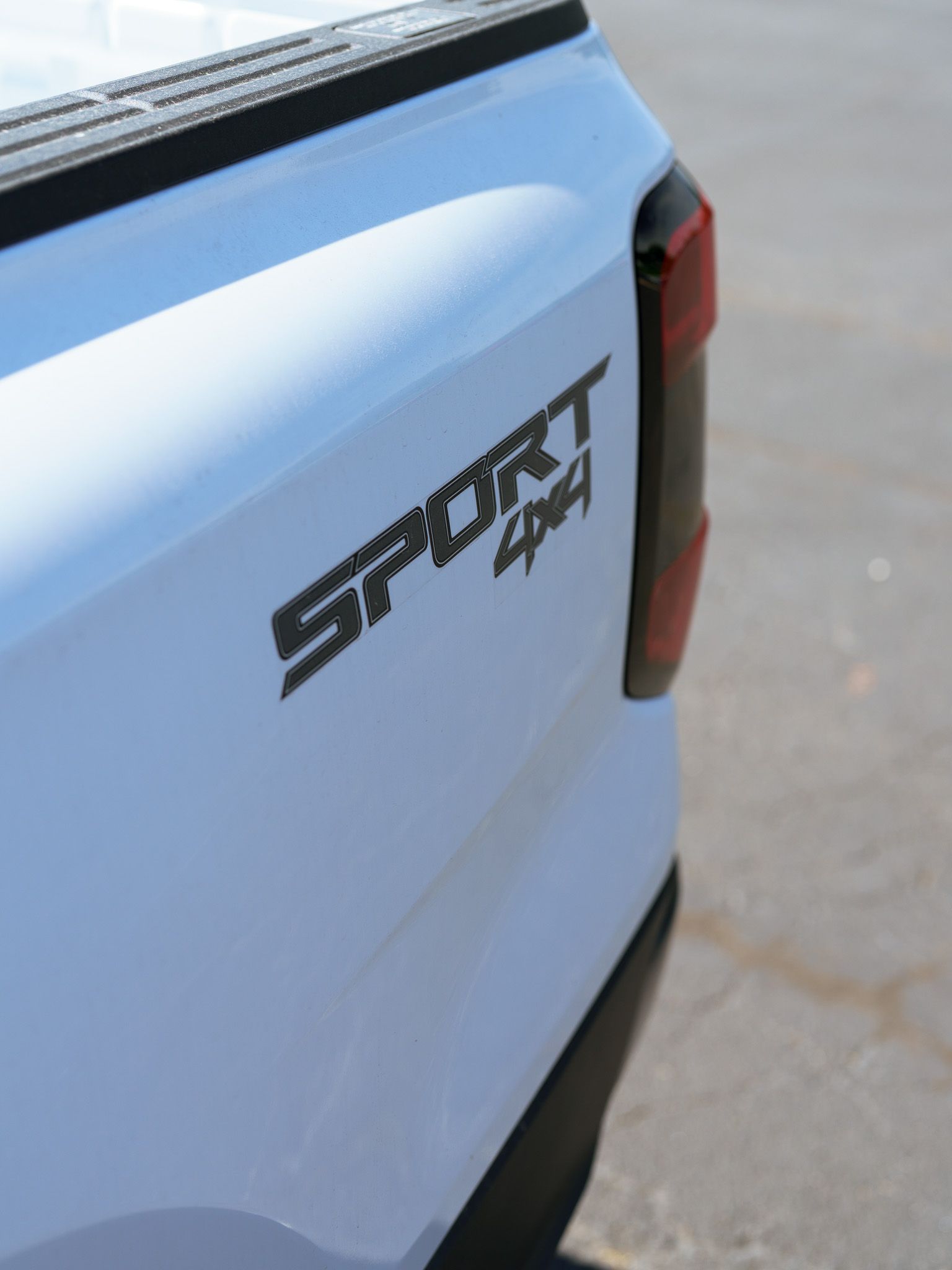
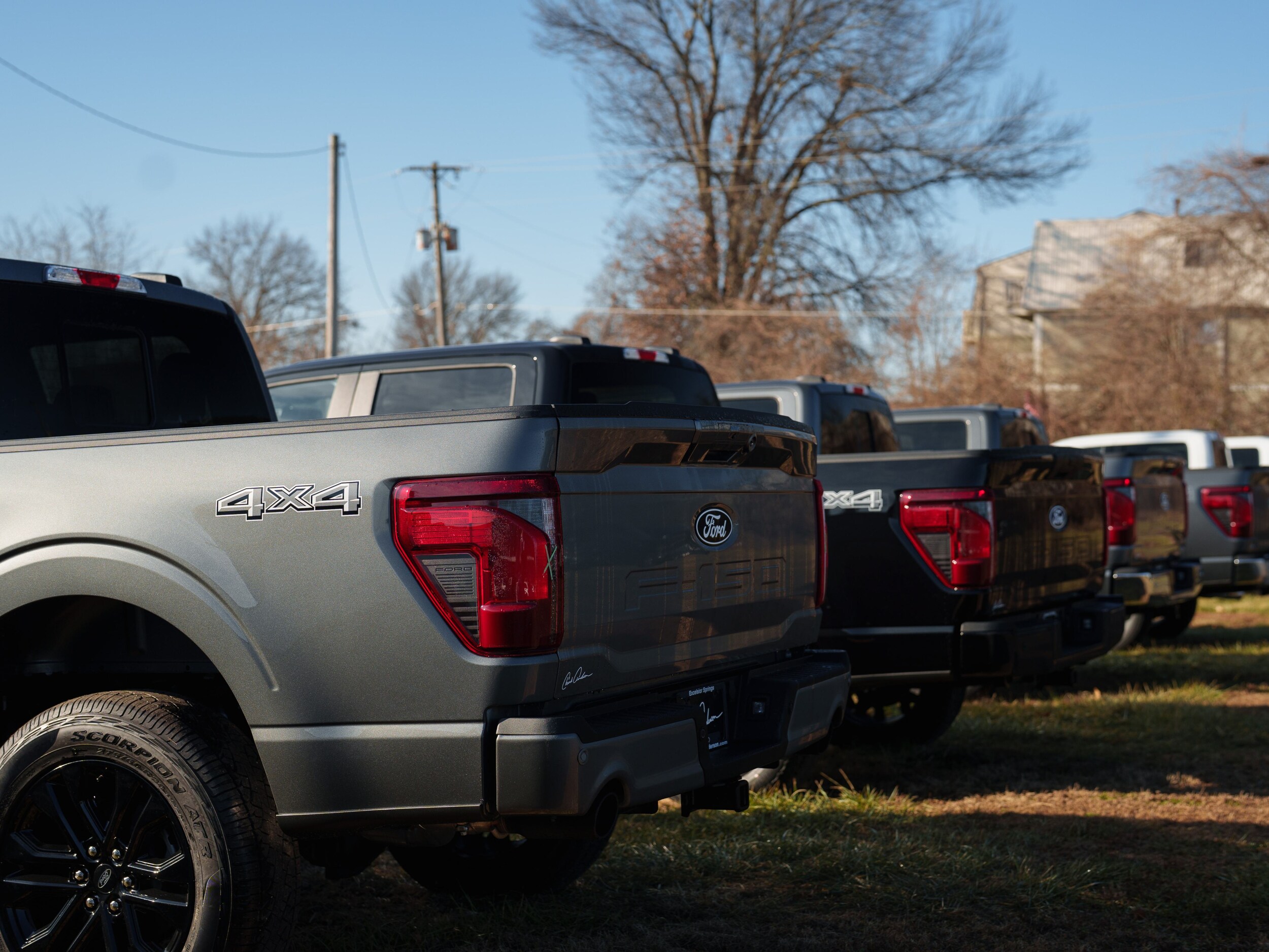
Why Buy F-150?
F-150 Makes Sense When You Will Actually Use the Extra Capacity
F-150 becomes the obvious choice when the additional dimensions solve a real problem.
The SuperCrew cabin provides substantially more rear-seat room, making it a stronger choice for adults, teenagers, rear-facing child seats and long-distance family travel.
Buyers also gain a broader range of bed lengths, powertrains, towing configurations, payload ratings, luxury trims and specialized work equipment.
If you regularly tow above Ranger territory or simply need more passenger and cargo room, the additional size of an F-150 starts paying for itself.
Explore F-150 QuestionsWhich Has More Interior Room: Ranger or F-150?
Both can carry five people, but the F-150 SuperCrew has a substantial rear-seat-space advantage.
34.6 IN.Ranger Rear Legroom
43.6 IN.F-150 SuperCrew Rear Legroom
56.7 IN.Ranger Rear Shoulder Room
66.0 IN.F-150 SuperCrew Rear Shoulder Room
For Regular Adult Rear-Seat Use, F-150 Has the Clear Advantage
Ranger's rear seat can work well for children, occasional adult passengers and many families, but the difference becomes obvious when taller adults sit in both trucks back to back.
The F-150 SuperCrew provides about nine additional inches of published rear legroom compared with Ranger.
If rear passengers are an occasional consideration, Ranger may be completely adequate. If you regularly travel with four adults or growing teenagers, F-150's additional cabin width and legroom are meaningful.
Is Ranger Big Enough for a Family?Which Has the Better Truck Bed?
F-150 wins if maximum bed space and configuration choice matter.
The Ranger SuperCrew uses a 59.6-inch bed with approximately 43.5 cubic feet of cargo volume.
Even the shorter 5.5-foot F-150 bed measures approximately 67.1 inches long and provides about 52.8 cubic feet of cargo volume.
F-150 buyers can also move into longer bed configurations when the truck's job requires them.
Choose Ranger's Bed If:
- You carry tools and normal home-project supplies.
- You transport bikes or outdoor equipment.
- You value overall truck maneuverability.
- A five-foot-class bed covers your normal needs.
Choose F-150 If:
- You regularly carry bulky cargo.
- You want longer available bed configurations.
- Work equipment lives in the truck.
- Bed volume is a major purchase factor.
Ranger vs. F-150 Towing Capacity
Ranger covers a surprisingly large range of trailers. F-150 extends well beyond it.
Ford Ranger: Up to 7,500 Pounds
Properly equipped conventional Ranger configurations can tow up to 7,500 pounds.
That can cover many boats, utility trailers, enclosed trailers, small campers and recreational loads.
Both the conventional 2.3L and available 2.7L EcoBoost can reach the maximum rating in applicable configurations with the required towing equipment.
Ranger Towing GuideFord F-150: Up to 13,500 Pounds
A properly configured F-150 can tow up to 13,500 pounds in Ford's current published 2026 ratings.
That gives buyers much more headroom for larger travel trailers, boats, equipment and frequent towing.
The conventional 3.5L EcoBoost is the F-150 powertrain we would research first when maximum towing capability is the priority.
F-150 Towing GuideDo not choose using trailer weight alone. Trailer tongue weight counts against truck payload. Passengers, bed cargo and accessories do too. Always verify the ratings of the exact truck rather than assuming every Ranger or F-150 can reach the model's advertised maximum.
When Should Towing Push You From Ranger to F-150?
There is no universal trailer-weight cutoff where every Ranger buyer should automatically move to an F-150.
If your loaded trailer fits comfortably within the tow rating, payload and axle limits of the Ranger you are considering, Ranger may be entirely appropriate.
But if your trailer begins consuming most of Ranger's available capacity—or you expect to tow frequently, carry several passengers and load the bed at the same time—the F-150 gives you access to much more capability.
We would rather choose enough truck for the complete loaded combination than buy right at the edge of a truck's ratings.
F-150 Gives You Far More Powertrain Choices
Ranger keeps its engine menu relatively simple.
The current Ranger family uses a standard 2.3L EcoBoost, available 2.7L EcoBoost V6 and the Ranger Raptor's exclusive 3.0L EcoBoost V6.
F-150 expands the menu considerably with mainstream EcoBoost engines, a naturally aspirated 5.0L V8, PowerBoost full-hybrid capability and dedicated Raptor powertrains.
If a V8 or hybrid truck is a priority, the decision moves toward F-150 immediately.
Ranger Engine Choices
- 2.3L EcoBoost: 270 hp / 310 lb-ft
- 2.7L EcoBoost V6: 315 hp / 400 lb-ft
- Raptor 3.0L EcoBoost: 405 hp / 430 lb-ft
F-150 Adds Options Such As:
- Higher-output conventional EcoBoost power
- 5.0L naturally aspirated V8
- PowerBoost full hybrid
- Raptor High-Output EcoBoost
- Raptor R supercharged V8
Everyday Ownership
Which Is Better for Daily Driving?
This depends more on where you drive than many spec sheets admit.
Ranger can be the easier everyday truck if your commute includes tight parking, narrow streets, garages or urban driving.
Its shorter body and narrower width are advantages you use every single day.
F-150 can be the more comfortable everyday truck when passenger room, highway travel and a spacious cabin matter more than exterior size.
In other words, Ranger is easier to place. F-150 gives you more space once you are inside.
Ranger vs. F-150 for a Family
Both can work. Family size and rear-seat use determine which works better.
Ranger Can Work Well for a Family If...
- You have younger children.
- Rear passengers are not especially tall.
- Most trips are local or moderate in length.
- You value easier parking and garage fit.
- You need a pickup bed but not maximum cabin space.
- Your towing requirements fit Ranger capability.
F-150 Is Better for a Family If...
- You regularly carry teenagers or adults in back.
- You use rear-facing child seats.
- You take long road trips.
- You regularly fill all five seating positions.
- You carry significant passenger and bed cargo together.
- You want maximum room for the family to grow.
Which Is Better Off Road?
Overall size can become an advantage again when the pavement ends.
Ranger's narrower body and shorter wheelbase can make it easier to maneuver on tight trails, wooded property and confined terrain.
Ranger can also be equipped with dedicated off-road packages, and Ranger Raptor adds a 405-horsepower 3.0L EcoBoost V6, FOX Live Valve shocks and locking front and rear axles.
F-150 counters with Tremor, Raptor and Raptor R—giving buyers much more extreme factory performance if overall vehicle size is not a concern.
Choose Ranger for:
- Tighter trails
- Narrow wooded terrain
- Midsize off-road maneuverability
- Ranger Raptor performance
Choose F-150 for:
- F-150 Tremor capability
- Raptor long-travel performance
- Available 35- and 37-inch Raptor configurations
- Raptor R extreme factory power
Ranger Raptor vs. F-150 Raptor Is a Different Comparison
If you are specifically shopping for a Raptor, the normal Ranger versus F-150 decision changes.
Ranger Raptor gives you the performance philosophy of Raptor in a smaller midsize package. Its 3.0L EcoBoost produces 405 horsepower and 430 lb-ft of torque.
F-150 Raptor is larger, wider and substantially more powerful. Current conventional Raptor output reaches 450 horsepower, while Raptor R moves all the way to 720 horsepower.
Ranger Raptor makes an especially compelling case for buyers who want serious off-road hardware but actively prefer midsize exterior dimensions.
Ranger Raptor vs. RangerDon't Pay for Capability You Will Never Use
This is one of the most important parts of the Ranger-versus-F-150 decision.
The Case for Ranger
If Ranger comfortably handles your passengers, trailer and cargo, buying an F-150 may mean paying for a larger truck simply to own unused capacity.
Ranger can provide a better balance for buyers who actively prefer something smaller.
The Case for F-150
If you already know your needs are likely to grow, the additional cabin, towing, payload and bed capacity can prevent you from outgrowing the truck.
F-150 also offers far more ways to tailor the truck around future work or recreational needs.
Ranger or F-150? Choose in 30 Seconds
Find the statement that sounds most like the way you expect to use your truck.
"I want a real truck, but I don't want something huge."
Choose Ranger. That is exactly the midsize pickup's strongest argument.
"I regularly carry adults in the back seat."
Choose F-150 SuperCrew. Its additional rear legroom and cabin width are substantial.
"My trailer is under Ranger's capability."
Ranger may be enough. Verify loaded trailer weight, tongue weight and payload before making the decision.
"I tow larger campers or equipment."
Start with F-150. It provides much more towing and payload headroom.
"My garage is tight."
Measure it and look closely at Ranger. A Ranger SuperCrew is roughly 21 inches shorter than an F-150 SuperCrew with a 5.5-foot bed.
"I want a hybrid or a V8."
Choose F-150. Ranger's current powertrain lineup is EcoBoost-only.
"I want a truck for trails and daily driving."
Ranger deserves serious consideration. Its smaller dimensions can be valuable both on and off pavement.
"I want one truck I am unlikely to outgrow."
F-150 is the safer bet. Its larger cabin, bed, towing capacity and powertrain range give you substantially more room for future needs.
Our Verdict: Buy the Ranger If It Is Enough Truck
If Ranger comfortably handles your family, trailer and cargo, we would not move to F-150 simply because it is bigger.
Ranger provides legitimate pickup capability in a package that is about 21 inches shorter and several inches narrower than a comparable F-150 SuperCrew.
That is a meaningful everyday advantage for the right buyer.
Move to F-150 When You Need:
- More rear-seat room
- More towing capacity
- More payload capability
- A larger or longer bed
- V8 power
- PowerBoost hybrid capability
- Broader trim and configuration choices
The question is not which truck is better in isolation. It is whether the additional size of an F-150 solves a problem for you.
Ford Ranger vs. F-150 FAQs
Quick answers to common questions about choosing between Ford's midsize and full-size pickups.
Should I buy a Ford Ranger or F-150?
Choose Ranger if its passenger space, 7,500-pound maximum available towing capability and midsize bed meet your needs. Choose F-150 if you need more rear-seat room, bed space, payload, towing capability or powertrain choices.
How much smaller is a Ranger than an F-150?
A 2026 Ranger SuperCrew is approximately 210.6 inches long and 75.5 inches wide without mirrors. A comparable F-150 SuperCrew with a 5.5-foot bed is about 232 inches long and 79.9 inches wide.
Which tows more, Ranger or F-150?
F-150. Properly equipped conventional 2026 Ranger configurations can tow up to 7,500 pounds, while a properly configured 2026 F-150 can reach up to 13,500 pounds of available conventional towing.
Is Ranger easier to park than F-150?
Generally, yes. Ranger is significantly shorter and narrower than a comparable F-150 SuperCrew, which can make parking and maneuvering in tight spaces easier.
Does F-150 have more rear-seat room than Ranger?
Yes. Ford lists approximately 34.6 inches of rear legroom in the Ranger SuperCrew compared with approximately 43.6 inches in the F-150 SuperCrew.
Which has a bigger bed, Ranger or F-150?
F-150. Ranger's SuperCrew bed is approximately 59.6 inches long, while even the F-150's 5.5-foot bed measures approximately 67.1 inches. Longer F-150 bed configurations are also available.
Can a Ford Ranger tow a camper?
Yes, many campers can fit within Ranger capability. The camper's actual loaded weight and tongue weight must be compared with the towing, payload and axle ratings of the exact Ranger.
Which is better for a family, Ranger or F-150?
Ranger can work well for many families, especially those with younger children. F-150 SuperCrew is generally better when adults or taller teenagers regularly ride in back or maximum passenger room is important.
Does Ford Ranger have a V8?
No. The current Ranger lineup uses EcoBoost engines. Buyers specifically wanting a naturally aspirated V8 should compare the F-150 with its available 5.0L V8.
Which is better off road, Ranger or F-150?
Both can be configured for serious off-road use. Ranger's smaller dimensions can be useful on tight trails, while F-150 offers Tremor, Raptor and Raptor R configurations for increasingly specialized off-road performance.
Continue Your Ford Truck Research
Compare Ranger and F-150 capability, engines and everyday usefulness before choosing your truck.
Still Deciding Between a Ranger and F-150?
Drive them back to back.
The Ranger-versus-F-150 decision becomes much easier when you sit in the rear seat, compare the beds and experience the difference in overall size from behind the wheel.
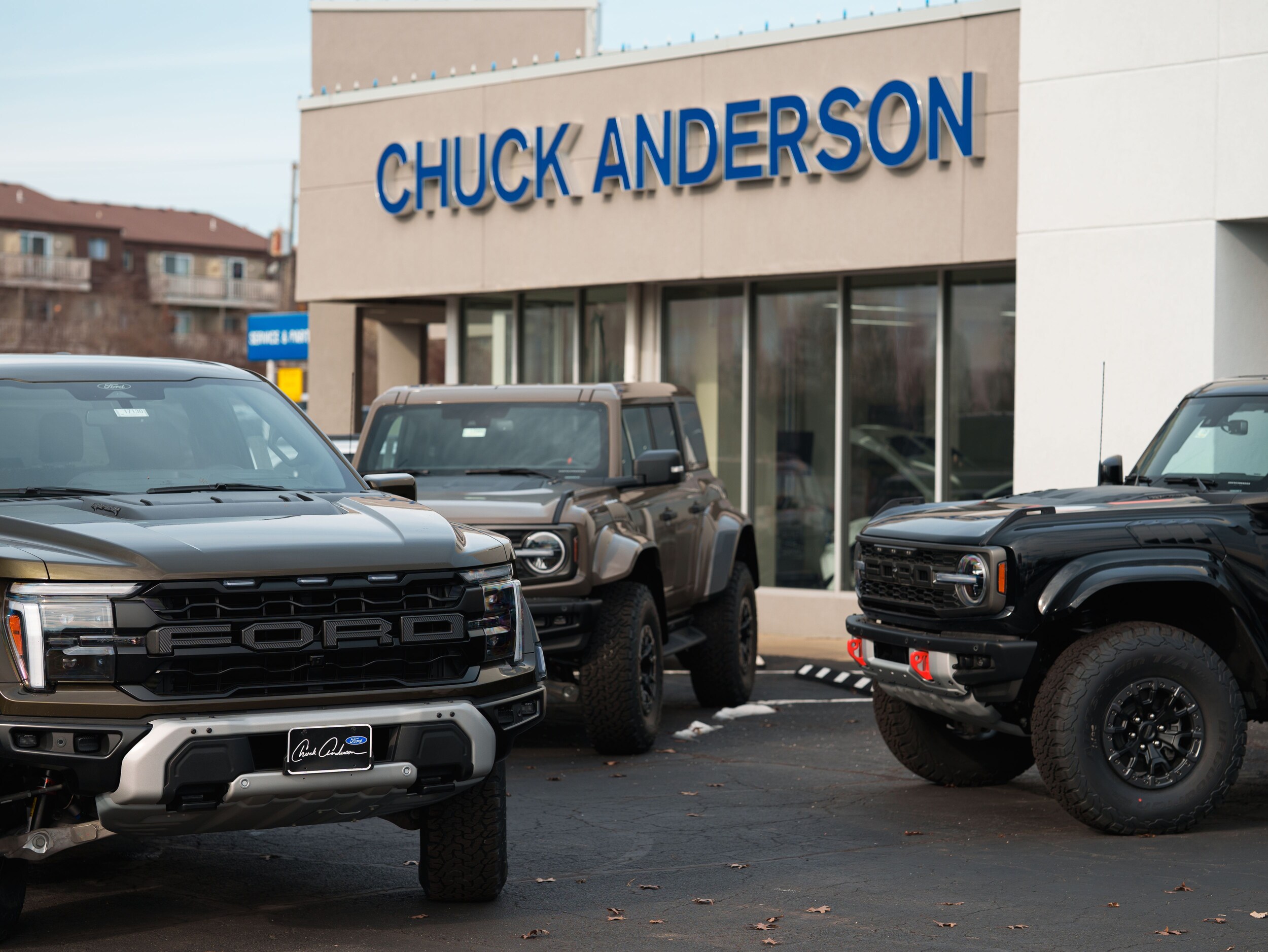
Chuck Anderson Ford can also help you compare your trailer, passenger needs, payload, engine preferences, 4x4 requirements and daily driving to determine how much truck you actually need.
Visit Chuck Anderson Ford in Excelsior Springs, Missouri, serving Ford truck shoppers from Liberty, Kearney, Lawson, Smithville and throughout the Kansas City Northland.
- Chuck Anderson Ford
- 1910 W Jesse James Road
- Excelsior Springs, MO 64024
- Sales: 816-648-6419
- Service: 816-648-6424
- Parts: 816-648-6429
Ford Ranger and F-150 engines, dimensions, towing capacity, payload, drivetrain availability, bed configurations, trim content and specifications vary by model year and vehicle configuration and are subject to change. Maximum towing and payload figures do not apply to every vehicle. Cab, bed, drivetrain, engine, axle ratio, towing equipment, passengers, cargo, accessories and trailer tongue weight affect actual capability. Dimension comparisons on this page use representative 2026 SuperCrew configurations unless otherwise noted. Always verify current manufacturer specifications, certification labels, payload labels and towing information for the exact vehicle before purchase or towing.