
Highway 10 & Regional Travel
Businesses traveling between Richmond, Excelsior Springs and surrounding communities may prioritize highway comfort, fuel use and dependable transportation.
A commercial vehicle around Richmond might spend the morning hauling equipment, the afternoon visiting customers and the evening carrying tools back to a shop somewhere in Ray County.
Chuck Anderson Ford helps businesses, farms and public agencies explore Ford commercial vehicles ranging from Maverick and Ranger to F-150, Super Duty and F-550 chassis cab applications, plus Transit vans, fleet SUVs and specialized public-safety vehicles.
Contractors. Farmers. Electricians. Plumbers. Landscapers. Delivery companies. Municipalities. Fleet operators.
Start with the work the vehicle needs to accomplish. We'll help you find the Ford that fits it.

A commercial vehicle should be chosen around how it earns its place in your operation—not simply because a certain truck looks impressive.
For some Richmond businesses, the right choice is an F-150 with a pickup bed, towing equipment and room for employees.
For a plumber or HVAC technician, an enclosed Transit van with organized shelving may save time on every service call.
For a farmer moving machinery or livestock trailers, properly configured Super Duty capability can become essential.
For a municipality, utility operation or contractor, an F-350, F-450 or F-550 chassis cab may provide the foundation for a specialized vehicle.
And not every person in the business needs the same level of capability.
An estimator may need reliable transportation and a few tools. A field crew may need heavy equipment, substantial payload and trailer capacity.
The right commercial fleet can include several different vehicle types working together.
Tell us what the vehicle carries, what it tows, where it operates and how long it spends on the road. Then we can begin narrowing the Ford options.

Richmond commercial vehicles operate in a different environment from trucks or vans serving only an urban business district.
Missouri Highway 10 connects Richmond toward Excelsior Springs. Highway 13 links the community north and south with other parts of the region.
Outside the city, farms, agricultural property, rural roads, small businesses and construction projects create additional vehicle requirements.
Businesses traveling between Richmond, Excelsior Springs and surrounding communities may prioritize highway comfort, fuel use and dependable transportation.
Customer visits, deliveries and regional jobs can make maneuverability, enclosed cargo and organized tools valuable.
Equipment, livestock trailers, fencing supplies, feed, material and rural access make payload, towing and drivetrain decisions important.
Gravel, uneven ground, jobsite parking, tools and material can influence vehicle size, ground clearance, tires and configuration.
A Richmond work vehicle may need to be comfortable on pavement and capable on rural property during the same workday.
That combination makes vehicle selection especially important.
Ford's commercial vehicle range offers solutions for light service work, construction, heavy towing, enclosed cargo, public transportation, vocational equipment and government fleets.
Chuck Anderson Ford can help Richmond-area customers evaluate the appropriate vehicle and discuss availability or ordering options.
For estimators, property managers, supervisors, mobile sales and lighter work where a useful pickup bed is more important than full-size truck capability.
Traditional truck utility in a midsize footprint for property work, tools, service calls, regional travel and compatible towing applications.
A versatile truck for contractors, trades, equipment, crews, towing, farm use and daily commercial transportation.
Super Duty capability for businesses requiring increased towing, payload and heavy-duty equipment support.
Heavy-duty capability for demanding pickup applications and compatible vocational-body configurations.
Selected pickup and chassis-cab configurations for substantial towing and specialized commercial applications.
A foundation for compatible service bodies, utility bodies, flatbeds, dump bodies and specialized commercial equipment.
Enclosed cargo and extensive upfit possibilities for HVAC, plumbing, electrical work, delivery, mobile service and transportation.
Enclosed cargo and passenger capacity for supervisors, company transportation, field personnel and certain fleet applications.
Purpose-built Ford law-enforcement utility capability for eligible police and public-safety fleet applications.
Specialized police pickup capability combining utility, four-wheel-drive operation and law-enforcement-focused engineering.
Other Ford models may be suitable for municipal, utility, transportation and vocational fleets depending on current programs and availability.
Agricultural work creates vehicle requirements that are easy to underestimate until the truck is fully loaded or a trailer is attached.
Ray County farms and rural property owners may need pickups for fencing, feed, tools, machinery, material, livestock trailers and property maintenance.
Some operations need a truck every day. Others depend on one during planting, harvesting, equipment maintenance or seasonal projects.
Posts, wire, tools, lumber, equipment and material make bed access, payload and durability important.
Regular bed cargo can consume available payload before a trailer is connected.
Heavier loaded trailers may require properly configured Super Duty trucks with the appropriate towing equipment.
Four-wheel-drive availability, suitable tires, ground clearance and operating conditions can influence the right configuration.
A small agricultural operation may find that an F-150 handles everyday farm supplies, light trailers and property maintenance.
A larger operation may need an F-350 or F-450 with appropriate payload, hitch and towing equipment.
Another may benefit from an F-550 chassis cab fitted with a flatbed or specialized utility body.
The best choice depends on what the operation actually carries, pulls and how the truck will be used.
One of the most important commercial-truck decisions is understanding total loaded vehicle weight—not simply maximum advertised towing.
Employees, toolboxes, material, permanent equipment, bodies, accessories and trailer tongue or gooseneck pin weight all affect vehicle loading.
A pickup may have enough power to move a trailer while lacking sufficient remaining payload for the complete operation.
The weight of the driver and employees must be counted when evaluating the vehicle's available capacity.
Toolboxes, compressors, generators, supplies, stock and other equipment contribute to the load.
Service bodies, shelving, liftgates, racks and permanent installations use capacity before cargo is loaded.
Trailer tongue or gooseneck pin weight contributes to the truck's load and must be evaluated alongside trailer capacity.
Commercial-truck buying rule: Verify the actual completed vehicle's GVWR, GAWR, GCWR, payload, towing ratings and other limits before selecting a truck or installing an upfit. Advertised maximum capability figures do not apply to every configuration.
Some businesses need a truck bed. Others need a secure, enclosed workspace that travels with the employee all day.
For Richmond-area electricians, plumbers, HVAC contractors, delivery businesses and mobile technicians, Ford Transit may provide a more useful working environment than an open-bed pickup.
An enclosed van can help organize tools, supplies and replacement parts while protecting them from ordinary weather exposure.
Available Transit configurations can accommodate different combinations of cargo space, roof height, wheelbase and commercial equipment.
Compatible commercial upfits may include shelving, partitions, drawers, ladder storage and other workplace equipment.
For a technician making several service calls each day, the amount of time spent locating tools and parts can add up.
A properly organized van can help reduce those inefficiencies.
Instead of simply transporting the technician to the job, the vehicle becomes part of the technician's working system.

A commercial van is often most useful when the cargo is expensive, numerous, difficult to organize or needs protection from the weather.
Organized tools, replacement parts, diagnostic equipment and supplies for service calls.
Space for wire, fittings, tools, conduit and appropriately secured ladders or material.
Enclosed storage for fittings, parts, tools, supplies and mobile repair equipment.
Enclosed cargo for packages, supplies, equipment and local or regional delivery routes.
Vehicle-based storage for technicians supporting customers at homes, businesses and jobsites.
Organized tools and material that need to travel between several jobs during the day.
Available configurations for tools, diagnostic equipment, supplies and specialized installations.
Applicable Transit passenger configurations for eligible businesses and organizations that transport people.
Before selecting a Transit, consider the combined weight of employees, shelving, tools, equipment and cargo, as well as the roof height, interior dimensions, access and parking conditions required for the work.
A van carrying commercial tools and parts becomes more useful when employees can find what they need without unloading half the vehicle.

Properly designed shelves and compartments can provide dedicated locations for tools, parts, fittings and supplies.
Good organization can make service calls more efficient and help keep frequently used items accessible.

Compatible partitions, drawers, racks and equipment can help create a mobile work area tailored to the trade.
Upfit selection should account for safety, secured loads, total installed weight and the completed vehicle's capacity.
Heavy-duty truck capability is often necessary because of the actual workload—not because the owner simply prefers a bigger truck.
A Richmond contractor may pull compact equipment between jobsites.
A farmer may move tractors, livestock trailers or agricultural supplies.
A construction business may carry crews, materials, tools and equipment in the same truck.
Those jobs can move beyond what a light-duty truck is appropriately configured to handle.
Ford Super Duty offers multiple truck classes and configurations to address heavier towing, payload and commercial applications.
F-250, F-350 and F-450 pickups serve different demands, while selected F-350, F-450 and F-550 chassis-cab configurations support specialized commercial bodies.
Gas and Power Stroke diesel powertrain choices are available across applicable configurations.
But the correct decision must be based on the trailer, cargo, body equipment and completed vehicle—not the maximum towing number in a brochure.
Bring the actual job requirements into the truck conversation before choosing the class, engine, wheelbase or axle configuration.

A chassis cab is designed to support a compatible specialized body or vocational installation rather than a conventional pickup bed.
The finished vehicle may be configured for tools, hydraulic equipment, specialized cargo, utility work or municipal operations.
For Richmond-area customers, this creates possibilities beyond a traditional pickup truck.
Compartmented storage for mechanics, contractors, utility workers and field-service technicians.
Open commercial bodies for material, equipment and loads benefiting from accessible sides and rear.
Compatible vocational applications for landscaping, construction, aggregate, property maintenance and public works.
Specialized equipment and storage for utilities, infrastructure, field repairs and maintenance operations.
Configurations supporting farm work, equipment, material handling and property-related operations.
Appropriate upfits for public works, seasonal maintenance, infrastructure and municipal operations.
Commercial builds around welders, compressors, generators, tool storage and specialized equipment.
Vehicle configurations selected around compatible job-specific bodies, components and operating requirements.
The body itself has weight.
So do the shelving, hydraulic systems, tools, materials, equipment and people who will operate the vehicle.
Axle ratings, chassis dimensions, cab-to-axle measurement, wheelbase, GVWR and other specifications matter when selecting the foundation for an upfit.
Buying the wrong chassis can make the intended body impractical or unsuitable.
Chuck Anderson Ford can discuss chassis-cab options and applicable ordering paths. The compatibility of any planned body or vocational equipment must be confirmed for the exact chassis and with the relevant upfitter.
For many businesses, the commercial vehicle is also a storage system, equipment platform and mobile workspace.
Upfit decisions can determine how quickly employees find tools, access material and complete service calls.
Organized space for tools, fittings, parts, supplies and frequently used equipment.
Compatible cargo-area partitions can help separate occupants from stored commercial equipment.
Useful for businesses carrying many small components, fasteners, fittings or repair parts.
Properly rated racks and securement systems for ladders, pipe, conduit and other long materials.
Secured compartments, service bodies and organized equipment locations for field workers.
Compatible electrical, generator and power-related equipment for appropriate commercial applications.
Systems for organizing and securing commercial supplies, tools and payload.
Job-specific vocational systems selected around the vehicle's capability and the operational requirements.
Upfit planning matters: A commercial body, liftgate, shelving package or other permanent equipment consumes vehicle capacity. Confirm structural compatibility, finished weight, axle loads, electrical requirements and all relevant manufacturer and upfitter specifications before placing an order.
A Richmond farm, plumbing company, delivery business and municipality can all need commercial vehicles for completely different reasons.
F-150, Super Duty, chassis cabs and Transit configurations for crews, tools, materials, equipment trailers and jobsite support.
Pickups and specialized trucks for farms, fencing, equipment, livestock trailers, feed and property maintenance.
Transit vans and appropriate service trucks for tools, parts, equipment and technicians making multiple customer calls.
Commercial vehicles for wire, ladders, tools, replacement components, conduit and service equipment.
Transit vans, service bodies and pickup configurations for fittings, tools, materials and field work.
Pickups and appropriate chassis cabs for mowers, equipment trailers, materials, plants, tools and compatible dump applications.
Transit cargo configurations for packages, parts, supplies and local or regional delivery routes.
Maverick, Ranger, F-150, Explorer and Transit options for inspections, maintenance, repairs and employee transportation.
Ford trucks, vans and SUVs for public works, parks, facilities, road maintenance and department transportation.
Purpose-built police vehicles and eligible commercial configurations for qualifying public-safety fleet needs.
Organized commercial vans and service trucks for technicians performing maintenance or repairs at customer locations.
Begin with one appropriately configured commercial vehicle and expand the fleet as the workload and business grow.
Municipalities, public agencies and law-enforcement departments often require vehicles designed around specific operational responsibilities rather than ordinary personal transportation.
Ford offers specialized public-safety and fleet solutions, including the Police Interceptor Utility and F-150 Police Responder.
Additional Ford trucks, SUVs, vans and chassis cabs may be appropriate for public works, parks, facilities, maintenance and other municipal departments.
Chuck Anderson Ford can discuss applicable Ford commercial and fleet solutions with qualifying public-sector customers.

For eligible law-enforcement departments requiring specialized truck utility, four-wheel-drive capability and police-oriented equipment.

A purpose-built Ford law-enforcement SUV platform for eligible police and public-safety fleet applications.
Trucks and specialized commercial bodies for streets, facilities, infrastructure and maintenance.
Pickup and utility configurations for grounds, equipment, material and property maintenance.
Ford vans and SUVs for eligible departments requiring employee, passenger or cargo transportation.
Appropriate vehicles for supervisors, inspections, service operations and other department activities.
Government, police and public-safety vehicle ordering is subject to applicable Ford program rules, agency eligibility, equipment requirements and current model availability.
A commercial vehicle should be sized around regular work, completed configuration and operating demands.
Employees, tools, permanent equipment, material, body weight and cargo all matter.
Use the loaded trailer weight, hitch configuration and individual vehicle ratings rather than a marketing maximum.
Highway driving, gravel roads, farm property, jobsite access and tight customer locations can change the ideal configuration.
Body, shelving, cargo management, electrical equipment and permanent installations affect the finished vehicle.
Buying more truck than the job requires can add acquisition cost, size and operating expense.
Buying too little truck can limit payload, towing, upfit possibilities and the work employees can safely perform.
A properly selected commercial vehicle should be capable of its demanding regular tasks without becoming unnecessarily expensive or difficult to operate every day.
As a company grows, vehicle decisions affect more than the employee driving each truck or van.
Commercial fleet planning involves maintenance, standardization, replacement cycles, upfits, employee assignments, financing and downtime.
Similar vehicle configurations can simplify maintenance planning, parts sourcing, driver familiarity and future replacement decisions.
A supervisor, estimator, mobile technician and heavy equipment crew may each require a different Ford configuration.
Replacing aging vehicles intentionally can help reduce operational disruption caused by unexpected failures or repair costs.
A truck or van waiting for repairs can affect jobs, employees, customer appointments and business revenue.
A growing Richmond business may add its first dedicated service van, replace an older work truck or need another vehicle because a new employee is joining the operation.
Those decisions can be easier when the business has already identified its preferred vehicle types, equipment requirements and replacement timeline.
Chuck Anderson Ford can discuss available Ford fleet and commercial options based on the business's needs and applicable program eligibility.
Commercial vehicle purchasing can look different depending on the size, cash flow and stage of the business.
A new contractor may be purchasing the company's first dedicated truck.
An agricultural operation may be replacing a pickup used for heavy towing.
A service company may need another Transit because it has added a technician.
A municipality may follow specific purchasing procedures and budget requirements.
Chuck Anderson Ford's Finance Center can discuss available financing options for qualifying buyers and appropriate commercial transactions.
Approval, lender programs, rates, terms and eligibility depend on the actual buyer, vehicle and transaction.
Before committing to a vehicle, consider the full cost of the commercial operation—including equipment, upfits, maintenance, insurance, fuel or energy, financing and potential downtime.
A commercial vehicle that no longer fits the operation may still have meaningful market value.
Existing pickups and applicable commercial trucks can be evaluated toward the next vehicle purchase.
A business may replace an existing van with another Transit, a pickup or a different commercial platform better suited to current work.
Replacement time is an opportunity to ask whether the job still requires the same vehicle type, payload, towing capability or upfit.
Chuck Anderson Ford can evaluate many cars, trucks, vans and specialty vehicles. The offer depends on the actual vehicle, condition, equipment and resale market.
Commercial customers need more than a place to purchase a truck or van.
They need maintenance and repair support throughout the vehicle's working life.
For a Richmond contractor, having a truck out of service may delay a job.
For a delivery company, it may interrupt a route.
For a farmer, it may affect equipment or material transportation.
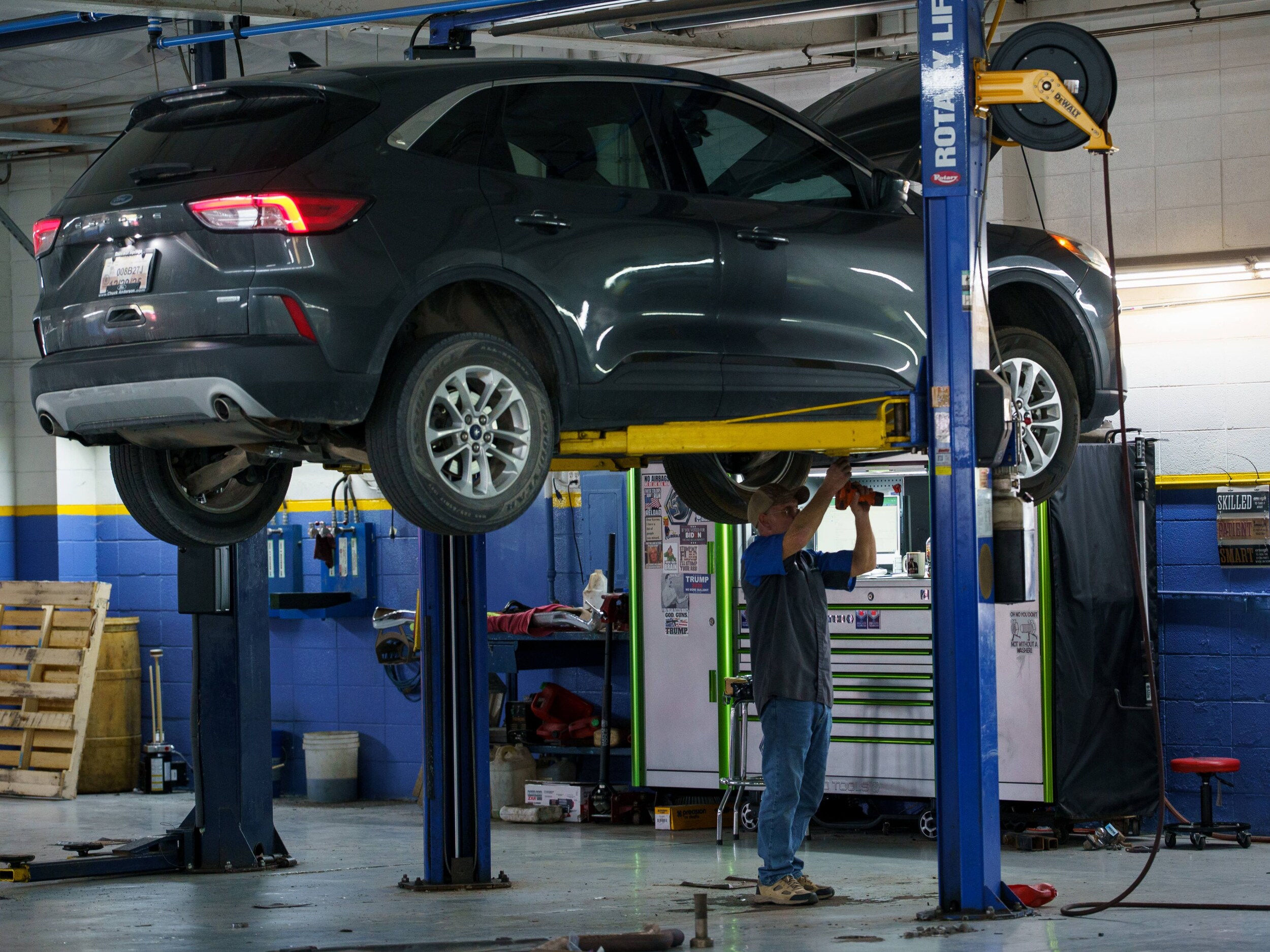
Chuck Anderson Ford offers Ford maintenance, diagnostics, parts and repair services for many supported commercial vehicles.
That includes oil changes, tires, brakes, batteries, general maintenance, applicable recalls, warranty repairs and additional service.
Our Parts Department can assist with applicable Genuine Ford and Motorcraft replacement components.
A commercial vehicle maintenance plan should help the business keep its vehicles available for the work they were purchased to perform.
Vehicle-specific maintenance for supported gasoline, diesel and hybrid powertrains.
Inspections and applicable repairs for vehicles carrying tools, employees, cargo or trailers.
Tire selection and maintenance based on applicable load ratings, operating conditions and vehicle specifications.
Testing and applicable replacement for vehicles that need reliable starting and electrical performance.
Vehicle-specific evaluation of warning lights, drivability, electrical concerns and other faults.
Genuine Ford and Motorcraft parts for supported commercial maintenance and repair applications.
Applicable Ford recall and warranty service subject to the individual vehicle and program eligibility.
Convenient service options for many common maintenance needs and supported vehicle types.
The work description should guide the vehicle decision before the trim, appearance or price becomes the focus.
Employees, equipment, tools, cargo, supplies and installed upfits all influence the appropriate vehicle.
Determine actual loaded trailer weights, tongue or pin weight and required towing equipment.
Highways 10 and 13, Richmond streets, rural gravel roads, farms and jobsites create different needs.
Consider the finished body, shelving, tools, equipment, electrical needs and total operating weight.
Richmond's commercial needs reflect both the businesses operating in town and the agricultural and rural environment surrounding it.
Founded in 1827, Richmond serves as the county seat of Ray County.
Its historic courthouse square, Farris Theatre, Richmond Spartans traditions and annual Mushroom Festival contribute to the character of the community.
Highway 10 and Highway 13 connect businesses with customers, suppliers, jobsites and neighboring communities.
That combination creates opportunities for several different types of Ford commercial vehicle.

Local service businesses, administrative operations, contractors and government departments can have very different fleet requirements.

Local events and community businesses create transportation, equipment, maintenance and delivery needs throughout the year.

Schools, facilities, maintenance operations and public services may require trucks, vans or passenger-capable fleet vehicles.

Vendors, retailers, trades and small businesses can benefit from commercial vehicles suited to supplies, deliveries and mobile operations.
Regional service calls, deliveries and jobsites make operating cost, maneuverability and dependable highway transportation important.
Farms, acreage, equipment trailers, rural roads and property maintenance make commercial truck capability important throughout the county.
The best work vehicle isn't automatically the most expensive truck or the one with the highest advertised capability.
It is the vehicle that does the job efficiently and fits the operation's real requirements.
Chuck Anderson and his family purchased the Ford dealership in Excelsior Springs in 1974.
More than five decades later, Chuck Anderson Ford remains family-owned and continues serving Richmond, Ray County and surrounding Missouri communities.
Our approach to commercial vehicle buying starts with the operation.
How much does the vehicle carry?
What does it tow?
Where does it work?
How will it be upfitted?
How many employees need transportation?
How much vehicle downtime can the business tolerate?
Once those questions are answered, we can help explore which Ford platform and configuration make sense.
And our Ford Service and Parts Departments remain available after the vehicle enters service.
We want Richmond businesses to purchase vehicles that support the work—not vehicles that create unnecessary expense or operational limitations.
Richmond businesses don't need to travel deep into Kansas City to begin exploring Ford work trucks, commercial vans and fleet vehicles.
Chuck Anderson Ford is located at 1910 W. Jesse James Road in nearby Excelsior Springs, Missouri.
Start near the Ray County Courthouse at 100 W. Main Street.
Connect to Missouri Highway 10 West toward Excelsior Springs.
Continue toward W. Jesse James Road and follow current navigation to Chuck Anderson Ford.
Before making the drive, contact our team with the vehicle class, body requirements, intended upfit or equipment you're looking for.
That helps us discuss available inventory, incoming vehicles and applicable ordering options before your visit.
1910 W. Jesse James Road
Excelsior Springs, MO 64024
Sales: 816-648-6419
Service: 816-648-6424
Parts: 816-648-6429
Ford pickups, Super Duty trucks, commercial chassis cabs, Transit vans, fleet SUVs and specialized public-sector vehicle inquiries.
Serving Richmond, Ray County, Lawson, Kearney, Liberty, Smithville, Excelsior Springs and surrounding Missouri communities.
Family-owned since 1974.
Chuck Anderson Ford in nearby Excelsior Springs can help Richmond-area businesses, farms, contractors, fleets, municipalities and eligible agencies explore Ford commercial vehicles. Our dealership is located at 1910 W. Jesse James Road, Excelsior Springs, MO 64024.
Chuck Anderson Ford can help customers explore Ford Maverick, Ranger, F-150, Super Duty pickups, selected F-350 through F-550 chassis-cab configurations, Transit vans, fleet SUVs and specialized law-enforcement vehicles, subject to current inventory, ordering and program availability.
Ford Maverick can be useful for lighter-duty work such as estimating, supervision, property management, inspections and service calls where a pickup bed is helpful but larger-truck capability isn't required.
Yes. Ranger may fit businesses needing midsize truck utility for tools, field service, property maintenance, regional travel and compatible towing applications.
Ford F-150 can serve contractors, service businesses, agricultural operations and fleet customers requiring a balance of cab space, payload, bed utility, towing and everyday drivability. The right configuration depends on the specific work.
Yes. Chuck Anderson Ford can help commercial customers explore applicable Ford F-250, F-350 and F-450 Super Duty pickups and compatible chassis-cab applications, subject to availability and ordering options.
Chuck Anderson Ford can discuss available F-550 chassis-cab configurations and applicable ordering paths for customers needing a commercial vocational platform. Availability depends on current Ford programs and production.
A chassis cab is a commercial truck configuration designed to support a compatible vocational body or specialized upfit rather than a conventional pickup bed.
Depending on the exact chassis and upfit compatibility, potential applications include service bodies, flatbeds, dump bodies, utility bodies and specialized vocational equipment. Final body suitability must be confirmed before installation.
Yes. A properly configured Ford F-550 chassis cab can support compatible service-body applications for mechanics, contractors, utilities and mobile field-service operations. Completed vehicle ratings and upfit compatibility must be verified.
Chuck Anderson Ford can assist commercial customers seeking applicable Ford Transit cargo and passenger configurations, subject to current inventory and ordering availability.
Ford Transit can be a useful platform for electrical, plumbing and HVAC businesses because it offers enclosed cargo space and compatible commercial upfit possibilities for tools, parts and equipment.
Yes. Compatible commercial upfits may include shelving, partitions, drawers, racks and other storage equipment. The final design must fit the specific van and its payload and safety requirements.
A Transit van emphasizes enclosed cargo storage and organized mobile workspace, while a pickup provides an open bed and different towing or hauling configurations. The better option depends on the tools, material, equipment and work environment.
The right truck depends on payload, trailer weight, terrain and operating conditions. Maverick, Ranger, F-150 and Super Duty trucks can each fit different agricultural and rural-property applications.
Properly configured Ford Super Duty trucks may be suitable for substantial equipment trailers. The exact truck should be selected using loaded trailer weight, tongue or pin weight, payload, hitch equipment and all applicable vehicle ratings.
Payload relates to how much weight the vehicle can carry within its applicable ratings, including occupants, cargo, accessories and trailer tongue or pin weight. Towing capacity addresses the trailer the specific vehicle is rated to pull. Both must be considered together.
Yes. Service bodies, shelving, liftgates, racks and other permanently installed equipment contribute weight to the completed vehicle and reduce capacity available for additional cargo and occupants.
Four-wheel-drive configurations are available on many Ford truck models, depending on the specific vehicle and equipment. Availability and suitability should be checked for the intended commercial application.
Yes. Ford pickups, Super Duty trucks, chassis cabs and Transit vans can support different construction applications involving workers, material, tools, equipment and trailers.
Ford Transit vans and appropriately equipped service trucks can work well for HVAC companies carrying tools, parts, diagnostic equipment and service supplies. The vehicle should be selected around cargo weight, storage layout and daily route needs.
Yes. Pickups, heavy-duty trucks and compatible chassis-cab configurations can support landscaping operations involving equipment trailers, materials, tools, crews and suitable dump or utility applications.
Ford Transit cargo configurations can be appropriate for package delivery, parts distribution, supplies and other route-based transportation. The correct configuration depends on cargo size, weight, route conditions and daily mileage.
Depending on configuration and availability, Ford Explorer can serve supervisory, company transportation and other fleet needs where passenger space and enclosed cargo are useful.
Yes. Ford offers purpose-built law-enforcement platforms including Police Interceptor Utility and F-150 Police Responder for eligible public-safety applications.
Chuck Anderson Ford can discuss applicable Ford law-enforcement vehicles with qualifying agencies. Ordering, eligibility, equipment and availability are subject to Ford's current police and government fleet requirements.
Chuck Anderson Ford can discuss suitable Ford trucks, vans, SUVs and other available fleet applications with municipalities and eligible public-sector customers.
Chuck Anderson Ford can help businesses compare vehicle types, configurations, ordering options and maintenance considerations as their fleet requirements grow. Applicable fleet programs depend on eligibility and availability.
Standardizing suitable vehicle configurations may simplify maintenance, driver familiarity and replacement planning. However, different employees and jobs may require different vehicle classes, so a mixed fleet can also make sense.
Yes. A business does not necessarily need a large fleet to buy a suitable Ford work truck or van. Specific fleet pricing or commercial programs may have additional eligibility requirements.
Chuck Anderson Ford's Finance Center can discuss available financing options for qualifying customers and appropriate commercial purchases. Approval, rates, terms and program eligibility vary by buyer, lender and vehicle.
Yes. Chuck Anderson Ford can evaluate many existing pickups, commercial vans and work vehicles for trade or direct purchase. Value depends on the actual vehicle and current market.
Chuck Anderson Ford provides maintenance and applicable repairs for many supported Ford commercial vehicles, including oil changes, brakes, tires, batteries, diagnostics, parts and other service.
Yes. Our Parts Department can help identify and order available Genuine Ford and Motorcraft components for supported Ford commercial vehicles using the vehicle's VIN.
Chuck Anderson Ford can discuss applicable Ford ordering options for customers needing specific work-truck configurations. Model availability, order banks, production schedules and vocational equipment requirements vary.
From downtown Richmond near the Ray County Courthouse, connect to Missouri Highway 10 West toward Excelsior Springs. Chuck Anderson Ford is located at 1910 W. Jesse James Road. Open Google Maps directions for the current route.
Chuck Anderson and his family purchased the Ford dealership in Excelsior Springs in 1974. Chuck Anderson Ford remains family-owned and has served Richmond, Ray County and surrounding Missouri communities for more than five decades.
Commercial Vehicle & Fleet Disclaimer: Vehicle specifications, available commercial models, towing ratings, payload, chassis dimensions, drivetrain equipment, engine availability, upfit compatibility, public-sector eligibility, fleet programs and inventory availability vary by model, configuration and production period. Advertised maximum towing or payload ratings apply only to specific properly equipped vehicles. Employees, cargo, tools, equipment, service bodies, accessories, trailer tongue or pin weight and other installed components affect the completed vehicle's capacity. Confirm applicable GVWR, GAWR, GCWR, axle ratings, payload, towing limits, body compatibility and other manufacturer or upfitter requirements before purchasing, ordering, modifying or operating the vehicle. Public-safety and government vehicles are subject to applicable eligibility, ordering and program restrictions. Financing and fleet programs are subject to approval and availability. Not every commercial vehicle or specialty body is necessarily in dealership stock.
Whether you're purchasing a commercial vehicle, maintaining an existing truck or researching your next Ford, Chuck Anderson Ford offers additional resources for Richmond and Ray County customers.
Compare Maverick, Ranger, F-150 and Super Duty for work, towing, rural property, agriculture and everyday transportation.
Richmond Ford Trucks ›Explore maintenance, diagnostics, brakes, tires, oil changes and applicable Ford repair services at Chuck Anderson Ford.
Richmond Ford Service ›Review available financing resources and discuss qualifying options for a new or pre-owned vehicle purchase.
Richmond Auto Financing ›Highway 10. Highway 13. Farm property. Construction site. Equipment trailer. Plumbing van. HVAC technician. Landscaping company. Electrician. Municipal crew. Police department. Delivery route. Growing business.
Maverick. Ranger. F-150. F-250. F-350. F-450. F-550. Transit. Fleet SUV. Police Interceptor. Police Responder. Chassis cab. Service body. Flatbed. Dump body.
Whatever the operation needs, Chuck Anderson Ford wants the opportunity to help you explore the right commercial vehicle.
Chuck Anderson Ford
1910 W. Jesse James Road
Excelsior Springs, MO 64024
Sales: 816-648-6419