

F-150 vs F-250: which truck do I need?
Ford Truck Comparison
F-150 vs. F-250: Which Truck Do I Need?
Choose the Ford F-150 if you need a capable pickup that still excels at commuting, family use, moderate-to-heavy towing and everyday driving. Move to the F-250 Super Duty when trailer weight, tongue or pin weight, payload or frequent heavy towing begins pushing beyond what a light-duty truck comfortably handles.
Quick Answer: Buy the F-150 Unless Your Workload Gives You a Reason to Need the F-250
For most pickup buyers, the F-150 is the better everyday truck. It is easier to maneuver, generally lighter, offers strong gasoline and hybrid powertrains and can tow up to 13,500 pounds in a properly configured 2026 model.
Choose the F-250 when the trailer or payload—not simply preference—starts demanding a heavier-duty truck.
F-250 gives you a heavier-duty frame, suspension, axles, braking system and higher-capacity towing platform. Properly configured current F-250 models can substantially exceed F-150 towing capability, with certain configurations reaching 22,000 pounds of conventional towing.
Fifth-wheel pin weight, heavy equipment, large travel trailers, livestock trailers and frequent commercial towing are situations where the F-250 becomes increasingly relevant.
Daily Driving
F-150
Easier to maneuver and better suited to normal everyday truck use.
Heavy Towing
F-250
Heavy-duty chassis and significantly greater capability.
Payload
F-250
More room for tongue weight, pin weight, tools and bed cargo.
Most Buyers
F-150
Buy the smaller truck unless your workload justifies Super Duty.
Ford F-150 vs. F-250 at a Glance
These trucks overlap in what they can do, but they are built around different levels of work.
| Category | Ford F-150 | Ford F-250 Super Duty | Advantage |
|---|---|---|---|
| Truck Class | Light-duty full-size pickup | Heavy-duty Super Duty pickup | Different missions |
| 2026 Max Available Conventional Towing | Up to 13,500 lbs | Up to approximately 22,000 lbs in specific configurations | F-250 |
| 2026 F-150 Max Available Payload | Up to 2,440 lbs | Substantially higher capability available depending on configuration | F-250 |
| Diesel Engine | No conventional Power Stroke diesel | Power Stroke diesel available | F-250 |
| Hybrid Engine | PowerBoost available | No PowerBoost full-hybrid equivalent | F-150 |
| Fifth-Wheel / Gooseneck Use | Limited by configuration and payload | Designed for substantially heavier applications | F-250 |
| Ride & Everyday Maneuverability | More everyday-friendly | Heavier-duty ride and larger feel | F-150 |
| Heavy Bed Loads | Strong light-duty capability | Higher-capacity heavy-duty platform | F-250 |
| Frequent Heavy Towing | Capable within ratings | Better suited to sustained heavy-duty work | F-250 |
| Fuel-Economy Focus | PowerBoost and smaller EcoBoost options | Capability takes priority over fuel economy | F-150 |
| Best Fit | Daily driving, family use, boats, campers, moderate towing | Large trailers, equipment, fifth wheels and heavy work | Depends on workload |
There is no single trailer-weight number where every buyer should automatically switch from F-150 to F-250. Payload, tongue or pin weight, towing frequency, passengers, cargo, terrain and desired safety margin all matter in addition to trailer weight.
Why Choose F-150?
The F-150 Is Enough Truck for a Lot of Buyers
It is easy to look at Super Duty specifications and conclude that more capability must automatically be better.
But every additional pound of heavy-duty capability comes with tradeoffs.
F-150 is designed to balance truck capability with everyday use. It can commute, carry a family, fit into normal parking spaces, handle home-improvement projects, pull boats and campers and still provide serious towing capability.
A properly configured F-150 with the 3.5L EcoBoost can tow up to 13,500 pounds in Ford's published 2026 ratings, while PowerBoost adds hybrid assistance and available onboard electrical power.
If the F-150 safely handles your loaded trailer, tongue weight, passengers and cargo with appropriate capacity remaining, moving to an F-250 may provide capability you do not actually need.
How Much Can an F-150 Tow?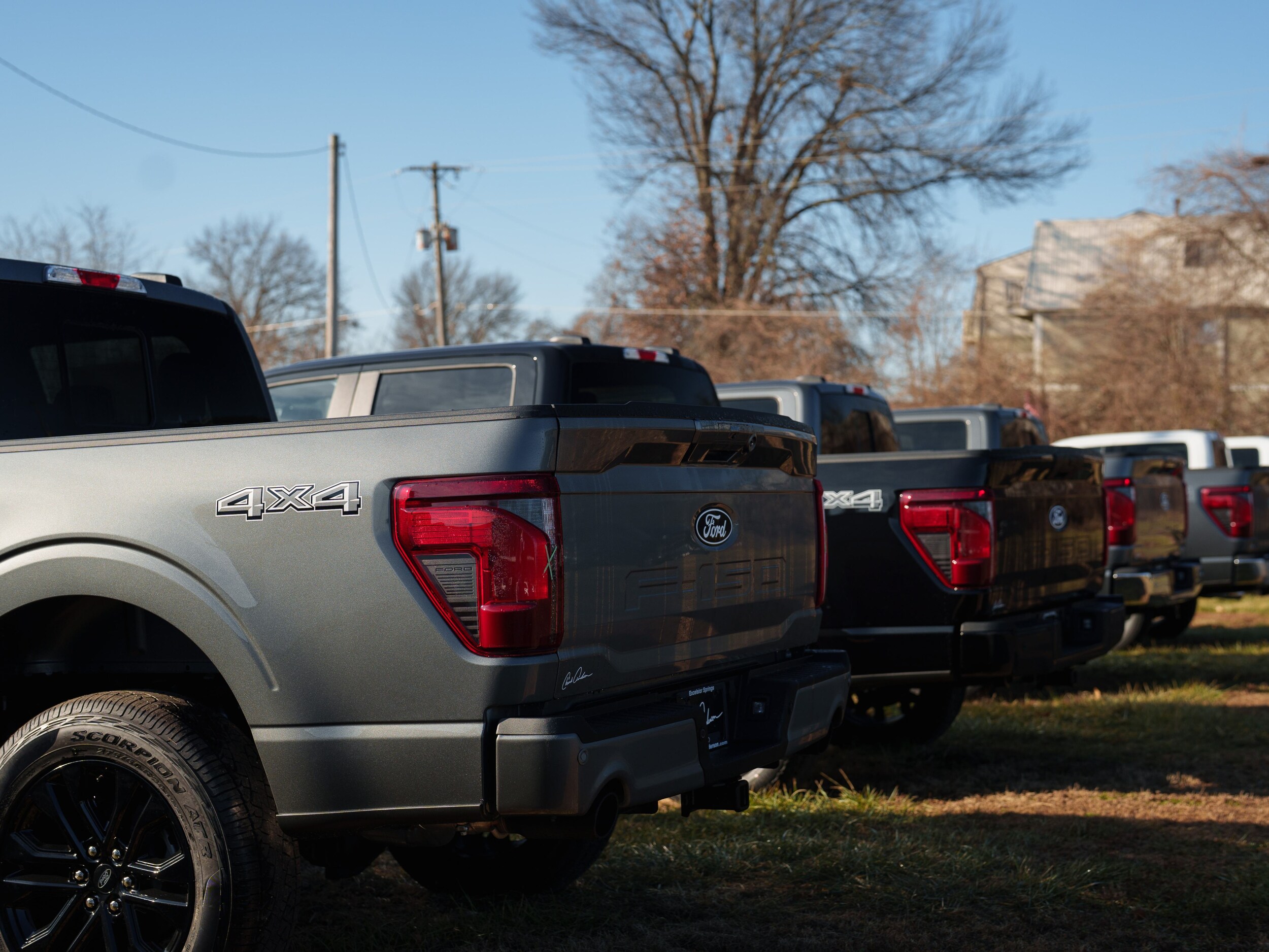
Why Move Up to an F-250?
F-250 is not simply an F-150 with a bigger engine.
It is part of Ford's Super Duty family and uses heavier-duty chassis, axle, suspension and braking hardware designed around greater payload and towing requirements.
That additional capacity becomes especially important when a trailer places substantial tongue or fifth-wheel pin weight directly onto the truck.
Current Super Duty powertrain choices also move beyond F-150 territory, including a large-displacement gas V8 and available Power Stroke turbo-diesel power.
Consider F-250 If:
- You tow a heavy trailer frequently.
- Your F-150 would operate close to maximum payload.
- You have substantial trailer tongue weight.
- You are shopping for a fifth-wheel camper.
- You tow a large gooseneck trailer.
- You carry heavy tools or equipment in the bed.
- You want Power Stroke diesel capability.
- You expect your trailer needs to grow.
Payload Is Often the Real Reason You Need an F-250
Many buyers focus almost entirely on the advertised towing number. The payload label may tell you more.
A Trailer Can Fit the Tow Rating and Still Overload the Truck
Imagine an F-150 with enough rated towing capacity for your travel trailer. That does not automatically mean the combination works.
Trailer tongue weight pushes down on the truck and counts against payload. Then add the driver, passengers, coolers, tools, a bed cover, firewood, luggage and anything else carried by the F-150.
The truck can reach its payload or axle limits before reaching its advertised maximum trailer weight.
This issue becomes even more important with fifth-wheel trailers because their pin weight can place a substantial load directly over the rear axle.
If payload is the number preventing an F-150 from safely handling your trailer, that is one of the strongest reasons to move into an F-250.
When Does an F-250 Start Making More Sense?
These are practical shopping guidelines, not official towing thresholds.
Trailer Well Below F-150 Limits
Start with F-150.
If loaded trailer weight, tongue weight and cargo fit comfortably within an appropriately configured F-150's ratings, the F-150 is usually the easier everyday truck to own.
Trailer Approaching F-150 Limits
Compare both trucks.
This is where payload, tongue weight, towing frequency, terrain and how much capability you want in reserve become extremely important.
Heavy Trailer Used Frequently
F-250 becomes increasingly attractive.
Repeated heavy towing is where Super Duty's heavier chassis and greater capacity can provide a better fit.
Fifth-Wheel or Heavy Gooseneck
Start the conversation with Super Duty.
Pin weight and heavy-duty hitch requirements often make payload capacity as important as the trailer's total weight.
Do not shop by a made-up cutoff such as "anything over 10,000 pounds needs an F-250." A 9,000-pound travel trailer with substantial tongue weight, passengers and bed cargo can create a very different truck requirement from a lower-profile equipment trailer at a similar total weight.
F-150 or F-250 for a Travel Trailer?
Many travel trailers fit comfortably within properly configured F-150 capability.
As campers become longer and heavier, however, tongue weight, frontal area and payload can become more important than the dry weight printed in the brochure.
If you regularly tow a large travel trailer on interstate trips, through hills or in windy conditions, an F-250 may provide the heavier-duty platform you prefer even when an F-150 technically has enough published towing capacity.
For Camper Shopping, Know:
- Loaded trailer weight
- Loaded tongue weight
- Trailer length
- Trailer frontal area
- Number of passengers
- Bed cargo
- Expected highway mileage
- Terrain and travel frequency
Never select a tow vehicle using dry trailer weight alone.

Fifth-Wheel Towing
Fifth Wheels Are Where Super Duty Starts to Make Much More Sense
Fifth-wheel trailers place their hitch load in the pickup bed rather than on a conventional receiver behind the truck.
That design can provide excellent towing stability, but it also means a significant amount of trailer pin weight becomes payload carried directly by the truck.
This is exactly where an F-250's heavier-duty payload and chassis capability can become more important than simply comparing horsepower.
For especially heavy fifth wheels, even an F-250 may not be the final answer. F-350—and potentially dual-rear-wheel configurations—should be considered as pin weight and trailer requirements increase.
Which Is Better for Daily Driving?
If heavy-duty capability is not required, F-150 is usually easier to live with.
F-150 for Everyday Use
F-150 is lighter-duty by design, and that can be an advantage when the trailer is disconnected.
- Easier parking and maneuvering
- More fuel-economy-oriented powertrain choices
- Available PowerBoost hybrid
- More conventional unloaded ride
- Excellent family and commuting capability
- Still provides substantial towing capability
F-250 for Everyday Use
Modern F-250 Crew Cab trucks can absolutely serve as comfortable daily vehicles, especially in premium trims.
- Heavy-duty chassis is always underneath you
- Larger overall truck feel
- Stiffer unloaded ride characteristics
- Greater capability when work begins
- Gas or Power Stroke diesel options
- Ideal for owners who tow or haul frequently
F-150 vs. F-250 Engines
Moving to Super Duty changes the powertrain conversation as much as it changes the chassis.
F-150 Engine Strategy
F-150 gives buyers several ways to balance efficiency, acceleration, towing and everyday use.
- EcoBoost turbocharged gasoline engines
- 5.0L naturally aspirated V8
- PowerBoost full-hybrid powertrain
- High-output Raptor powertrains
For maximum conventional F-150 towing, the 3.5L EcoBoost remains the powertrain we would research first.
Compare F-150 EnginesF-250 Super Duty Engine Strategy
Super Duty engines are designed around heavier-duty sustained workloads.
Current 2027 Chuck Anderson Ford research highlights the 7.3L gas V8 at 420 horsepower and 445 lb-ft of torque and the 6.7L High-Output Power Stroke diesel at 500 horsepower and 1,200 lb-ft of torque.
Buyers who tow heavily and frequently are where the diesel's low-rpm torque and exhaust-braking capability become especially valuable.
Compare Super Duty EnginesIf You Need an F-250, Do You Also Need a Diesel?
No.
Moving from F-150 to F-250 and moving from gasoline to diesel are two separate decisions.
A gas F-250 can be an excellent choice for heavy-duty buyers who need greater chassis and payload capability without routinely pulling extremely heavy trailers.
Diesel becomes increasingly attractive as trailer weight, towing frequency and loaded highway mileage increase.
Consider the 7.3L Gas V8 If:
- You need Super Duty payload and chassis capability.
- You tow heavy loads but not constantly.
- You prefer gasoline ownership.
- Maximum diesel torque is unnecessary.
Consider Power Stroke Diesel If:
- You tow substantial loads frequently.
- You spend significant highway mileage under load.
- Low-rpm torque is extremely important.
- Diesel exhaust braking is valuable to your use.
There Is Such a Thing as Buying More Truck Than You Need
Bigger capability does not come free.
A heavier-duty truck can cost more to purchase, may use more fuel, can have a firmer unloaded ride and may cost more for tires, maintenance and certain replacement components.
Diesel ownership adds another layer of maintenance and operating considerations, including diesel fuel filters, Diesel Exhaust Fluid and emissions-system components.
If you use the additional capability, those tradeoffs can be completely worthwhile.
If your trailer and payload fit comfortably inside an F-150, buying an F-250 solely because "bigger is better" may make everyday ownership more expensive without solving a problem you actually had.
Choose Between F-150 and F-250 in Four Steps
Start with the workload instead of the truck.
1
Load the Trailer
Determine realistic loaded trailer weight rather than relying only on an empty or dry weight.
2
Find Hitch Weight
Know expected tongue weight or fifth-wheel pin weight because it consumes truck payload.
3
Add People & Cargo
Include passengers, tools, bed cargo, accessories and anything else the truck must carry.
4
Compare Exact Trucks
Verify the towing, payload, axle and certification labels of the exact F-150 or F-250 being considered.
F-150 or F-250? Best Truck by Use Case
Here is where we would begin for several common truck buyers.
Daily Driver + Weekend Projects
Start with F-150.
An F-150 provides substantial capability without carrying heavy-duty hardware you may rarely use.
Boat Owner
Usually start with F-150.
Many boat-and-trailer combinations fit well within F-150 capability. Verify loaded trailer weight and payload.
Travel Trailer Owner
Could be either.
Smaller and midsize campers often fit F-150 well. Large travel trailers can make payload and sustained towing reasons to compare an F-250.
Fifth-Wheel RV Owner
Start with Super Duty.
Fifth-wheel pin weight makes heavy-duty payload capability especially important.
Construction or Equipment Trailer
Depends on loaded equipment weight.
Lighter equipment may fit F-150. Repeated heavy machinery towing quickly moves the discussion toward F-250 or beyond.
Farm or Livestock Use
F-250 often deserves a close look.
Livestock, tack, feed, water and gooseneck pin weight can create significant towing and payload requirements.
What If the F-250 Is Still Close to Its Limits?
Do not solve every heavy-trailer problem by adding a diesel engine to an F-250.
A powerful engine does not increase every chassis, payload or rear- axle rating.
If fifth-wheel pin weight, bed payload or total trailer requirements begin pushing an F-250 close to its limits, an F-350 may be the more important upgrade.
Consider F-350 When:
- Fifth-wheel pin weight is substantial.
- Payload becomes the limiting number.
- You need dual-rear-wheel capability.
- You tow extremely heavy trailers.
- You carry heavy bed loads while towing.
- You want greater capacity in reserve.
Choose the truck model first, then choose gas or diesel.
Current 2027 Research
2027 F-150 vs. 2027 Super Duty
The fundamental difference remains the same for 2027: F-150 is Ford's light-duty full-size truck, while F-250 begins the Super Duty heavy-duty lineup.
Current 2027 F-150 information includes EcoBoost, 5.0L V8, PowerBoost hybrid and high-performance powertrain choices, depending on trim and configuration.
Current 2027 Super Duty research highlights the 420-horsepower 7.3L gas V8 and 500-horsepower High-Output Power Stroke diesel with 1,200 lb-ft of torque.
The correct truck still starts with loaded trailer weight, tongue or pin weight, passengers, cargo and towing frequency—not simply the highest horsepower figure.
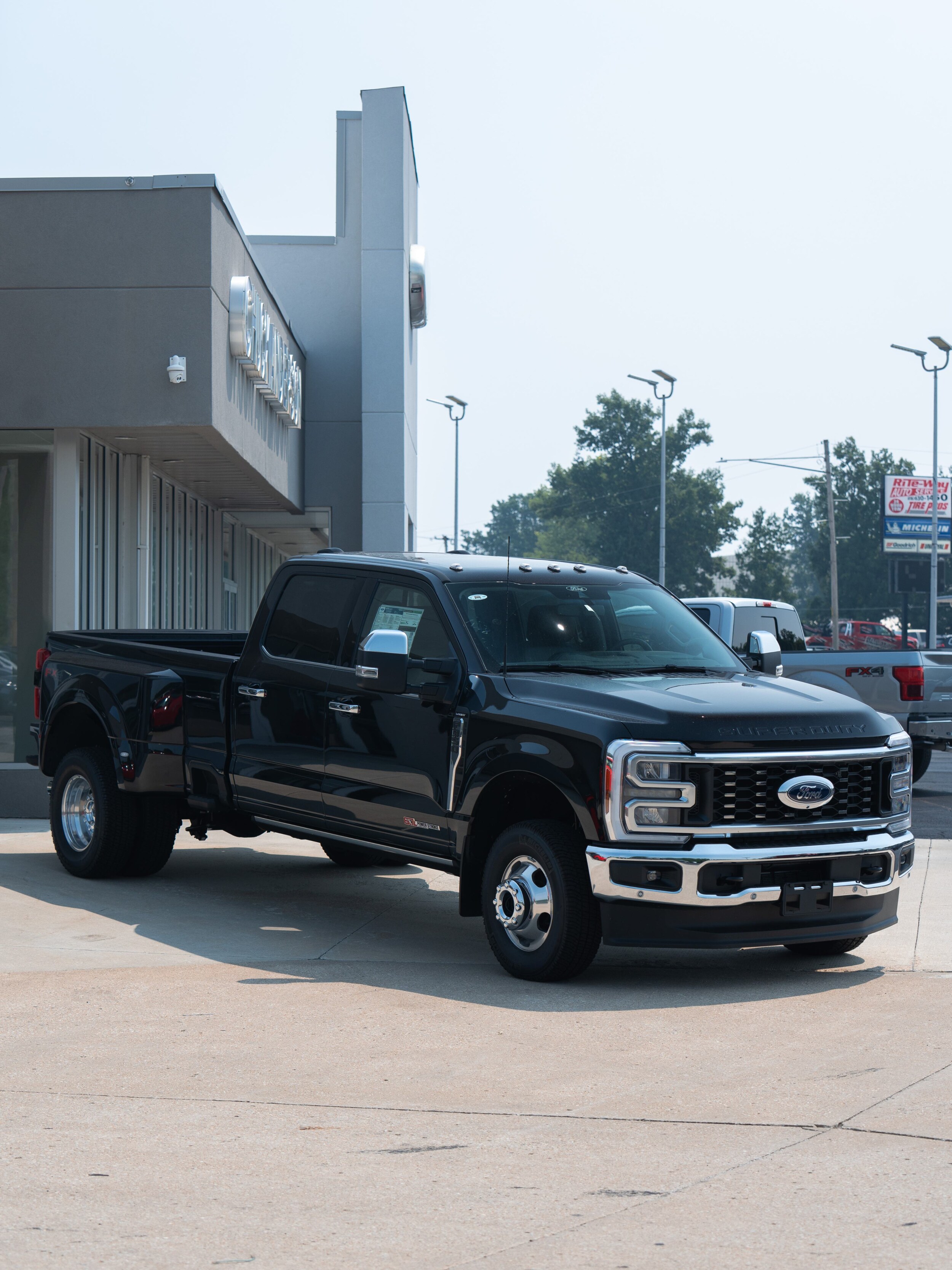
Our Verdict: F-150 for Most Buyers, F-250 When the Numbers Demand It
If your trailer, passengers and cargo fit comfortably inside the ratings of a properly configured F-150, we would generally buy the F-150.
It gives you substantial truck capability while remaining easier to use for commuting, errands, family transportation and everyday driving.
If your F-150 calculation starts getting tight on payload, tongue weight, pin weight or trailer capacity, move the conversation to F-250.
That is especially true when towing is frequent rather than occasional.
Do not buy an F-250 because it looks tougher on paper. Buy it because your workload benefits from the heavier-duty truck underneath you.
Ford F-150 vs. F-250 FAQs
Quick answers to common questions about choosing between Ford's light-duty and heavy-duty pickups.
What is the main difference between F-150 and F-250?
The F-150 is a light-duty full-size pickup designed to balance everyday driving with serious truck capability. The F-250 is a heavy-duty Super Duty pickup with heavier chassis, axle, suspension and towing capability.
How much can an F-150 tow?
Ford's published 2026 ratings list up to 13,500 pounds of maximum available conventional towing for a properly configured F-150 with the 3.5L EcoBoost.
How much can an F-250 tow?
Specific current F-250 configurations can reach approximately 22,000 pounds of conventional towing. Actual capacity varies substantially by engine, cab, drivetrain, axle ratio and equipment.
Do I need an F-250 to tow a travel trailer?
Not necessarily. Many travel trailers fit within properly configured F-150 capability. Larger trailers, higher tongue weights and frequent heavy towing make an F-250 increasingly worth considering.
Is an F-250 better for a fifth wheel?
Generally, yes. Fifth-wheel trailers can place substantial pin weight in the truck bed, making the F-250's heavier-duty payload platform more appropriate for many applications. Heavier fifth wheels may require an F-350 instead.
Is an F-250 harder to daily drive than an F-150?
F-250 can be used as a daily driver, but its heavier-duty chassis, larger dimensions and firmer unloaded ride generally make the F-150 easier for routine commuting and parking.
Does F-250 have a diesel engine?
Yes. Ford Super Duty offers Power Stroke turbo-diesel capability. Current 2027 research lists the High-Output 6.7L Power Stroke at 500 horsepower and 1,200 lb-ft of torque.
Do I need a diesel if I buy an F-250?
No. Gas-powered F-250 trucks can provide substantial heavy-duty towing and payload capability. Diesel becomes more attractive as trailer weight, towing frequency and loaded highway mileage increase.
Is payload more important than towing capacity?
Both matter. Payload can become the limiting factor because trailer tongue or pin weight, passengers, cargo and accessories all count against the truck's available payload.
Should I buy an F-150 or F-250?
Choose F-150 if your towing and payload requirements fit comfortably within an appropriate F-150 configuration. Choose F-250 when frequent heavy towing, high tongue or pin weight, heavy bed loads or diesel capability justify a Super Duty.
Continue Your Ford Truck Research
Compare towing, engines and truck classes before choosing your next Ford pickup.
Not Sure Whether You Need an F-150 or F-250?
Bring us the trailer numbers.
Tell Chuck Anderson Ford the loaded trailer weight, expected tongue or fifth-wheel pin weight, passengers, bed cargo and how often you plan to tow.
We can help you work backward from the job to determine whether an F-150 gives you enough capability—or whether moving into an F-250 Super Duty makes more sense.
Visit Chuck Anderson Ford in Excelsior Springs, Missouri, serving Ford truck buyers from Liberty, Kearney, Lawson, Smithville and throughout the Kansas City Northland.
- Chuck Anderson Ford
- 1910 W Jesse James Road
- Excelsior Springs, MO 64024
- Sales: 816-648-6419
- Service: 816-648-6424
- Parts: 816-648-6429
Ford F-150 and Super Duty towing capacity, payload, engines, horsepower, torque, axle ratings, equipment and specifications vary by model year and vehicle configuration and are subject to change. Maximum figures do not apply to every truck. Cab, bed, wheelbase, drivetrain, rear axle ratio, GVWR, GCWR, hitch type, towing equipment, passengers, cargo and trailer tongue or pin weight affect actual capability. 2026 capability figures are used where final published Ford towing data is available, while current 2027 product information is identified separately. Always verify Ford's towing guide, certification labels, payload label and specifications for the exact vehicle and trailer before purchase or towing.