

Ford Explorer vs Expedition: which should I buy?
Ford SUV Comparison
Ford Explorer vs. Expedition: Which Should I Buy?
Choose the Ford Explorer if you want three rows, strong EcoBoost power and useful towing capability in a midsize SUV that is easier to park and drive every day. Move to the Ford Expedition when your family needs more third-row room, more cargo space, eight-passenger capability or substantially more towing.
Quick Answer: Buy Explorer Unless Your Family Gives You a Reason to Need Expedition
For most families who want three-row seating, we would start with the Ford Explorer.
Explorer seats up to seven, is approximately 198.7 inches long, offers up to 400 horsepower and can tow up to 5,000 pounds when properly equipped.
Choose Expedition when people, cargo or trailers start pushing beyond what Explorer comfortably handles.
Expedition seats up to eight, provides substantially more second- and third-row space, offers standard and extended-length MAX body styles and can tow up to 9,600 pounds when properly equipped.
In simple terms: Explorer is easier to live with. Expedition gives you more room to live in.
Daily Driving
Explorer
Shorter, lighter and easier to maneuver in everyday traffic.
Passenger Space
Expedition
More room in all three rows and seating for up to eight.
Maximum Towing
Expedition
Up to 9,600 lbs versus 5,000 lbs for Explorer.
Easier to Park
Explorer
Roughly 11 inches shorter than standard Expedition.
2027 Ford Explorer vs. Expedition Comparison
These are both three-row Ford SUVs, but they belong to different size and capability classes.
| Category | Ford Explorer | Ford Expedition | Advantage |
|---|---|---|---|
| SUV Class | Midsize three-row SUV | Full-size three-row SUV | Different missions |
| Maximum Seating | Up to 7 | Up to 8 | Expedition |
| Overall Length | Approximately 198.7 in. | 209.9 in. / 221.7 in. MAX | Explorer for maneuverability |
| Second-Row Legroom | Up to approximately 37.5 in. depending on model | Approximately 41.1 in. | Expedition |
| Third-Row Legroom | Approximately 31.8 in. | Approximately 36.5 in. | Expedition |
| Cargo Behind Third Row | Approximately 16.3 cu. ft. | Up to 22.9 cu. ft. / 37.4 cu. ft. MAX | Expedition |
| Maximum Cargo Volume | Up to approximately 85.8 cu. ft. | Up to 108.5 cu. ft. / 123.1 cu. ft. MAX | Expedition |
| Standard Engine | 2.3L EcoBoost I-4 | 3.5L EcoBoost V6 | Depends on needs |
| Standard Horsepower | 300 hp | 400 hp | Expedition |
| Maximum Available Horsepower | Up to 400 hp | Up to 440 hp | Expedition |
| Maximum Available Towing | 5,000 lbs | 9,600 lbs | Expedition |
| Available 4WD | Yes | Yes | Tie |
| Performance Model | Explorer ST | High-Output EcoBoost packages | Different personalities |
| Off-Road Model | Explorer Tremor | Expedition Tremor | Expedition for more serious full-size capability |
| Extended-Length Version | No | Expedition MAX | Expedition |
| Best Fit | Typical family use, commuting and moderate towing | Large families, heavy towing and maximum passenger-plus-cargo use | Depends on family |
Do not automatically buy the larger SUV. If Explorer comfortably fits your passengers, cargo and trailer, Expedition's extra size may create cost and maneuverability you do not need. If Explorer feels tight during the test drive, Expedition can solve problems that no Explorer trim upgrade will fix.
Size Difference
How Much Bigger Is Expedition Than Explorer?
The 2027 Explorer measures approximately 198.7 inches long.
Standard Expedition stretches to 209.9 inches, making it roughly 11 inches longer.
Expedition MAX measures approximately 221.7 inches long, adding nearly another foot beyond standard Expedition.
Those numbers affect more than the garage.
Explorer is easier to maneuver around schools, grocery stores, downtown streets and parking garages. Expedition uses its extra exterior size to create considerably more passenger and cargo room.
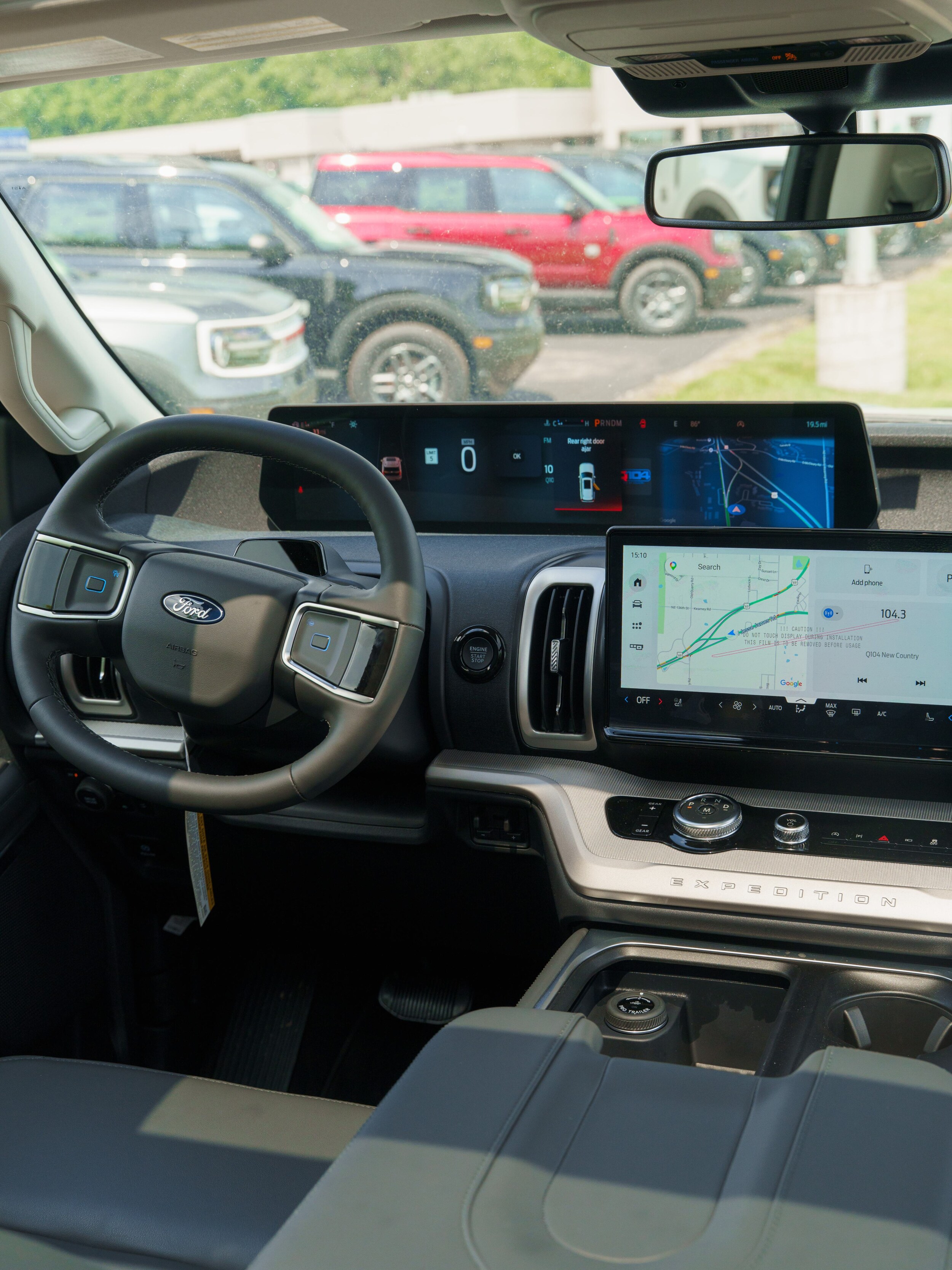
Explorer Is Easier to Live With Every Day
If most of your SUV's life involves commuting, school drop-off, errands and normal suburban driving, Explorer's smaller footprint is an advantage you experience every single day.
It still gives you three rows, available Intelligent 4WD, useful cargo space and up to 5,000 pounds of towing.
Explorer Makes More Sense When:
- You rarely carry more than six or seven people.
- The third row is used mostly by children.
- You do not need huge cargo room with all seats occupied.
- Your trailer stays within Explorer capability.
- You park in tighter spaces regularly.
- You value a more manageable exterior size.
Passenger Space Is Where Expedition Earns Its Size
Both have three rows. The experience in those rows is not the same.
37.5 IN.Explorer Second-Row Legroom on Active
31.8 IN.Explorer Third-Row Legroom
41.1 IN.Expedition Second-Row Legroom
36.5 IN.Expedition Third-Row Legroom
The Third Row Is the Biggest Family Difference
Explorer's third row can work very well for children and occasional passengers.
Expedition's third row is much closer to a true adult-use seating area.
If teenagers, grandparents or other adults will regularly occupy the third row, Expedition's additional legroom and cabin width become much easier to justify.
If the third row is used twice a month, Explorer may be all you need. If it is used twice a day, look very closely at Expedition.
Explorer: Up to Seven Passengers
Explorer offers three-row seating with configurations for up to seven occupants.
Six-passenger configurations with second-row captain's chairs can make third-row access easier and create a more open cabin.
This setup works especially well for many families of four, five or six.
Expedition: Up to Eight Passengers
Applicable Expedition configurations can seat up to eight people using a second-row bench.
Models with second-row captain's chairs typically seat seven.
Expedition therefore gives larger families both more seating capacity and more space around those passengers.
Cargo Space May Be the Real Reason You Need Expedition
Many families discover that the problem is not fitting seven people into an SUV.
The problem is fitting seven people and everything those seven people bring with them.
Explorer provides approximately 16.3 cubic feet behind its third row.
Standard Expedition can provide up to approximately 22.9 cubic feet behind its upright third row.
Expedition MAX pushes that figure to approximately 37.4 cubic feet.
Think About Real Family Cargo:
- Strollers
- Suitcases
- Baseball and soccer bags
- Coolers
- Camping equipment
- Groceries
- Golf clubs
- Baby gear
If all three rows are occupied frequently, cargo room behind the third row should be one of the first measurements you compare.
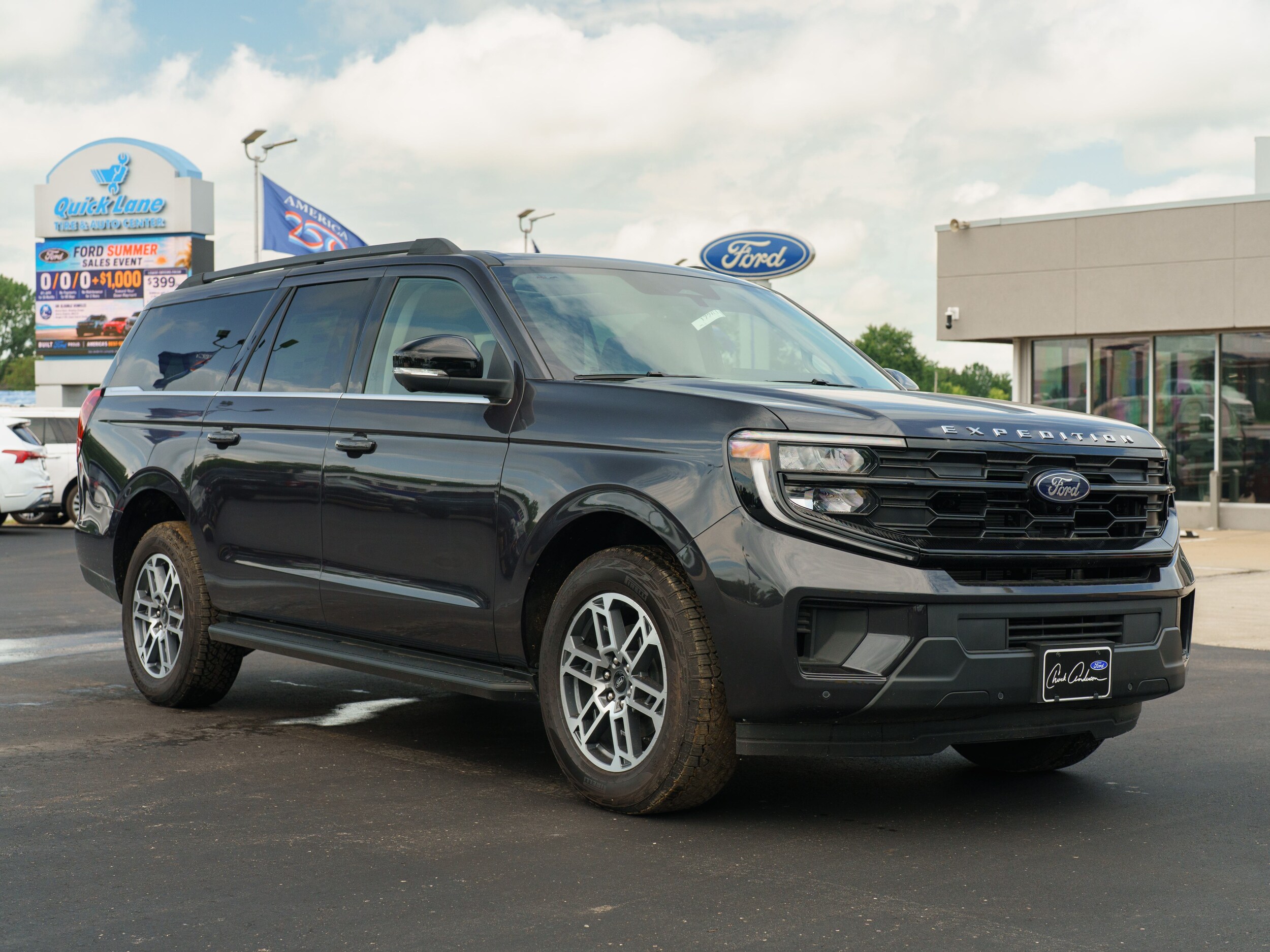
Maximum Space
Expedition MAX Is for Families Who Use All Three Rows and Still Need Cargo
Expedition MAX is not simply a higher trim.
It is an extended-length version of Expedition with approximately 221.7 inches of overall length.
Maximum optimized cargo volume grows to approximately 123.1 cubic feet, compared with up to 108.5 cubic feet in standard Expedition and roughly 85.8 cubic feet in applicable Explorer configurations.
More importantly for road trips, MAX offers up to approximately 37.4 cubic feet behind the third row.
If your family regularly fills every seating row and still needs serious luggage space, Expedition MAX is the strongest Ford SUV option.
Explorer vs. Expedition Engines
Both use turbocharged EcoBoost power, but Expedition starts where Explorer's performance range ends.
Explorer 2.3L EcoBoost
The standard Explorer engine produces 300 horsepower.
It provides plenty of power for normal family use and can still support Explorer's 5,000-pound maximum towing capability in applicable configurations.
For most Explorer shoppers, this is all the engine needed.
Explorer 3.0L EcoBoost V6
Applicable Explorer models offer a twin-turbocharged 3.0L EcoBoost V6 with up to approximately 400 horsepower.
Explorer ST makes performance a central part of the vehicle, while the V6 is also available in other applicable configurations.
Expedition 3.5L EcoBoost V6
Expedition's standard engine produces 400 horsepower and 480 lb-ft of torque.
That substantial torque fits Expedition's larger body, passenger capacity and heavier towing mission.
Expedition High-Output 3.5L EcoBoost
Select Expedition models and packages offer a High-Output version producing 440 horsepower and 510 lb-ft of torque.
It is standard on Expedition Tremor and available on applicable premium configurations.
Want a Sporty Family SUV? Explorer ST Has the Better Personality
Bigger and more powerful does not automatically mean sportier.
Explorer ST packages its available 3.0L EcoBoost performance into a smaller midsize platform specifically positioned around more engaging on-road driving.
If acceleration, handling and a performance-oriented personality matter more than maximum interior volume, Explorer ST is the Ford SUV we would look at first.
Choose Explorer ST If:
- You want three rows without full-size SUV dimensions.
- You value performance-oriented tuning.
- Up to seven seats are enough.
- You do not need Expedition towing.
- You want a performance SUV rather than simply a powerful large SUV.
Explorer vs. Expedition Towing Capacity
Trailer weight can make the decision between these SUVs very easy.
Explorer: Up to 5,000 Pounds
Properly configured 2027 Explorer models can tow up to 5,000 pounds.
Ford's standard Trailer Tow Package includes a Class III hitch receiver and trailer wiring equipment.
That can work for many smaller boats, utility trailers and appropriately sized recreational trailers.
Explorer Towing GuideExpedition: Up to 9,600 Pounds
Select properly equipped Expedition 4x4 configurations with the Heavy-Duty Trailer Tow Package can tow up to 9,600 pounds.
Properly equipped Expedition MAX 4x4 configurations can reach up to approximately 9,000 pounds.
Expedition is the clear choice when your family owns a larger boat, camper or other substantial trailer.
Expedition Towing GuideIf Your Trailer Is Close to 5,000 Pounds, Look Closely at Expedition
A 5,000-pound Explorer maximum does not mean every 4,900-pound trailer is automatically an ideal match.
Passengers, cargo, trailer tongue weight, frontal area and the exact vehicle configuration all matter.
This becomes especially important for families because the people and luggage inside the SUV count against vehicle payload.
If your family frequently tows near Explorer's upper limit, Expedition may provide useful additional capability and flexibility.
Explorer and Expedition Are Built Around Different Jobs
Explorer is a midsize SUV designed around the balance between passenger comfort, road manners, performance and everyday practicality.
Expedition uses body-on-frame construction more closely related to a traditional full-size truck architecture.
That helps Expedition support the larger passenger compartment, heavy-duty towing and more substantial overall capability expected from a full-size SUV.
Think of It This Way
Explorer: Start with family SUV priorities and add meaningful towing and performance.
Expedition: Start with full-size truck-like capability and build a three-row family SUV around it.
Neither approach is automatically better. They solve different problems.
Everyday Usability
Do Not Ignore Parking, Garage Space and Daily Maneuverability
Families often compare cargo volume and towing ratings but forget that the SUV still has to fit into everyday life.
Explorer's approximately 198.7-inch length is roughly 11 inches shorter than standard Expedition and roughly 23 inches shorter than Expedition MAX.
That can make Explorer easier in parking garages, school pickup lines, older downtown parking spaces and tighter residential garages.
Expedition's available cameras and driver-assistance technology help manage its size, but technology does not make the vehicle physically smaller.
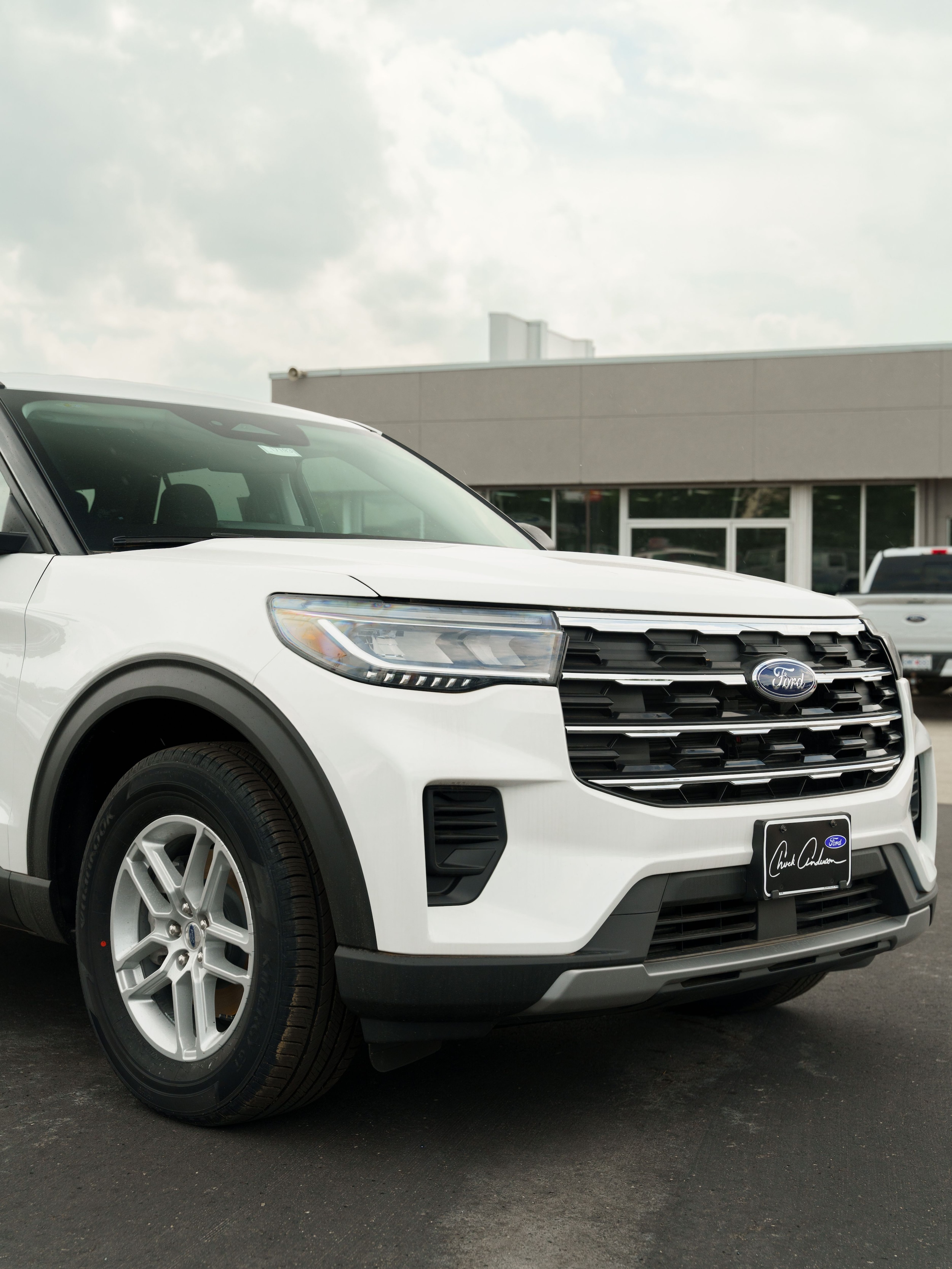
Explorer Tremor vs. Expedition Tremor
Both SUVs offer a Tremor path, but Expedition remains the more substantial full-size off-road platform.
Explorer Tremor
Explorer Tremor combines three-row midsize practicality with standard Intelligent 4WD, all-terrain tires, increased ride height and off-road-focused suspension and traction hardware.
It is the better fit when you want additional trail capability without living with full-size Expedition dimensions.
Expedition Tremor
Expedition Tremor starts with Expedition's full-size platform and adds the 440-horsepower High-Output EcoBoost V6, standard 4WD, all-terrain tires, locking rear differential, skid plates and specialized terrain capability.
It makes more sense when off-road adventures also involve a large family, significant cargo or a heavier trailer.
Who Should Buy Explorer?
- Families of four, five or six
- Drivers who use the third row occasionally
- Families whose third-row passengers are primarily children
- Commuters who want three-row flexibility
- Buyers towing under 5,000 pounds within vehicle limits
- Drivers who value easier parking
- Explorer ST performance shoppers
- Families who simply do not need full-size SUV dimensions
Who Should Buy Expedition?
- Larger families
- Families regularly carrying seven or eight people
- Adults or teenagers frequently using the third row
- Heavy trailer owners
- Families needing more luggage space with every seat occupied
- Expedition MAX shoppers
- Buyers wanting up to 9,600 pounds of towing
- People who need full-size SUV capability regularly
Which Is Better for Family Road Trips?
How many people are traveling matters more than the number of miles.
Explorer for Four or Five People
Explorer can be an excellent long-distance family vehicle when the third row is folded or used occasionally.
Folding unused third-row seating opens substantially more room for luggage while maintaining Explorer's easier-to-manage exterior footprint.
Expedition for Six, Seven or Eight People
Expedition becomes more valuable when every row stays occupied while luggage still needs somewhere to go.
Expedition MAX is particularly useful for a full cabin on a long trip because of its additional cargo space behind the third row.
Which Is Better for Car Seats?
Both Explorer and Expedition are family-focused SUVs that can accommodate child-restraint systems in applicable seating positions.
Expedition's larger cabin can make life easier when multiple large rear-facing seats, boosters and adults all need to coexist.
Explorer may still provide all the space a family of four or five needs while being easier to drive every day.
Bring your actual child seats when you test drive. Install them, move the front seats to your normal positions and make sure third-row access still works the way your family needs it to.
More SUV Also Means More SUV to Own
Expedition's extra capability is valuable when you use it.
But bigger dimensions and a heavier full-size platform can also mean higher fuel use, larger tires and more space needed for parking and storage.
If your family never needs the third-row room, cargo capacity or 9,600-pound towing ceiling, buying Expedition solely because it is larger may not improve your ownership experience.
Do Not Pay for Capability You Never Use
Explorer already provides three rows, available 4WD, 300- to 400-horsepower EcoBoost performance and useful towing capability.
Expedition becomes worth the step up when its additional room and capability solve recurring problems—not just hypothetical ones.
Explorer or Expedition? Choose in 30 Seconds
Find the statement that sounds most like your household.
"We are a family of four."
Start with Explorer. You may get all the passenger space you need without moving to a full-size SUV.
"We regularly carry seven or eight people."
Start with Expedition. Its larger cabin and available eight-passenger configuration make more sense.
"We use the third row mostly for kids."
Explorer may be plenty. Test the seating positions before paying for additional SUV.
"Adults regularly sit in the third row."
Choose Expedition. Its approximately 36.5 inches of third-row legroom is much friendlier to regular adult use.
"We tow less than 5,000 pounds."
Explorer may handle the job. Verify the actual loaded trailer and exact Explorer configuration first.
"Our camper weighs more than Explorer can handle."
Choose Expedition. Properly equipped configurations can reach up to 9,600 pounds.
"Our garage is tight."
Measure before buying Expedition. Explorer's shorter exterior can make daily ownership much easier.
"Every seat is occupied and we still need luggage space."
Look hard at Expedition MAX. Its cargo room behind the third row is the strongest option in this comparison.
"I want a sporty three-row SUV."
Look at Explorer ST. It is the more performance-oriented choice of the two SUV families.
"We want maximum family flexibility for the next ten years."
Expedition may give you more room to grow. Especially if children are becoming teenagers or towing needs may increase.
Our Verdict: Start With Explorer and Move to Expedition When Space or Towing Demands It
For the average three-row SUV shopper, we would start with Explorer.
It seats up to seven, offers plenty of power, tows up to 5,000 pounds and is significantly easier to maneuver than a full-size SUV.
There is no reason to carry Expedition's additional size every day if your family does not actually need it.
Expedition becomes the better answer when Explorer begins forcing compromises.
If adults regularly use the third row, every seating position is occupied, luggage space behind the third row matters or your trailer is beyond Explorer's comfort zone, Expedition solves those problems directly.
And if standard Expedition still does not provide enough cargo room with the third row upright, Expedition MAX goes even farther.
Buy the smallest SUV that comfortably handles your family today—and the way you realistically expect to use it tomorrow.
Ford Explorer vs. Expedition FAQs
Quick answers to the most common Explorer and Expedition questions.
Should I buy a Ford Explorer or Expedition?
Choose Explorer if seven-passenger seating, up to 5,000 pounds of towing and midsize dimensions cover your needs. Choose Expedition if you need more passenger room, more cargo space, up to eight seats or substantially greater towing capability.
Which is bigger, Ford Explorer or Expedition?
Expedition is larger. Explorer is approximately 198.7 inches long, standard Expedition measures approximately 209.9 inches and Expedition MAX measures approximately 221.7 inches.
Which has more third-row room, Explorer or Expedition?
Expedition. Current published specifications list approximately 36.5 inches of third-row legroom in Expedition compared with about 31.8 inches in Explorer.
How many people can Explorer and Expedition seat?
Explorer can seat up to seven people depending on configuration. Expedition can seat up to eight depending on trim and second-row seating configuration.
Which has more cargo space, Explorer or Expedition?
Expedition has more cargo capacity. Explorer provides roughly 16.3 cubic feet behind its third row, while standard Expedition offers up to about 22.9 cubic feet and Expedition MAX up to about 37.4 cubic feet.
Which tows more, Explorer or Expedition?
Expedition. Explorer can tow up to 5,000 pounds when properly configured, while select properly equipped Expedition 4x4 models can tow up to 9,600 pounds.
Is Explorer easier to drive than Expedition?
Explorer's smaller exterior dimensions generally make it easier to maneuver in tight parking lots, garages and urban environments. Expedition provides more interior room in exchange for its larger footprint.
What is Expedition MAX?
Expedition MAX is the extended-length Expedition. It measures approximately 221.7 inches long and provides up to about 37.4 cubic feet of cargo room behind the third row and 123.1 cubic feet of maximum optimized cargo space.
Which is better for a large family, Explorer or Expedition?
Expedition is generally better for larger families that regularly use all three rows. It offers more second- and third-row room, seating for up to eight and more cargo capacity.
Which is better for a family of four, Explorer or Expedition?
Explorer is often the better starting point for a family of four because it provides three-row flexibility without the size of a full-size SUV. Expedition may still be preferable if towing or cargo requirements are substantial.
Does Expedition have more horsepower than Explorer?
Expedition starts with 400 horsepower and offers up to 440 horsepower. Explorer starts with 300 horsepower and offers up to approximately 400 horsepower on applicable 3.0L EcoBoost models.
Which is better for road trips, Explorer or Expedition?
Explorer can be excellent for smaller families, especially when the third row can be folded for cargo. Expedition is generally better when more passengers occupy all three rows and substantial luggage still needs to fit behind them.
Continue Your Ford SUV Research
Compare Explorer and Expedition with competitors, towing needs and trim choices before deciding.
Still Deciding Between Explorer and Expedition?
Put your family in both.
Sit in the third row. Move the front and second-row seats where your family actually uses them. Bring the car seats. Open the cargo area with every seat upright. If you tow, bring us the trailer numbers.
Chuck Anderson Ford can help you compare Explorer and Expedition based on passenger space, cargo, towing, engines, drivetrain, technology and daily driving.
Visit Chuck Anderson Ford in Excelsior Springs, Missouri, serving SUV shoppers from Liberty, Kearney, Lawson, Smithville and throughout the Kansas City Northland.
Chuck Anderson Ford
- 1910 W Jesse James Road
- Excelsior Springs, MO 64024
- Sales: 816-648-6419
- Service: 816-648-6424
- Parts: 816-648-6429
2027 Ford Explorer and Expedition engines, horsepower, torque, seating, cargo capacity, dimensions, towing capacity, drivetrain availability, trim content, packages and specifications vary by model and vehicle configuration and are subject to change. Maximum towing figures do not apply to every vehicle and require proper equipment. Expedition towing ratings vary by drivetrain, body length, equipment, wheels and other configuration factors. Passengers, cargo, accessories and trailer tongue weight affect available payload and towing capability. Cargo measurements vary by seating position and configuration. Always verify current manufacturer specifications, vehicle certification information and towing requirements for the exact vehicle before purchase or towing.