

Ford Explorer vs Jeep Grand Cherokee: which is better?
SUV Comparison
Ford Explorer vs. Jeep Grand Cherokee: Which Is Better?
Ford Explorer and Jeep Grand Cherokee overlap on price, capability and family use, but they approach the SUV market differently. Explorer is a three-row SUV in every configuration and offers up to 400 horsepower. Grand Cherokee can be ordered as a two-row SUV or as the longer three-row Grand Cherokee L, and Jeep puts greater emphasis on maximum towing and specialized off-road capability.
Quick Answer: Explorer for Three-Row Family Performance; Grand Cherokee for Towing and Specialized Off-Road Use
We would choose the Ford Explorer for most shoppers who need three rows.
Every Explorer is designed around a three-row cabin, seating for up to seven, up to approximately 85.8 cubic feet of maximum cargo space and available EcoBoost V6 performance reaching 400 horsepower and 415 lb-ft of torque.
Grand Cherokee has two major advantages shoppers should not ignore.
Properly equipped current Grand Cherokee models can tow up to 6,200 pounds, compared with 5,000 pounds for Explorer, and Jeep offers extremely capable off-road configurations such as Grand Cherokee Trailhawk.
If you want a five-passenger premium SUV, the standard two-row Grand Cherokee may also make more sense than buying a three-row Explorer you do not need.
Three-Row Family Use
Explorer
Every Explorer is built around a three-row cabin.
Maximum Horsepower
Explorer
Up to 400 hp versus 324 hp in current Grand Cherokee gas models.
Maximum Towing
Grand Cherokee
Up to 6,200 lbs versus 5,000 lbs for Explorer.
Extreme Off-Road Use
Grand Cherokee
Trailhawk offers highly specialized Jeep 4x4 hardware.
First: Which Grand Cherokee Are You Comparing?
This comparison gets confusing because "Grand Cherokee" can describe two different body styles.
The standard Grand Cherokee has two rows and seating for five.
The longer Grand Cherokee L adds a third row and can seat up to seven.
For a Fair Comparison:
Explorer vs. Grand Cherokee 2-Row
Makes sense if you are deciding whether you actually need a third row.
Explorer vs. Grand Cherokee L
Is the more direct comparison when three-row family seating is required.
Explorer gives you the third row without requiring a separate longer-body version.
2027 Ford Explorer vs. 2027 Jeep Grand Cherokee
Because Jeep offers both two-row and three-row Grand Cherokee models, the table shows where the Grand Cherokee L matters.
| Category | Ford Explorer | Jeep Grand Cherokee | Advantage |
|---|---|---|---|
| Standard Seating Layout | Three rows | Two rows | Depends on need |
| Maximum Seating | Up to 7 | 5 in two-row / up to 7 in Grand Cherokee L | Tie with Grand Cherokee L |
| Overall Length | Approximately 198.7 in. | 193.5 in. two-row / about 204.9 in. Grand Cherokee L | Depends on body style |
| Maximum Cargo Volume | Up to approximately 85.8 cu. ft. | 70.8 cu. ft. two-row / 84.6 cu. ft. Grand Cherokee L | Explorer vs. three-row L |
| Cargo Behind Third Row | Approximately 16.3 cu. ft. | Approximately 17.2 cu. ft. in Grand Cherokee L | Grand Cherokee L slightly |
| Main Explorer Engine | 2.3L EcoBoost I-4 | 3.6L Pentastar V6 on Laredo/Laredo X | Different approaches |
| Main Turbo Engine | 2.3L EcoBoost: 300 hp | 2.0L Hurricane 4 Turbo: 324 hp | Grand Cherokee |
| Maximum Available Horsepower | Up to 400 hp | 324 hp in current gas lineup | Explorer |
| Maximum Available Torque | 415 lb-ft | 332 lb-ft | Explorer |
| Maximum Towing Capacity | 5,000 lbs | 6,200 lbs | Grand Cherokee |
| Transmission | 10-speed automatic | Automatic transmission | Preference |
| Available 4WD | Yes | Yes | Tie |
| Performance Model | Explorer ST | No direct 400-hp ST equivalent | Explorer |
| Off-Road Model | Explorer Tremor | Grand Cherokee Trailhawk | Grand Cherokee for extreme off-road hardware |
| Luxury Direction | Explorer Platinum | Overland / Summit | Preference |
| Best Family Buyer | Three-row family wanting performance and everyday versatility | Buyer wanting Jeep capability, towing or two-row/three-row flexibility | Depends on use |
Do not compare Explorer only with the five-passenger Grand Cherokee and conclude Explorer has more seats. Jeep offers Grand Cherokee L specifically for shoppers who need three rows. If you need seven-passenger capability, Grand Cherokee L is the Jeep you should test against Explorer.
Family Use
Explorer Is the More Straightforward Three-Row Family SUV
Explorer's entire platform is built around three-row use.
Every Explorer gives you three rows rather than asking you to choose between a shorter two-row body and a longer three-row version.
Explorer offers seating for up to seven and approximately 16.3 cubic feet of cargo space behind the third row.
Fold the second and third rows and applicable Explorer configurations provide up to approximately 85.8 cubic feet of maximum cargo space.
For a family that wants one midsize SUV to handle kids, road trips, school, sports and occasional third-row passengers, Explorer is a very easy vehicle to understand.
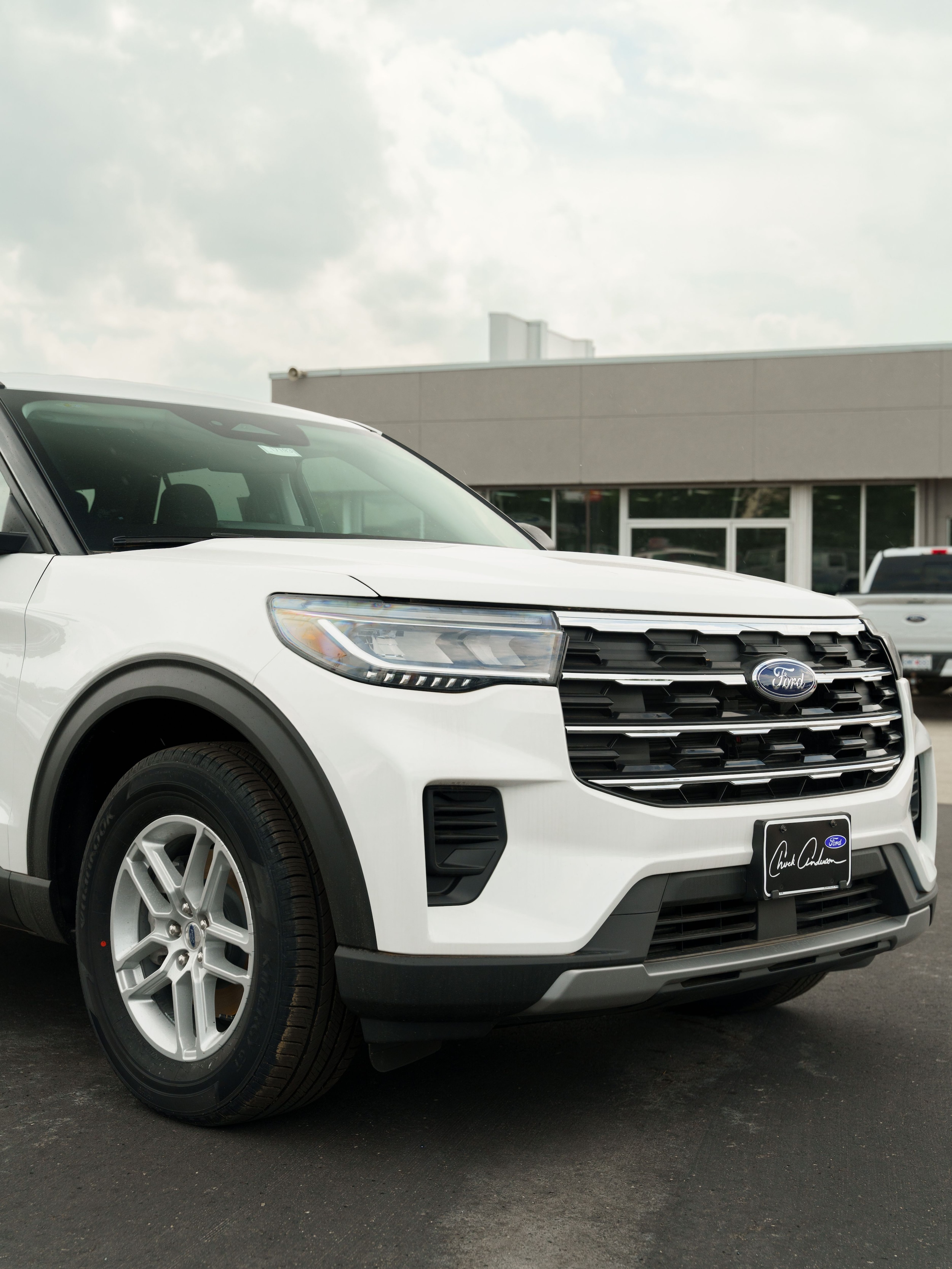
Grand Cherokee L Is Jeep's Direct Explorer Competitor
Grand Cherokee L stretches the Jeep's body to approximately 204.9 inches and adds a third row.
It can seat up to seven with the available second-row bench and provides approximately 17.2 cubic feet of cargo space behind the third row.
With the second and third rows folded, Grand Cherokee L provides approximately 84.6 cubic feet of maximum cargo volume.
Explorer vs. Grand Cherokee L Cargo
Behind third row:
Explorer: approximately 16.3 cu. ft.
Grand Cherokee L: approximately 17.2 cu. ft.
Maximum cargo:
Explorer: up to approximately 85.8 cu. ft.
Grand Cherokee L: approximately 84.6 cu. ft.
In three-row form, these SUVs are actually very close in overall cargo capability.
What if You Do Not Need a Third Row?
This is where Grand Cherokee becomes a very different proposition.
The standard two-row Grand Cherokee seats up to five and measures approximately 193.5 inches long.
It provides approximately 37.7 cubic feet of cargo space behind the second row and up to 70.8 cubic feet with the rear seats folded.
If you know you will never use a third row, Grand Cherokee lets you buy a shorter premium SUV specifically designed around five passengers.
Explorer makes more sense when the third row has real value. Two-row Grand Cherokee makes more sense when it does not.
Explorer vs. Grand Cherokee Engines
Jeep has refreshed its gas powertrain lineup, while Explorer retains a significant advantage at the performance end.
Explorer 2.3L EcoBoost
The mainstream Explorer engine is a turbocharged 2.3L EcoBoost four-cylinder producing 300 horsepower.
It is standard on Active, ST-Line, Tremor and Platinum.
For normal family use, commuting and 5,000-pound maximum towing capability, the standard Explorer engine is already a strong fit.
Explorer 3.0L EcoBoost V6
Explorer's available twin-turbocharged V6 produces up to 400 horsepower and 415 lb-ft of torque.
It is standard on Explorer ST and available on applicable Tremor and Platinum configurations.
This is the engine that gives Explorer a clear performance advantage in the comparison.
Grand Cherokee 3.6L Pentastar V6
Jeep continues to offer the naturally aspirated 3.6L Pentastar V6 with 293 horsepower and 260 lb-ft of torque on current Laredo and Laredo X models.
It offers a traditional naturally aspirated alternative for buyers who prefer that engine character.
Grand Cherokee Hurricane 4 Turbo
Jeep's newer 2.0L Hurricane 4 Turbo produces 324 horsepower and 332 lb-ft of torque.
It is standard across much of the current Grand Cherokee lineup outside Laredo and Laredo X.
It gives Jeep more standard turbocharged power than Explorer's 2.3L, but does not reach Explorer's available V6 output.
If Performance Matters, Explorer Has the Stronger Argument
Jeep's 324-horsepower Hurricane 4 Turbo is a substantial modern powertrain.
But Explorer gives buyers another level.
The available 3.0L EcoBoost V6 reaches 400 horsepower and 415 lb-ft of torque.
Explorer ST Goes Even Further
Explorer ST does not simply install the stronger engine.
Ford combines the V6 with a performance-oriented suspension and chassis tuning intended to make the three-row SUV more engaging on pavement.
If acceleration and sporty road manners are high priorities, Explorer ST has no direct current Grand Cherokee equivalent.
Explorer ST vs. PlatinumWhich Tows More: Explorer or Grand Cherokee?
Jeep has the headline towing-capacity advantage.
5,000 LBSExplorer Maximum Towing
6,200 LBSGrand Cherokee Maximum Towing
+1,200 LBSJeep Maximum Tow Advantage
5,000 LBSExplorer 2.3L Can Still Reach
Grand Cherokee Wins If Your Trailer Is the Deciding Factor
Properly equipped current Grand Cherokee configurations can tow up to 6,200 pounds.
Properly equipped Explorer configurations can tow up to 5,000 pounds.
That gives Jeep a meaningful 1,200-pound advantage in maximum published towing capacity.
If your loaded boat or camper falls between those two ratings, Grand Cherokee may eliminate the Explorer from consideration.
If your trailer is comfortably below 5,000 pounds, the towing difference may matter much less than passenger room, performance, cargo space and daily driving.
Explorer Towing GuideDo Not Shop From Maximum Towing Capacity Alone
A maximum trailer rating is only one part of matching an SUV to a trailer.
Passenger weight, luggage, accessories and trailer tongue weight all consume available vehicle payload.
That becomes especially important in a three-row family SUV because the same vehicle may be carrying six or seven people while towing.
Compare the actual loaded trailer with the ratings of the exact Explorer or Grand Cherokee—not simply the maximum number on a model comparison page.
Grand Cherokee Trailhawk Has the Stronger Extreme Off-Road Case
Explorer Tremor gives Ford buyers real off-road capability in a three-row family SUV.
But the returning Grand Cherokee Trailhawk goes farther into dedicated off-road hardware.
Current Trailhawk equipment includes Jeep's Quadra-Trac II 4x4 system with a two-speed transfer case, Selec-Terrain with Rock mode, Quadra-Lift air suspension and an electronic limited-slip rear differential.
Trailhawk Also Adds:
- Up to 11.4 inches of ground clearance
- All-terrain tires
- Multiple steel skid plates
- TrailCam off-road camera
- Air suspension with electronic damping
- Specialized approach, breakover and departure geometry
If difficult trails and technical terrain are central to the purchase, Jeep deserves the advantage here.
Explorer Tremor
You Do Not Need a Jeep to Leave the Pavement
Explorer Tremor gives families a more rugged Explorer without abandoning the three-row layout.
Tremor includes standard Intelligent 4WD, all-terrain tires, increased ground clearance and off-road-focused suspension and traction hardware.
It can also be configured with Explorer's available 3.0L EcoBoost V6 for up to 400 horsepower.
That makes Explorer Tremor particularly attractive for families whose adventures involve snow, gravel roads, camping, rough access roads and moderate trails rather than extreme rock crawling.
Trailhawk is the more specialized off-roader. Explorer Tremor may be the easier all-around family compromise.
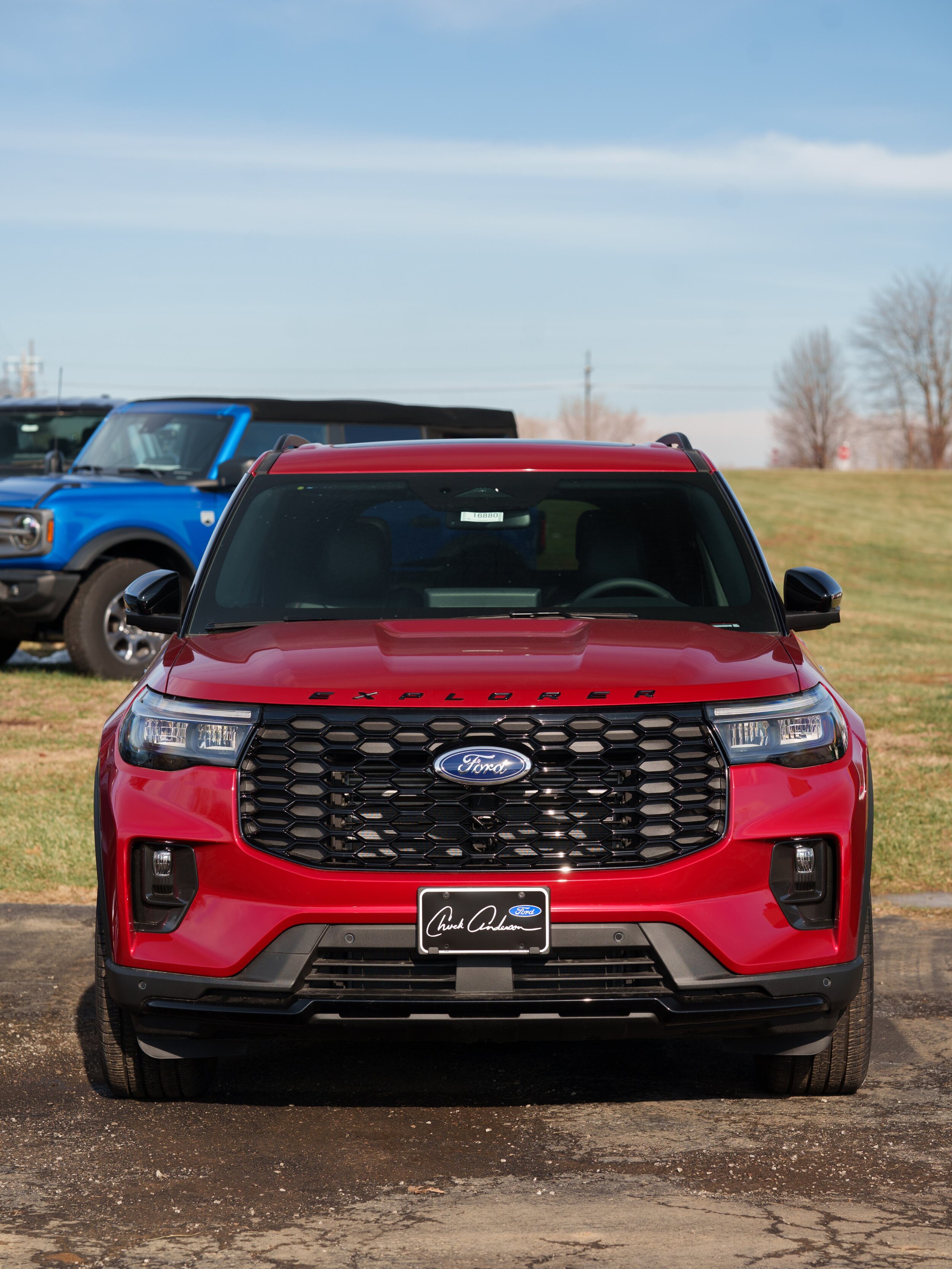
Explorer Platinum vs. Grand Cherokee Overland or Summit
Both SUV families can move well beyond basic family transportation.
Explorer Platinum
Explorer Platinum focuses on premium family comfort while retaining the Explorer's three-row versatility.
Current equipment includes heated and ventilated front seating, heated second-row seating, premium materials, a 14-speaker B&O audio system and available advanced driver-assistance technology.
The available 3.0L EcoBoost also lets Platinum combine luxury with up to 400 horsepower.
Grand Cherokee Overland / Summit
Jeep's upper trims place significant emphasis on premium materials and ride technology.
Available features include Nappa leather, multicontour front seats, massage functionality and Quadra-Lift air suspension on applicable configurations.
Buyers who prioritize a more traditional luxury-SUV atmosphere may find Grand Cherokee particularly compelling.
Which Is Better for Everyday Driving?
For most three-row family buyers, we lean Explorer.
Its approximately 198.7-inch length splits the difference between the 193.5-inch two-row Grand Cherokee and approximately 204.9-inch Grand Cherokee L.
You get three rows without moving into the longer footprint of the Jeep L.
Explorer Also Gives You More Driving Personalities
- Active for everyday family use
- ST-Line for sport-inspired appearance
- Tremor for adventure
- Platinum for luxury
- ST for 400-horsepower performance
That range makes it easier to tailor Explorer around how you drive, not merely how many people you carry.
Grand Cherokee Has a Real Advantage for Five-Passenger Buyers
Explorer's third row is valuable only if you need it.
A household that knows it will never carry more than five people may prefer the shorter two-row Grand Cherokee.
You get approximately 37.7 cubic feet of cargo space directly behind the second row without carrying the length associated with Grand Cherokee L.
If five seats are enough, do not automatically assume the three-row Explorer is the better fit simply because it provides more seating capacity.
The right vehicle is the one whose space you actually use.
Three-Row Buyers
If You Need Seven Seats, Explorer Makes a Stronger Case
Once three rows are required, Explorer and Grand Cherokee L become much closer competitors.
Both can seat up to seven.
Their maximum cargo capacities are also extremely close: approximately 85.8 cubic feet for Explorer and 84.6 cubic feet for Grand Cherokee L.
At that point, Explorer's available 400-horsepower V6, shorter overall length and trim variety become much more important.
Grand Cherokee L counters with Jeep's towing advantage and its available premium and 4x4 systems.
Technology: Two Very Different Modern Cabins
Explorer uses Ford's Digital Experience with a 13.2-inch center display and available BlueCruise hands-free highway driving technology.
Its system is built around a modern connected interface and integrates Google-based services along with smartphone connectivity.
Grand Cherokee Technology
Current Grand Cherokee models offer updated Uconnect displays, available hands-free driving technology and available passenger display functionality on applicable configurations.
Grand Cherokee L also offers useful family-focused technology such as the available interior FamCAM, which lets front-seat occupants view rear passengers through the center display.
Technology preference is best decided in person because interface design matters as much as screen dimensions.
Who Should Buy Ford Explorer?
- Families who need three rows
- Buyers wanting up to seven seats
- Drivers wanting up to 400 horsepower
- Explorer ST performance shoppers
- Families towing 5,000 pounds or less within vehicle ratings
- Buyers wanting a shorter three-row SUV than Grand Cherokee L
- Adventure buyers considering Explorer Tremor
- Drivers wanting distinct family, luxury, off-road and performance trims
Who Should Buy Jeep Grand Cherokee?
- Five-passenger buyers who do not need a third row
- Families considering Grand Cherokee L for seven seats
- Buyers needing up to 6,200 pounds of towing
- Drivers prioritizing specialized off-road ability
- Trailhawk buyers
- Shoppers wanting available air suspension
- Buyers who value premium two-row SUV packaging
- Drivers deeply invested in Jeep's 4x4 capability
Explorer or Grand Cherokee? Choose in 30 Seconds
Match the SUV to the reason you are shopping.
"I need three rows."
Start with Explorer. Three rows are fundamental to every Explorer rather than requiring the longer Jeep L body.
"I only need five seats."
Grand Cherokee deserves a serious look. Its shorter two-row format may fit your needs better.
"I want the most horsepower."
Explorer. The available 3.0L EcoBoost reaches up to 400 horsepower and 415 lb-ft.
"I tow more than 5,000 pounds."
Grand Cherokee. Properly equipped models can reach up to 6,200 pounds.
"I want a sporty three-row SUV."
Explorer ST. It provides a true performance-oriented powertrain and chassis setup.
"Serious off-road capability is my priority."
Grand Cherokee Trailhawk. Jeep's specialized 4x4 and suspension hardware gives it the advantage.
"I want an adventurous family SUV."
Compare Explorer Tremor and Grand Cherokee Trailhawk. Explorer may be the better three-row family compromise; Jeep goes farther into technical off-road capability.
"I want premium comfort."
Compare Explorer Platinum with Grand Cherokee Overland or Summit. Both take a luxury-oriented approach with different personalities.
"I need seven seats plus lots of cargo."
Both deserve a test. Their three-row maximum cargo capacities are surprisingly close.
"I want one SUV that does almost everything."
We lean Explorer for the average family. Its three-row packaging, engine choices and trim range cover a very broad set of needs.
Our Verdict: Explorer Wins for Most Three-Row Families
We would choose Explorer for the buyer who needs three rows and wants the broadest mix of family utility and performance.
It seats up to seven, gives you approximately 85.8 cubic feet of maximum cargo capacity, offers up to 400 horsepower and packages everything into a body shorter than Grand Cherokee L.
Explorer also gives buyers very different personalities through Active, ST-Line, Tremor, Platinum and ST.
Where Grand Cherokee Wins
Jeep deserves credit where it has real advantages.
- Higher 6,200-pound maximum towing capability
- Dedicated five-passenger two-row configuration
- Highly specialized Trailhawk off-road hardware
- Available Quadra-Lift air suspension
- Strong premium Overland and Summit choices
The right answer depends on whether those advantages matter more than Explorer's three-row-first design and available 400-horsepower performance.
Bottom Line: Which One Should You Buy?
Buy the Ford Explorer if you need three rows, want strong family versatility and value having the option of a genuine 400-horsepower performance SUV.
Buy the Jeep Grand Cherokee if you need more than 5,000 pounds of towing, want serious Trailhawk off-road capability or prefer a premium five-passenger SUV without a third row.
If you need three rows and are leaning Jeep, make sure you are comparing Explorer against Grand Cherokee L, not simply the standard two-row Grand Cherokee.
For most traditional three-row family buyers, we give Explorer the edge.
Ford Explorer vs. Jeep Grand Cherokee FAQs
Quick answers to common questions about these SUVs.
Which is better, Ford Explorer or Jeep Grand Cherokee?
Ford Explorer is our pick for most three-row family buyers because it offers seating for up to seven, up to 400 horsepower and a broad trim lineup. Grand Cherokee has advantages in maximum towing, two-row flexibility and specialized off-road capability.
Does Jeep Grand Cherokee have three rows?
The standard Grand Cherokee has two rows and seating for five. Grand Cherokee L is the longer three-row version and offers seating for up to seven.
Which is bigger, Explorer or Grand Cherokee?
Explorer is approximately 198.7 inches long. The two-row Grand Cherokee is approximately 193.5 inches long, while Grand Cherokee L is approximately 204.9 inches long.
Which has more horsepower, Explorer or Grand Cherokee?
Explorer has the higher maximum current gas-engine output. Its available 3.0L EcoBoost V6 produces up to 400 horsepower, while Jeep's 2.0L Hurricane 4 Turbo produces 324 horsepower.
Which tows more, Ford Explorer or Jeep Grand Cherokee?
Grand Cherokee has the higher maximum towing capacity. Properly equipped current Grand Cherokee models can tow up to 6,200 pounds, while Explorer can tow up to 5,000 pounds.
Which has more cargo space, Explorer or Grand Cherokee L?
The three-row SUVs are very close. Explorer offers up to approximately 85.8 cubic feet of maximum cargo volume, while Grand Cherokee L offers approximately 84.6 cubic feet.
Which has more cargo room behind the third row?
Grand Cherokee L has a slight published advantage at approximately 17.2 cubic feet compared with approximately 16.3 cubic feet in Explorer.
Which is better off road, Explorer or Grand Cherokee?
Grand Cherokee Trailhawk has the advantage for demanding technical off-road driving. Explorer Tremor remains a capable choice for families wanting three rows with additional trail capability.
What is the Jeep equivalent of Explorer Tremor?
Grand Cherokee Trailhawk is the closest off-road-focused Jeep comparison, although Trailhawk goes farther into specialized technical off-road hardware.
Does Jeep Grand Cherokee have an Explorer ST equivalent?
There is no direct current Grand Cherokee equivalent to the 400-horsepower Explorer ST. Explorer ST is specifically positioned as a performance-oriented three-row SUV.
Which is better for a family of five?
Either can work well. Explorer provides an additional third row whenever needed, while the two-row Grand Cherokee gives a family of five a shorter vehicle with generous cargo room behind the second row.
Which is better for a family of seven?
Explorer and Grand Cherokee L can both seat up to seven. Explorer has slightly more maximum cargo capacity and more available horsepower, while Grand Cherokee offers greater maximum towing.
Continue Your Ford SUV Research
Compare Explorer with other SUVs, research towing and explore Explorer trims and engines.
Comparing Ford Explorer With Jeep Grand Cherokee?
Start with the seats.
If you need three rows, compare Explorer with Grand Cherokee L. If you only need five seats, decide whether the standard Grand Cherokee's shorter body is more valuable than Explorer's extra flexibility.
Then compare your trailer, your normal driving and how much performance you want.
Chuck Anderson Ford can help you compare Explorer Active, ST-Line, Tremor, Platinum and ST and find the configuration that fits your family, towing needs and driving style.
Visit Chuck Anderson Ford in Excelsior Springs, Missouri, serving Explorer shoppers from Liberty, Kearney, Lawson, Smithville and throughout the Kansas City Northland.
Chuck Anderson Ford
- 1910 W Jesse James Road
- Excelsior Springs, MO 64024
- Sales: 816-648-6419
- Service: 816-648-6424
- Parts: 816-648-6429
Ford Explorer and Jeep Grand Cherokee engines, horsepower, torque, towing capacity, seating, cargo capacity, dimensions, drivetrain availability, trim content, packages, technology and specifications vary by model, body style and vehicle configuration and are subject to change. Grand Cherokee is available in both two-row and three-row Grand Cherokee L configurations, so passenger and cargo comparisons differ by body style. Maximum towing figures require proper vehicle and trailer equipment and do not apply to every configuration. Off-road capability varies by trim and equipment. Competitor information reflects manufacturer-published information available when this page was prepared. Always verify current specifications and equipment for the exact vehicle before purchase, towing or off-road use.