
Ford Bronco vs Bronco Sport: what's the difference?
Bronco Family Comparison
Ford Bronco vs. Bronco Sport: What's the Difference?
They share a name, rugged styling and standard four-wheel-drive capability, but Ford Bronco and Bronco Sport are fundamentally different SUVs. Bronco is the larger body-on-frame choice built around serious off-road capability, removable doors and open-air driving. Bronco Sport is the smaller five-passenger SUV designed to make commuting, parking, road trips and weekend adventure easier.
Quick Answer: Bronco Is the Off-Road SUV; Bronco Sport Is the Everyday SUV
Buy the Ford Bronco if you specifically want the full Bronco experience.
That means body-on-frame construction, available 2-Door and 4-Door bodies, removable doors, removable roof configurations, an available manual transmission, much more powerful engines and significantly more extreme factory off-road equipment.
Buy Bronco Sport if you want Bronco attitude in a smaller, easier-to-own package.
Bronco Sport is a five-passenger unibody SUV with standard 4x4, independent suspension, an automatic transmission and compact dimensions that make more sense for commuting, parking and normal family use.
Bronco Sport Badlands and Sasquatch-equipped models can still be impressively capable away from pavement. They simply approach off-roading from a different starting point.
If you are asking which one is "better," the answer depends on whether adventure capability or everyday convenience is higher on your list.
Serious Off-Roading
Bronco
Body-on-frame construction and substantially more extreme hardware.
Daily Driving
Bronco Sport
Smaller footprint and crossover-style packaging make everyday use easier.
Power
Bronco
Up to 418 hp versus 250 hp in Bronco Sport.
Fuel Economy
Bronco Sport
The 1.5L model is EPA-estimated at up to 25 city / 30 highway.
Ford Bronco vs. Bronco Sport Comparison
The easiest way to understand them is to compare what is underneath the similar styling.
| Category | 2026 Ford Bronco | 2026 Ford Bronco Sport | Advantage |
|---|---|---|---|
| Vehicle Class | Rugged midsize off-road SUV | Compact adventure SUV | Different missions |
| Construction | Body-on-frame | Unibody | Depends on use |
| Body Styles | 2-Door or 4-Door depending on trim | 4-Door only | Bronco |
| Maximum Seating | 4 in 2-Door / 5 in 4-Door | 5 | Bronco Sport for consistent five-seat packaging |
| Standard 4x4 | Yes | Yes | Tie |
| Front Suspension | Independent long-travel off-road suspension | Independent MacPherson-strut suspension | Different missions |
| Rear Suspension | Solid rear axle | Independent rear suspension | Different missions |
| Base Engine | 2.3L EcoBoost I-4 | 1.5L EcoBoost I-3 | Bronco for power |
| Base Engine Output | Up to 300 hp / 325 lb-ft | 180 hp / 200 lb-ft | Bronco |
| Available Mainstream Engine | 2.7L EcoBoost V6 | 2.0L EcoBoost I-4 on Badlands | Bronco |
| Available Engine Output | Up to 330 hp / 415 lb-ft | 250 hp / 280 lb-ft | Bronco |
| Maximum Horsepower | 418 hp — Bronco Raptor | 250 hp — Badlands | Bronco |
| Manual Transmission | Available 7-speed manual | No | Bronco |
| Automatic Transmission | 10-speed automatic | 8-speed automatic | Preference |
| Removable Doors | Yes | No | Bronco |
| Removable Roof | Yes | No | Bronco |
| Maximum Towing | Up to 4,500 lbs — Raptor | Up to 2,700 lbs — Badlands | Bronco |
| Typical Max Conventional Towing | Up to 3,500 lbs | Up to 2,200 lbs with 1.5L | Bronco |
| Maximum Cargo Volume | Up to 83.0 cu. ft. in 4-Door soft-top configuration | Up to 65.2 cu. ft. with 1.5L | Bronco |
| Approx. Standard Length | 173.7 in. 2-Door / 189.4 in. 4-Door | About 173.1 in. | Bronco Sport for compact size |
| Wheelbase | 100.4 in. 2-Door / 116.1 in. 4-Door | 105.1 in. | Different missions |
| Maximum Factory Ground Clearance | Up to 13.1 in. on Bronco Raptor | Much lower; varies by trim/package | Bronco |
| Advanced Off-Road Packages | Sasquatch, Wildtrak Package, Badlands, Raptor | Black Diamond and Sasquatch on applicable models | Bronco |
| Best For | Serious off-roading and open-air adventure | Everyday driving with weekend capability | Depends on buyer |
The Biggest Difference
Bronco Is Body-on-Frame. Bronco Sport Is Unibody.
The similar names can make Bronco and Bronco Sport sound like two sizes of the same SUV.
Mechanically, that is not what Ford built.
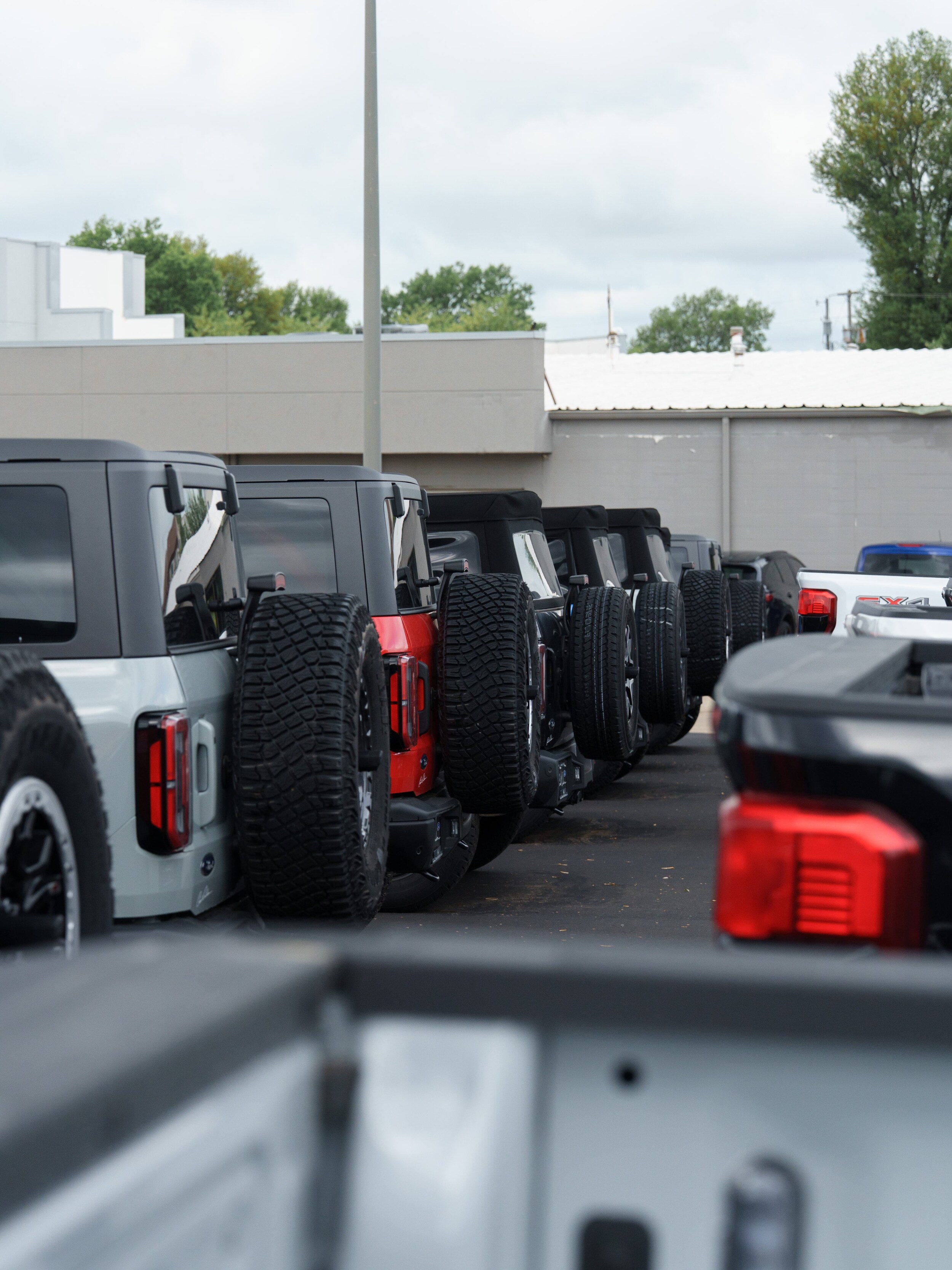
Bronco uses body-on-frame construction with a high-strength-steel frame, independent front suspension and solid rear axle.
That architecture is much closer in philosophy to traditional trucks and dedicated off-road SUVs.
Bronco Sport uses unibody construction with fully independent suspension.
That makes it closer in basic architecture to a modern compact crossover, though Ford adds standard 4x4 and legitimate trail-oriented hardware.
What Does Body-on-Frame vs. Unibody Mean to the Driver?
It helps explain why the two vehicles feel so different even though they wear similar Bronco styling.
Bronco's architecture supports greater suspension travel, larger tires, more extreme axle hardware and more specialized off-road configurations.
Bronco Sport's Advantage
Unibody construction and independent suspension make it possible to package the Bronco Sport as a smaller, lighter and more everyday-friendly SUV.
That makes it easier to park, easier to maneuver and more closely aligned with what many compact-SUV shoppers expect on pavement.
One is not automatically "better." They were engineered for different priorities.
How Much Bigger Is the Ford Bronco?
The answer changes dramatically depending on whether you compare Bronco Sport with a 2-Door or 4-Door Bronco.
Bronco Sport vs. 2-Door Bronco
Bronco Sport is approximately 173.1 inches long with the 1.5L engine.
A standard 2-Door Bronco is approximately 173.7 inches long.
Surprisingly, the two are nearly identical in overall length.
The major difference is packaging: Bronco Sport has four conventional passenger doors and five seats, while the 2-Door Bronco prioritizes shorter-wheelbase off-road capability and seats four.
Bronco Sport vs. 4-Door Bronco
A standard 4-Door Bronco stretches to approximately 189.4 inches.
That makes it roughly 16 inches longer than a typical Bronco Sport.
The longer wheelbase creates more rear-seat and cargo room while retaining the full-size Bronco's removable-door and removable-roof design.
Which Is Easier to Drive Every Day?
Bronco Sport.
That is one of the main reasons the smaller SUV exists.
Its compact dimensions, unibody construction, fully independent suspension and automatic transmission make it particularly well suited to commuting, errands, school runs and highway travel.
Bronco can absolutely be a daily driver, especially in 4-Door form. But larger tires, greater width on some configurations, removable roof hardware and more aggressive off-road equipment can add compromises that many Bronco Sport owners never need to make.
If 95% of your driving is pavement and you simply want the ability to explore on the other 5%, Bronco Sport deserves serious consideration.
```
Bronco Has Much More Power
Current Bronco buyers can choose among three EcoBoost engines.
2.3L EcoBoost:
Up to 300 hp / 325 lb-ft
2.7L EcoBoost V6:
Up to 330 hp / 415 lb-ft
Bronco Raptor 3.0L EcoBoost V6:
Up to 418 hp / 440 lb-ft
Bronco Sport Focuses More on Efficiency
Bronco Sport uses two smaller EcoBoost engines.
1.5L EcoBoost:
180 hp / 200 lb-ft
Badlands 2.0L EcoBoost:
250 hp / 280 lb-ft
The standard 1.5L is designed around everyday drivability and efficiency, while Badlands gets the stronger 2.0L for buyers who want more performance and off-road capability.
Don't Buy Bronco Sport Expecting It to Feel Like a Smaller 2.7L Bronco
The engine numbers tell part of the story.
Bronco Sport's standard 1.5L produces 180 horsepower, while even the standard full-size Bronco 2.3L reaches up to 300 horsepower.
Bronco Sport Badlands narrows the gap with its 250-horsepower 2.0L, but the full-size Bronco still moves into another performance range with the 2.7L and Raptor 3.0L engines.
Buy Bronco Sport because you value its size, efficiency and practicality—not because you expect it to duplicate Bronco's powertrain experience.
Fuel Economy
Bronco Sport Is the Better Choice if MPG Matters
The standard 1.5L EcoBoost Bronco Sport is EPA-estimated at up to 25 MPG city, 30 MPG highway and 27 MPG combined.
Even the more capable 2.0L Badlands is rated at approximately 21 city, 27 highway and 23 combined.
The full-size Bronco is larger, heavier and designed around more aggressive off-road hardware, so efficiency is not its central mission.
For someone commuting significant mileage every week, Bronco Sport's fuel-economy advantage can be one of the most important differences in actual ownership cost.
Want a Manual? You Need the Full-Size Bronco
Applicable Bronco models with the 2.3L EcoBoost can be equipped with Ford's 7-speed manual transmission.
It includes six conventional forward gears plus a dedicated crawler gear for low-speed trail use.
Bronco Sport Is Automatic Only
Every current Bronco Sport uses an 8-speed automatic transmission.
Badlands adds SelectShift capability with paddle shifters, but there is no clutch-pedal option.
If a manual transmission is one of the reasons you want a Bronco, the choice is already made.
Open-Air Driving
Only the Full-Size Bronco Has Removable Doors and Roof Panels
This is one of the simplest ways to decide between them.
Full-size Bronco was designed around open-air driving.
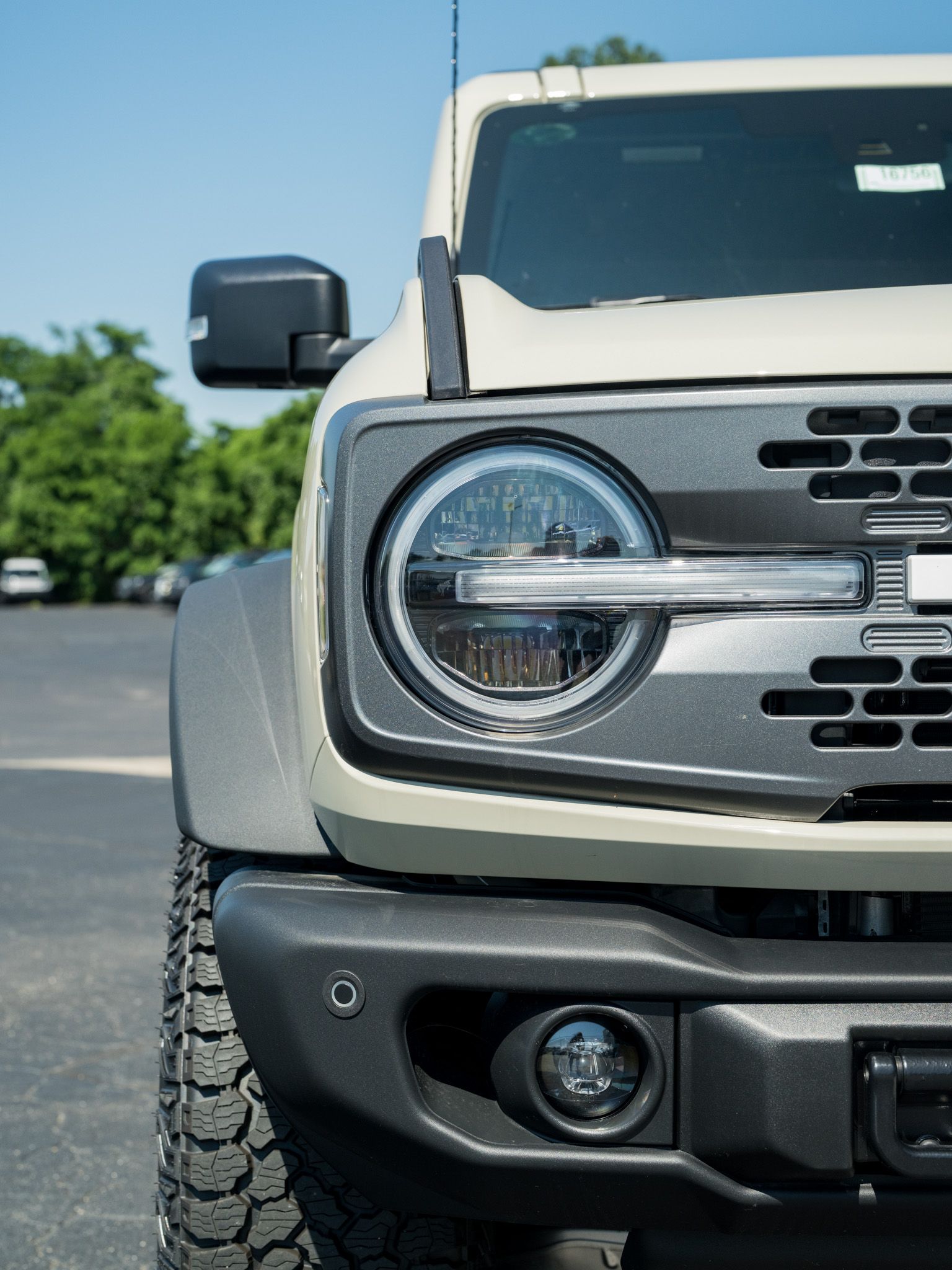
Its doors can be removed, and the side mirrors remain mounted to the vehicle rather than leaving with the doors.
Bronco also offers removable roof configurations. Depending on body style and equipment, buyers can choose hard-top or soft-top solutions.
Bronco Sport's doors and roof are conventional fixed parts of the vehicle.
If taking the doors and roof off is part of the experience you picture when you say, "I want a Bronco," buy the full-size Bronco.
Can You Take the Doors Off a Bronco?
Yes. The full-size Bronco's frameless doors are designed to be removed.
Ford also mounts the mirrors to the body so they remain in their normal position when the doors are off.
Bronco Door Removal GuideCan You Take the Roof Off a Bronco?
Yes. Full-size Bronco offers removable roof configurations in both 2-Door and 4-Door form.
Bronco Sport uses a conventional fixed roof and is not designed for the same open-air transformation.
Bronco Roof Removal GuideWhich Is Better Off Road?
Full-size Bronco wins when the terrain becomes genuinely difficult.
Its body-on-frame architecture supports greater suspension travel, larger tires, more ground clearance, available locking front and rear differentials and significantly more specialized trail configurations.
Sasquatch, Badlands and Bronco Raptor push the platform far beyond what most compact SUVs attempt.
But Don't Dismiss Bronco Sport
Every Bronco Sport comes with standard 4x4.
Badlands upgrades to Advanced 4x4 with a twin-clutch rear drive unit and seven G.O.A.T. Modes.
Available Sasquatch packages add even more specialized suspension, tires, protection and recovery equipment on applicable Bronco Sport models.
Bronco Sport is far more adventure-capable than its compact crossover dimensions might suggest.
Does Bronco Sport Have Real 4x4?
Yes. Ford equips every current Bronco Sport with a four-wheel-drive system rather than making it an optional upgrade.
Big Bend, Heritage and Outer Banks use standard 4x4.
Badlands steps up to Advanced 4x4 with a twin-clutch rear drive unit designed to distribute torque more aggressively across the rear axle when terrain gets difficult.
That system is part of why Bronco Sport Badlands deserves to be taken seriously as an adventure SUV.
The difference is not "Bronco has 4x4 and Bronco Sport doesn't." The difference is how far each platform can take that capability.
Does Bronco Sport Have a Sasquatch Package Too?
Yes, but Bronco Sasquatch and Bronco Sport Sasquatch are not mechanically identical packages.
Full-Size Bronco Sasquatch
Bronco Sasquatch is one of Ford's signature off-road packages.
- 35-inch tires
- Electronic-locking front axle
- Electronic-locking rear axle
- 4.70 final drive ratio
- High-clearance suspension
- Upgraded HOSS hardware
Package content varies with trim and current production configuration.
Bronco Sport Sasquatch
Sasquatch is available on applicable Bronco Sport Outer Banks and Badlands configurations.
The package adds more aggressive off-road suspension, all-terrain tires, underbody protection, recovery equipment and Advanced 4x4 capability where applicable.
It makes Bronco Sport significantly more trail-ready without turning it into the same type of vehicle as full-size Bronco.
Bronco Badlands and Bronco Sport Badlands Are Also Different Vehicles
Ford uses the Badlands name on both lineups because both represent capability-focused versions of their respective platforms.
Full-size Bronco Badlands starts from the more extreme body-on-frame Bronco platform and offers hardware intended for technical off-roading.
Bronco Sport Badlands uses the 250-horsepower 2.0L EcoBoost, Advanced 4x4, a twin-clutch rear drive unit, seven G.O.A.T. Modes and additional underbody protection.
Bronco Sport Badlands is the most capable Bronco Sport. Bronco Badlands still sits on a considerably more specialized off-road platform.
Which Tows More?
Ford Bronco.
Properly equipped conventional Bronco models with the 2.3L or 2.7L EcoBoost can tow up to 3,500 pounds.
Bronco Raptor increases that to 4,500 pounds.
Bronco Sport Towing
Applicable 1.5L Bronco Sport configurations equipped with the required Class II Trailer Tow Package can tow up to 2,200 pounds.
Bronco Sport Badlands with the 2.0L can reach up to 2,700 pounds when properly equipped.
If trailer weight regularly approaches 3,000 pounds or more, full-size Bronco is the better place to start.
Bronco Sport Can Work Well For:
- Small utility trailers
- Light recreational trailers
- Personal watercraft
- Lightweight equipment trailers
- Properly sized small campers
Always use actual loaded trailer weight rather than an advertised dry-weight number.
Full-Size Bronco Opens More Options
Bronco's higher ratings allow more trailer flexibility, especially when moving into Bronco Raptor's 4,500-pound maximum.
Bronco still is not intended to replace an Expedition or Ford pickup for heavy trailer duty.
Ford Bronco Towing GuideCargo & Practicality
Which Has More Cargo Space?
The 4-Door Bronco has the higher maximum.
Ford publishes up to approximately 77.6 cubic feet behind the first row with a 4-Door Bronco hard top and up to 83.0 cubic feet with the soft top.
The 1.5L Bronco Sport provides up to approximately 65.2 cubic feet behind the first row.
But maximum cargo volume is not the whole usability story.
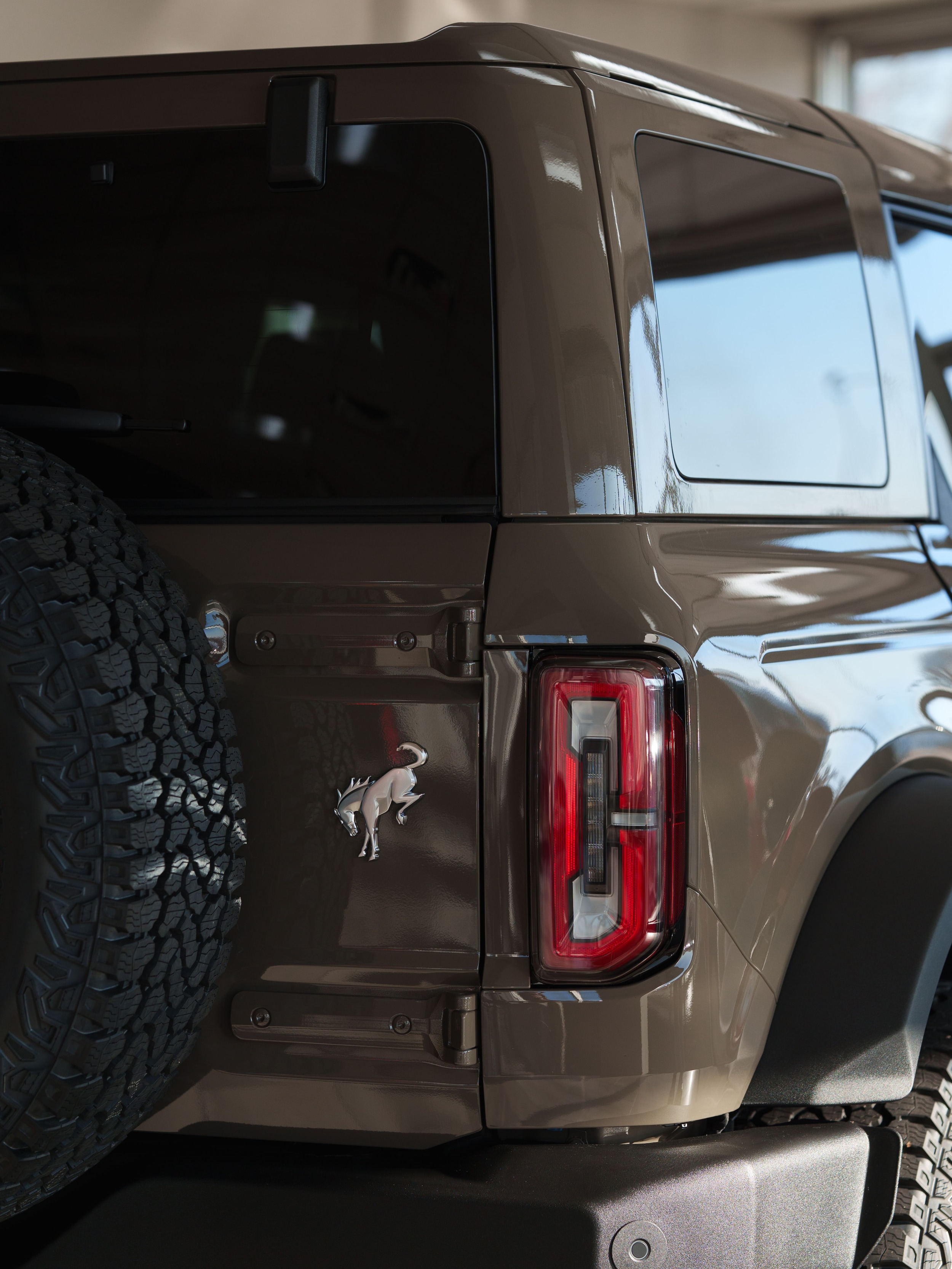
Bronco Sport's conventional rear liftgate, flip-up rear glass, compact dimensions and lower everyday mission can make loading and unloading very convenient.
Which Is Better for a Small Family?
For most families who do not specifically need full-size Bronco capability, Bronco Sport is easier to recommend.
It comes only as a four-door, seats five and provides approximately 36.9 inches of rear legroom.
The smaller exterior dimensions also make parking, garages and daily school or daycare trips easier.
When 4-Door Bronco Makes More Sense
Choose the full-size Bronco if family practicality has to coexist with:
- More serious off-roading
- Removable doors and roof
- More powerful engines
- Manual-transmission driving
- More towing capability
- More maximum cargo space
Don't Compare Bronco Sport With a 2-Door Bronco Based on Length Alone
Their exterior lengths are remarkably similar.
Bronco Sport measures roughly 173 inches long, and a standard 2-Door Bronco is also roughly 174 inches.
Yet their packaging could hardly be more different.
Bronco Sport provides four side doors, five seats, a longer 105.1-inch wheelbase and compact-SUV practicality.
2-Door Bronco seats four, uses a shorter 100.4-inch wheelbase and prioritizes off-road geometry, removable body panels and the classic short-wheelbase Bronco experience.
Similar length does not make them similar SUVs.
Missouri Weather
Which Is Better in Snow?
Both start with a major advantage: 4x4 is standard.
Bronco offers increasingly sophisticated 4x4 hardware depending on trim and package.
Bronco Sport Badlands and applicable Sasquatch configurations use Advanced 4x4 with a twin-clutch rear drive unit, while more everyday-focused Bronco Sports retain useful Slippery and Off-Road G.O.A.T. Modes.
For normal winter commuting, Bronco Sport's smaller dimensions and everyday-oriented chassis can make it the easier choice.
For unusually deep snow, rough unplowed roads or off-road winter use, a properly equipped full-size Bronco has substantially more extreme hardware available.
Is the Bronco Good in Snow?Full-Size Bronco Has Much More Extreme Ground-Clearance Potential
Bronco's available packages can radically change ride height and tire size.
Sasquatch-equipped Broncos use 35-inch tires, while Bronco Raptor moves to 37-inch tires and reaches up to approximately 13.1 inches of ground clearance.
Bronco Sport Keeps the Vehicle More Compact
Standard Bronco Sport configurations sit much closer to normal compact-SUV height.
Badlands and Sasquatch configurations add useful clearance and underbody protection without making the vehicle as tall, wide or specialized as full-size Bronco.
That can be an advantage if your "off-roading" is more often a rough forest road than a rock garden.
Which Is Easier to Park?
Bronco Sport is the clear choice.
A 4-Door Bronco is approximately 189.4 inches long, while Bronco Sport is roughly 173 inches.
More extreme Bronco configurations also become substantially wider because of larger tires, fender flares and specialized suspension.
That matters in downtown parking structures, older garages and crowded lots.
If your adventures begin after five days of city or suburban commuting, the Bronco Sport's footprint is one of its strongest selling points.
Which Bronco Sport Should You Buy?
Bronco Sport's trim lineup is simpler than the full-size Bronco lineup.
Big Bend
The everyday value choice.
It combines the 1.5L EcoBoost, standard 4x4, five G.O.A.T. Modes and useful compact-SUV practicality without requiring premium or extreme off-road equipment.
Heritage
The retro-styled choice.
Heritage retains the 1.5L EcoBoost and standard 4x4 but adds distinctive visual details inspired by early Bronco design.
Outer Banks
The comfort-focused Bronco Sport.
Outer Banks emphasizes interior refinement and everyday amenities, with additional off-road capability available through Sasquatch.
Badlands
The capability-focused Bronco Sport.
Its 250-horsepower 2.0L EcoBoost, Advanced 4x4, twin-clutch rear drive unit and seven G.O.A.T. Modes make it the starting point for shoppers who genuinely expect to spend time off pavement.
Full-Size Bronco Gives You a Much Wider Capability Range
Current Bronco configurations stretch from relatively straightforward Base and Big Bend models to Outer Banks, Heritage Edition, Badlands, Stroppe Edition and the extreme Bronco Raptor.
Ford also offers packages such as Sasquatch, and Wildtrak has returned as an available equipment group on applicable 2026 Badlands 4-Door models.
That means two Broncos parked next to each other can have dramatically different suspension, tires, drivetrain hardware, engine output and intended use.
Bronco Sport is easier to shop. Full-size Bronco gives you more ways to build exactly the off-road SUV you want.
Which Bronco Trim Is Best?Who Should Buy the Full-Size Ford Bronco?
- Drivers who want removable doors and roof panels
- Buyers who want a manual transmission
- Drivers regularly tackling difficult trails
- Shoppers wanting 35- or 37-inch factory tires
- Buyers wanting a powerful V6
- Drivers wanting up to 418 horsepower
- Owners needing more towing capability
- Buyers interested in Badlands or Raptor hardware
Who Should Buy Bronco Sport?
- Daily commuters
- Small families
- Drivers wanting compact SUV dimensions
- Shoppers prioritizing better fuel economy
- Owners who still want standard 4x4
- Weekend campers and outdoor enthusiasts
- Drivers who do not need removable body panels
- Buyers who want capability without full-size Bronco compromises
Bronco or Bronco Sport? Decide in 30 Seconds
Match the SUV to what you actually want to do with it.
"I want to take the doors off."
Bronco. Bronco Sport's doors are not designed to be removed.
"I want to take the roof off."
Bronco. The full-size SUV provides the open-air design you're looking for.
"I just want something good in snow."
Bronco Sport may be enough. Standard 4x4 makes it a compelling winter daily driver.
"I want a manual."
Bronco. Applicable 2.3L configurations offer the 7-speed manual.
"I commute 50 miles a day."
Bronco Sport. Its smaller size and better fuel economy make more sense for many high-mileage commuters.
"I want to rock crawl."
Bronco. Start with Badlands and explore Sasquatch and higher-capability configurations.
"I want a small SUV but actually go camping."
Bronco Sport. It was designed for exactly that combination of daily use and weekend recreation.
"I want a V6."
Bronco. The 2.7L EcoBoost and Raptor 3.0L are V6 options. Bronco Sport is four- and three-cylinder only.
"I want the highest towing capacity."
Bronco. Up to 4,500 pounds in Raptor versus 2,700 pounds in Bronco Sport Badlands.
"I want the easiest Bronco-family vehicle to live with."
Bronco Sport. That is essentially its mission.
Don't Pay for Full-Size Bronco Capability You Will Never Use
There is nothing wrong with buying Bronco because you simply love it.
But if your buying decision is based on practical value, be realistic about how you drive.
If the doors will never come off, the roof will never come off, the vehicle will never see a trail difficult enough to need locking differentials and the manual transmission does not interest you, Bronco Sport may deliver more of what you actually use every day.
On the other hand, if those are exactly the things that excite you, buying Bronco Sport to save money may leave you wishing you had bought the real thing you wanted.
Buy based on the capabilities you value, not merely the badge on the grille.
Our Verdict: There Isn't One Universal Winner
Bronco and Bronco Sport are different enough that calling one universally better misses the point.
Bronco is unquestionably the more capable and more distinctive off-road vehicle.
It offers more power, more towing, removable body panels, manual transmission availability and factory configurations capable of extremely difficult terrain.
But Bronco Sport May Be the Smarter Purchase
For the buyer who spends nearly every day on pavement, Bronco Sport is smaller, more efficient and easier to integrate into normal life.
Standard 4x4 means you do not have to give up all-weather confidence just because you chose the smaller SUV.
Badlands and Sasquatch configurations can also provide far more off-road capability than many compact-SUV buyers will ever need.
So, Should You Buy Bronco or Bronco Sport?
Buy Ford Bronco if the Bronco experience itself is what you want.
If removable doors, an open roof, a manual transmission, serious trail capability, larger tires, more power or the possibility of Badlands and Raptor-level hardware are important, Bronco is the correct vehicle.
Buy Bronco Sport if you want an adventure-ready compact SUV that happens to carry the Bronco name extremely well.
Its standard 4x4, useful cargo space, strong fuel economy and manageable dimensions make it the better choice for many people who need one vehicle to handle commuting Monday through Friday and recreation on the weekend.
The best way to choose is not to ask whether Bronco is "better" because it is bigger.
Ask whether you need the capability that makes Bronco bigger in the first place.
Ford Bronco vs. Bronco Sport FAQs
Quick answers to the most common questions shoppers ask about the two Bronco-family SUVs.
What is the difference between Ford Bronco and Bronco Sport?
Ford Bronco is a larger body-on-frame off-road SUV available in 2-Door and 4-Door configurations with removable doors and roof capability. Bronco Sport is a smaller five-passenger unibody SUV designed around compact dimensions, everyday practicality and standard 4x4.
Is Bronco Sport just a smaller Ford Bronco?
No. They are separate vehicles using different platforms, suspensions, engines, transmissions and body construction. They share design themes and an adventure-oriented philosophy but have different missions.
Is Ford Bronco body-on-frame?
Yes. Full-size Ford Bronco uses body-on-frame construction with a high-strength-steel frame, independent front suspension and solid rear axle.
Is Bronco Sport body-on-frame?
No. Ford Bronco Sport uses unibody construction with independent front and rear suspension.
Does Bronco Sport have four-wheel drive?
Yes. Every current Bronco Sport comes with standard 4x4. Badlands uses Advanced 4x4 with a twin-clutch rear drive unit, and applicable Sasquatch configurations add additional off-road hardware.
Is every full-size Ford Bronco 4x4?
Yes. The current full-size Bronco lineup is built around standard four-wheel-drive capability, with different 4x4 systems available depending on trim and package.
Can you take the doors off a Bronco Sport?
No. Bronco Sport uses conventional fixed doors. Full-size Ford Bronco has removable frameless doors designed for open-air driving.
Can you take the roof off a Bronco Sport?
No. Bronco Sport has a conventional fixed roof. Full-size Ford Bronco offers removable roof configurations.
Can you get a manual Bronco Sport?
No. Current Bronco Sport models use an 8-speed automatic transmission. Applicable full-size Bronco models with the 2.3L EcoBoost offer a 7-speed manual transmission.
Which is more powerful, Bronco or Bronco Sport?
Full-size Bronco is substantially more powerful. Its engines range up to 418 horsepower in Bronco Raptor, while the current Bronco Sport lineup reaches 250 horsepower in Badlands.
How much horsepower does Bronco Sport have?
Current Bronco Sport Big Bend, Heritage and Outer Banks models use a 1.5L EcoBoost producing 180 horsepower, while Badlands uses a 2.0L EcoBoost producing 250 horsepower.
How much horsepower does Ford Bronco have?
The 2026 Bronco 2.3L EcoBoost produces up to 300 horsepower, the available 2.7L EcoBoost V6 produces up to 330 horsepower and Bronco Raptor's 3.0L EcoBoost V6 produces up to 418 horsepower.
Which tows more, Bronco or Bronco Sport?
Full-size Bronco tows more. Conventional Bronco configurations can tow up to 3,500 pounds and Bronco Raptor can tow up to 4,500 pounds. Bronco Sport can tow up to 2,200 pounds with applicable 1.5L configurations or up to 2,700 pounds in properly equipped Badlands models.
Which has more cargo space, Bronco or Bronco Sport?
Four-door Bronco has the higher maximum, reaching up to approximately 83 cubic feet in a soft-top configuration. Bronco Sport provides up to approximately 65.2 cubic feet with the 1.5L powertrain.
Which is better for daily driving, Bronco or Bronco Sport?
Bronco Sport is generally the easier everyday vehicle because of its smaller footprint, unibody construction, independent suspension and better fuel economy. Bronco can still be a good daily driver for buyers who value its additional capability.
Which is better off road, Bronco or Bronco Sport?
Full-size Ford Bronco has considerably greater maximum off-road capability, especially with Sasquatch, Badlands or Bronco Raptor equipment. Bronco Sport Badlands and Sasquatch models remain capable options for lighter trail and adventure use.
Does Bronco Sport have Sasquatch?
Yes. Sasquatch packages are available on applicable Bronco Sport Outer Banks and Badlands models, adding more specialized suspension, tires, protection and off-road drivetrain hardware.
Which is better in snow, Bronco or Bronco Sport?
Both offer standard 4x4 and can be excellent winter vehicles with appropriate tires. Bronco offers more extreme hardware for deep snow and difficult terrain, while Bronco Sport can be easier to drive and park during normal winter commuting.
Which is better for a family, Bronco or Bronco Sport?
Bronco Sport is a strong choice for families wanting a compact five-passenger SUV with four conventional doors and good everyday practicality. Four-door Bronco makes more sense when the family also wants open-air driving, more towing, greater cargo capacity or serious off-road capability.
Should I buy Bronco or Bronco Sport?
Buy Ford Bronco if you want removable doors and roof panels, stronger engines, a manual transmission or more serious off-road capability. Buy Bronco Sport if you prioritize compact dimensions, fuel economy, easy daily driving and standard 4x4 for weekend adventure.
Continue Your Ford Bronco Research
Compare Bronco trims, capability and ownership questions before choosing the right Bronco-family SUV.
Still Deciding Between Bronco and Bronco Sport?
Drive them back to back.
The difference is immediately obvious from the driver's seat. Bronco feels like a purpose-built off-road SUV. Bronco Sport feels like a compact SUV that has been given significantly more adventure capability than the average crossover.
Try parking both. Get into the rear seat. Fold the seats. Look at the cargo area. Drive them on the highway. Then decide whether removable doors, additional power and serious off-road hardware are worth moving into the larger Bronco.
Chuck Anderson Ford can help you compare available Bronco and Bronco Sport inventory without assuming the more expensive or more capable vehicle is automatically the right one for you.
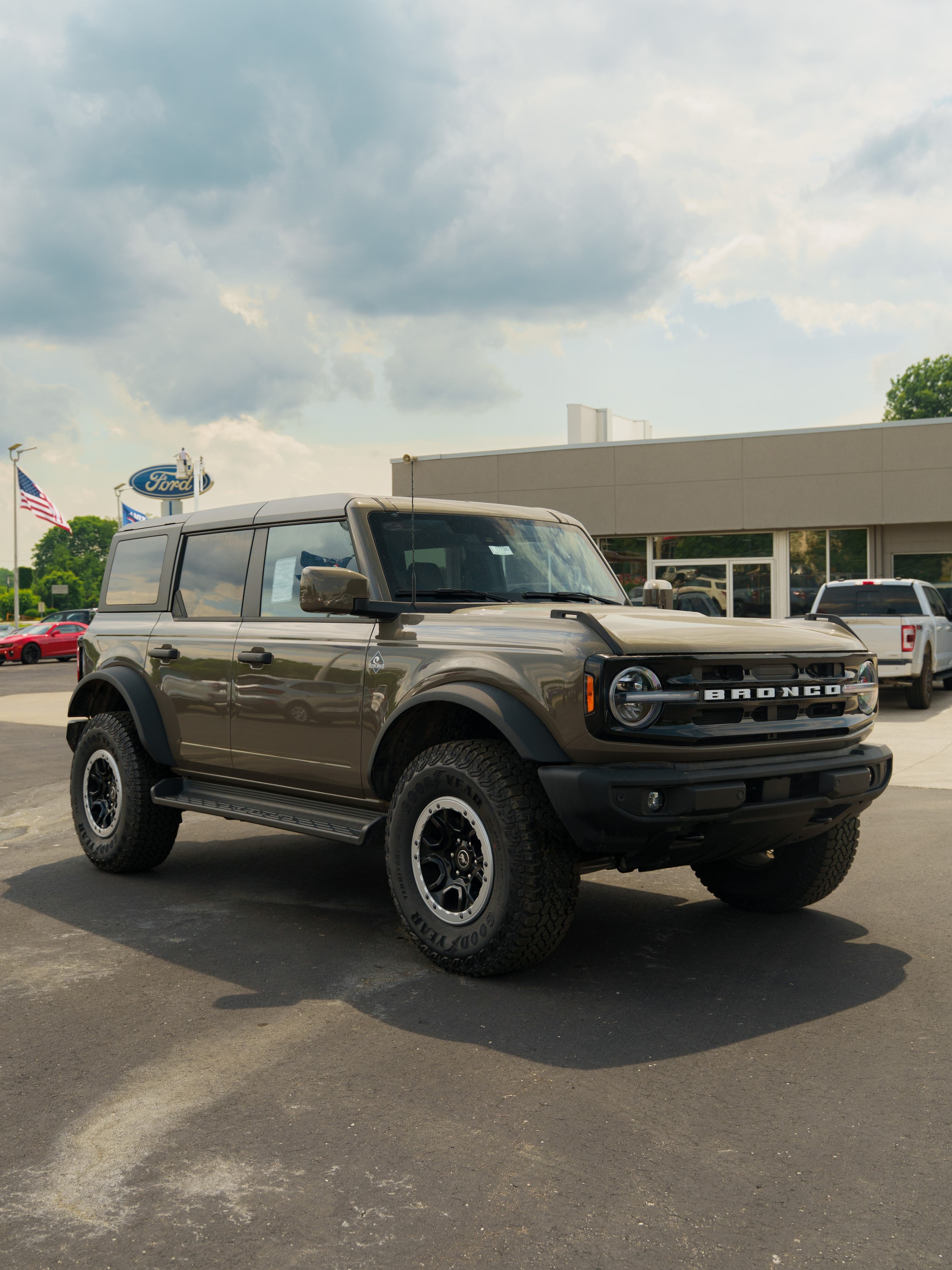
Visit Chuck Anderson Ford in Excelsior Springs, Missouri, serving Bronco and Bronco Sport shoppers from Liberty, Kearney, Lawson, Smithville and throughout the Kansas City Northland.
Chuck Anderson Ford
- 1910 W Jesse James Road
- Excelsior Springs, MO 64024
- Sales: 816-648-6419
- Service: 816-648-6424
- Parts: 816-648-6429
Specifications and comparisons on this page primarily reflect manufacturer-published 2026 Ford Bronco and 2026 Ford Bronco Sport information to provide an equivalent model-year comparison. Ford has also begun publishing newer Bronco Sport model-year information, so inventory and individual vehicle specifications may differ. Engines, horsepower, torque, fuel economy, towing capacity, body styles, transmission availability, cargo volume, four-wheel-drive systems, ground clearance, Sasquatch equipment, trims and other features vary by vehicle configuration and are subject to change. Maximum horsepower and torque figures may require premium fuel. Maximum towing applies only to properly equipped vehicles. Off-road driving involves inherent risks. Always verify current specifications, ratings and equipment for the exact vehicle before purchase, towing or off-road use.