
Ford Bronco vs Jeep Wrangler: which is better?
``` Off-Road SUV Comparison
Ford Bronco vs. Jeep Wrangler: Which Is Better?
Ford Bronco and Jeep Wrangler are two of the few modern SUVs built around legitimate four-wheel-drive capability, removable body panels and serious trail use. Wrangler retains traditional solid axles and offers tremendous towing and V8 performance in select configurations, while Bronco combines advanced off-road hardware with an independent front suspension and a strong EcoBoost engine lineup that can make it easier to live with every day.
```
``` Quick Answer: We Give the Ford Bronco the Overall Edge
If we had to recommend one vehicle to someone who needs an off-road SUV and an everyday SUV in the same garage, we would start with the Ford Bronco.
Bronco's independent front suspension gives it a different personality from Wrangler's solid-front-axle design. That helps make Bronco especially compelling for drivers who spend plenty of time on pavement but still want genuine trail capability.
Bronco also offers three EcoBoost engines ranging from up to 300 horsepower in the 2.3L to 418 horsepower in Bronco Raptor, along with standard 4x4 capability, removable doors and roof configurations and an available 7-speed manual transmission.
Wrangler absolutely earns several wins. Properly equipped 4-Door Rubicon configurations can tow up to 5,000 pounds, compared with up to 3,500 pounds for most Broncos and up to 4,500 pounds for Bronco Raptor.
Wrangler also retains a fold-down windshield, solid front and rear axles and an available 470-horsepower 6.4L HEMI V8 on select limited-production 392 models.
Bronco is our overall choice for the broader range of buyers. Wrangler remains an outstanding choice for someone who specifically values its solid-axle layout, higher available towing capacity or V8 power.
Daily Driving
Bronco
Independent front suspension gives Ford a strong everyday-use argument.
Maximum Towing
Wrangler
Up to 5,000 lbs on properly equipped 4-Door Rubicon models.
Maximum Ground Clearance
Bronco
Bronco Raptor reaches up to approximately 13.1 inches.
Peak Horsepower
Wrangler
Select 392 models reach 470 hp from a 6.4L HEMI V8.
```
``` 2026 Ford Bronco vs. 2026 Jeep Wrangler
Comparing the headline specifications makes the differences between these two off-road SUVs easier to understand.
| Category | 2026 Ford Bronco | 2026 Jeep Wrangler | Advantage |
|---|---|---|---|
| Vehicle Type | Body-on-frame off-road SUV | Body-on-frame off-road SUV | Tie |
| Available Body Styles | 2-Door and 4-Door | 2-Door and 4-Door | Tie |
| 4x4 | Standard | Standard | Tie |
| Standard Bronco Engine | 2.3L EcoBoost I-4 | 3.6L Pentastar V6 on applicable models | Different strategies |
| 2.3L Bronco Output | Up to 300 hp / 325 lb-ft | — | — |
| Wrangler 3.6L Output | — | 285 hp / 260 lb-ft | — |
| Wrangler 2.0L Turbo | — | 270 hp / 295 lb-ft | — |
| Available Bronco V6 | 2.7L EcoBoost: up to 330 hp / 415 lb-ft | — | Bronco for mainstream V6 torque |
| Highest Bronco Output | Raptor: 418 hp / 440 lb-ft | — | — |
| Highest Wrangler Output | — | 392: 470 hp / 470 lb-ft | Wrangler |
| Manual Transmission | 7-speed manual with 2.3L | 6-speed manual with 3.6L | Preference |
| Automatic Transmission | 10-speed | 8-speed | Preference |
| Front Suspension | Independent | Solid axle | Depends on use |
| Rear Suspension | Solid rear axle | Solid rear axle | Tie |
| Front/Rear Lockers Available | Yes | Yes | Tie |
| Disconnecting Stabilizer Bar | Available on applicable Badlands/Raptor configurations | Available on Rubicon | Tie |
| Maximum Ground Clearance | Up to 13.1 in. on Bronco Raptor | Up to approximately 12.9 in. on select 35-in. configurations | Bronco |
| Maximum Water Fording | Up to 37.0 in. on Bronco Raptor | Up to approximately 33.6 in. on select configurations | Bronco |
| Largest Factory Tires | 37 in. on Bronco Raptor | 35 in. on applicable configurations | Bronco |
| Removable Doors | Yes | Yes | Tie |
| Mirrors With Doors Removed | Mirrors remain mounted to the cowl | Configuration differs because mirrors are associated with doors | Bronco |
| Removable Roof | Yes | Yes | Tie |
| Fold-Down Windshield | No | Yes | Wrangler |
| 4-Door Conventional Max Towing | Up to 3,500 lbs | Up to 5,000 lbs on properly equipped Rubicon | Wrangler |
| Bronco Raptor Max Towing | Up to 4,500 lbs | — | — |
| 4-Door Length | About 189.4 in. on standard configurations | About 188.4 in. on standard configurations | Nearly identical |
| Best For | Balanced daily driving and serious off-road use | Traditional solid-axle trail character and higher max towing | Depends on buyer |
``` 
``` The Biggest Mechanical Difference
Bronco Uses Independent Front Suspension; Wrangler Uses a Solid Front Axle
This may be the single most important engineering difference between Bronco and Wrangler.
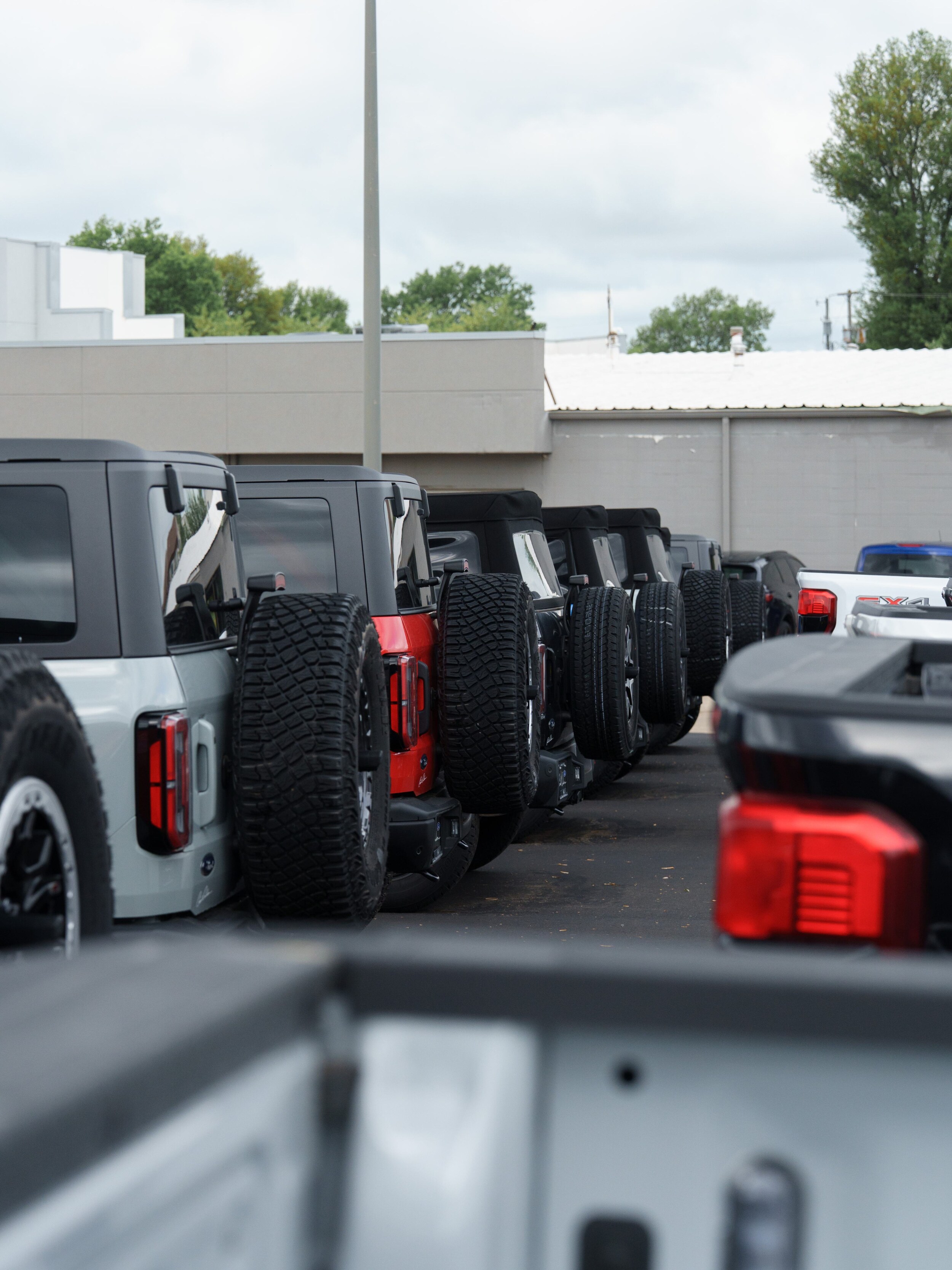
Ford designed Bronco with a long-travel independent front suspension and a solid rear axle.
Wrangler uses solid front and rear axles.
Neither layout is automatically better for every driver.
Bronco's independent front suspension allows the left and right front wheels to react more independently to bumps and pavement irregularities. That contributes to Bronco's strong argument as a vehicle that has to commute, travel and run errands between trail trips.
Wrangler's solid front axle remains attractive to dedicated off-road enthusiasts because of its traditional articulation, durability and straightforward extreme-trail formula.
```
``` Which Suspension Would We Rather Live With?
For most buyers, Bronco.
A modern off-road SUV normally spends substantially more time on pavement than crawling over rocks.
Bronco's independent front suspension helps Ford balance serious trail capability with the kind of highway and daily-driving behavior many owners actually use every week.
When Wrangler's Solid Axle Makes More Sense
- Extreme low-speed rock crawling is a major priority.
- You value maximum traditional axle articulation.
- You specifically want Wrangler's proven solid-axle layout.
- Your build plans revolve around heavy aftermarket modification.
This isn't a case of new technology automatically beating old technology. The two suspensions solve the problem differently.
```
``` Ford Bronco vs. Jeep Wrangler Engines
Bronco emphasizes turbocharged EcoBoost power. Wrangler gives buyers naturally aspirated V6 power, turbo-four power and limited-production HEMI V8 muscle.
Bronco 2.3L EcoBoost
The 2.3L EcoBoost four-cylinder produces up to 300 horsepower and 325 lb-ft of torque on premium fuel.
It is also the Bronco engine available with Ford's 7-speed manual transmission.
For most Bronco buyers, this engine provides much more performance than the phrase "four-cylinder" might suggest.
Bronco 2.7L EcoBoost V6
The available 2.7L EcoBoost V6 produces up to 330 horsepower and 415 lb-ft of torque on premium fuel.
That large torque increase is especially noticeable during acceleration and when moving the heavier off-road configurations.
The 2.7L pairs with the 10-speed automatic.
Bronco Raptor 3.0L EcoBoost
Bronco Raptor uses an exclusive 3.0L EcoBoost V6 producing up to 418 horsepower and 440 lb-ft of torque.
It is paired with Raptor-specific suspension, 37-inch tires and a significantly widened chassis.
Bronco Raptor is much more than a higher-horsepower trim.
Wrangler 2.0L Turbo
Jeep's 2.0L turbocharged four-cylinder produces 270 horsepower and 295 lb-ft of torque.
It is paired with an automatic transmission and is available across much of the Wrangler lineup.
Wrangler 3.6L Pentastar V6
Jeep's familiar 3.6L Pentastar V6 produces 285 horsepower and 260 lb-ft of torque.
It can be paired with the manual transmission on applicable Wrangler Sport, Sport S, Willys, Rubicon and Rubicon X configurations.
Wrangler 392
Select limited-production Wrangler 392 configurations use a 6.4L HEMI V8 producing 470 horsepower and 470 lb-ft of torque.
Bronco Raptor does not match the HEMI's raw horsepower.
If a V8 is a central part of the experience you want, Wrangler has a factory powertrain Bronco does not offer.
```
``` Which Has the Better Engine Lineup?
For mainstream configurations, we prefer the Bronco EcoBoost lineup.
The 2.3L produces up to 300 horsepower and 325 lb-ft, while the 2.7L V6 provides a very useful 415 lb-ft of torque without requiring a specialized flagship model.
Wrangler's advantage appears at the extreme upper end with the limited-production 392 and its 470-horsepower HEMI V8.
If you're comparing normal Broncos and normal Wranglers, Bronco has the stronger output argument. If the question is purely maximum factory horsepower, Wrangler 392 wins.
```
``` Can You Get Bronco and Wrangler With a Manual?
Yes. Both remain unusual in an SUV market increasingly dominated by automatics.
Bronco offers a 7-speed manual with the 2.3L EcoBoost on applicable configurations.
The transmission uses six conventional forward gears plus a dedicated crawler gear.
Wrangler Manual
Wrangler offers a 6-speed manual with its 3.6L Pentastar V6 on applicable trims.
For enthusiasts who refuse to give up a clutch pedal, either SUV can work.
The deciding factor becomes engine preference: turbocharged 2.3L Bronco or naturally aspirated 3.6L Wrangler.
``` 
``` 
Off-Road Capability
Can Bronco Really Compete With Wrangler Off Road?
Absolutely.
Wrangler's reputation was built over decades, but Bronco was not engineered as an ordinary crossover wearing aggressive tires.
Ford uses a fully boxed high-strength-steel frame, independent front suspension, solid rear axle, multiple HOSS suspension systems and available electronic-locking differentials.
Sasquatch-equipped Broncos add 35-inch tires, front and rear electronic-locking axles and increased ground clearance.
Badlands adds technical trail hardware, while Bronco Raptor pushes the platform into a completely different high-speed off-road category.
```
``` Bronco Sasquatch
Sasquatch is important because it allows buyers to add serious capability without always climbing to one specific trim.
- 35-inch tires
- Electronic-locking front axle
- Electronic-locking rear axle
- 4.70 final drive ratio
- Upgraded HOSS suspension
- Increased ride height
This gives Bronco shoppers tremendous flexibility when combining trim features with off-road equipment.
Wrangler Rubicon
Rubicon remains one of the benchmarks for factory rock-crawling capability.
- Rock-Trac 4x4 system
- 4:1 low-range gearing
- Available front and rear Tru-Lok lockers
- Electronic sway-bar disconnect
- Rock rails
- Available 35-inch tires
Wrangler's solid front axle also remains a major part of its rock-crawling identity.
```
``` Which Is Better for Rock Crawling?
This is the category where we would give Wrangler Rubicon a legitimate advantage for the traditionalist.
Its solid front axle, available front and rear lockers, Rock-Trac low-range system and electronic sway-bar disconnect are an extremely proven combination.
Bronco Badlands Is Not Far Behind
Badlands brings electronic-locking capability, available stabilizer-bar disconnect and specialized HOSS suspension.
A Sasquatch-equipped Badlands adds 35-inch tires and even more clearance.
For most recreational trail drivers, either vehicle can provide substantially more capability than they will ever use.
```
``` Bronco Raptor Takes the Ford Formula Much Farther
Bronco Raptor is the configuration that makes the Bronco-Wrangler comparison especially interesting.
Its 3.0L EcoBoost V6 produces up to 418 horsepower and 440 lb-ft of torque.
Ford combines that with 37-inch tires, HOSS 4.0 suspension with FOX internal-bypass semi-active dampers and significant increases in suspension travel.
Ford publishes up to 13.1 inches of ground clearance and 37 inches of maximum water-fording capability for Bronco Raptor.
Wrangler 392 wins raw horsepower. Bronco Raptor's argument is the complete high-speed off-road chassis surrounding its engine.
```
``` 13.1 IN.Bronco Raptor Ground Clearance
37 IN.Bronco Raptor Water Fording
37-IN.Bronco Raptor Tires
47.2°Bronco Raptor Approach Angle
These are maximum Bronco Raptor figures, not standard Bronco figures. Ground clearance, approach angle, water-fording capability and tire size vary substantially by trim and package. Always know water depth before attempting a crossing and follow the applicable Owner's Manual.
```
``` Both Have Removable Doors — Bronco Has a Clever Advantage
Both Bronco and Wrangler allow owners to remove the doors for open-air driving.
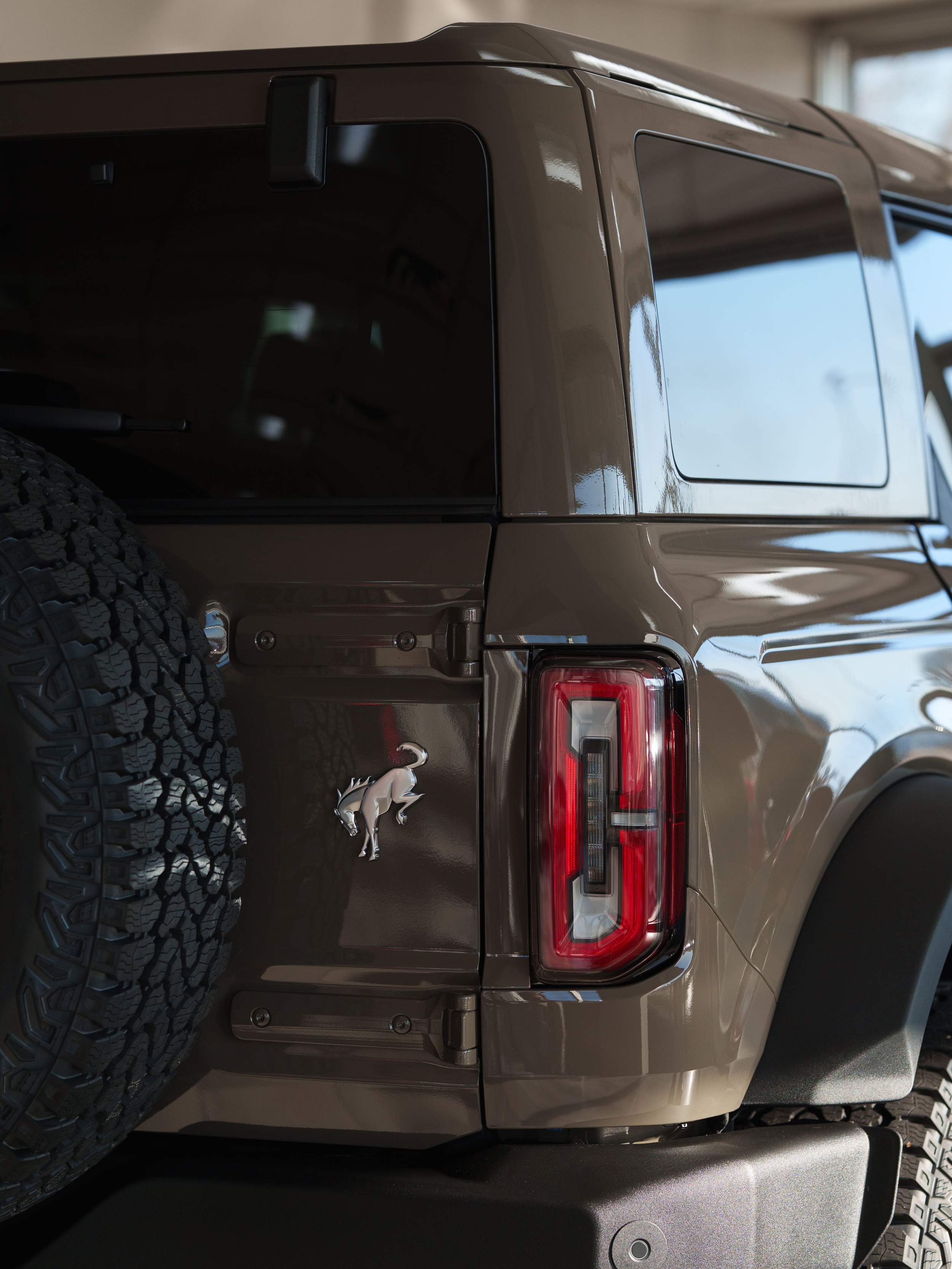
Ford made one major design decision that becomes obvious the first time the doors come off: Bronco's side mirrors are mounted to the cowl rather than to the doors.
Remove the Bronco doors and the factory mirrors stay with the vehicle.
Why That Matters
You retain normal side-mirror positioning without relying on the doors to hold the mirrors.
Ford also designed Bronco with frameless removable doors, and available storage bags can allow the doors of applicable 4-Door Broncos to be stored onboard.
Bronco Removable Doors Guide ``` 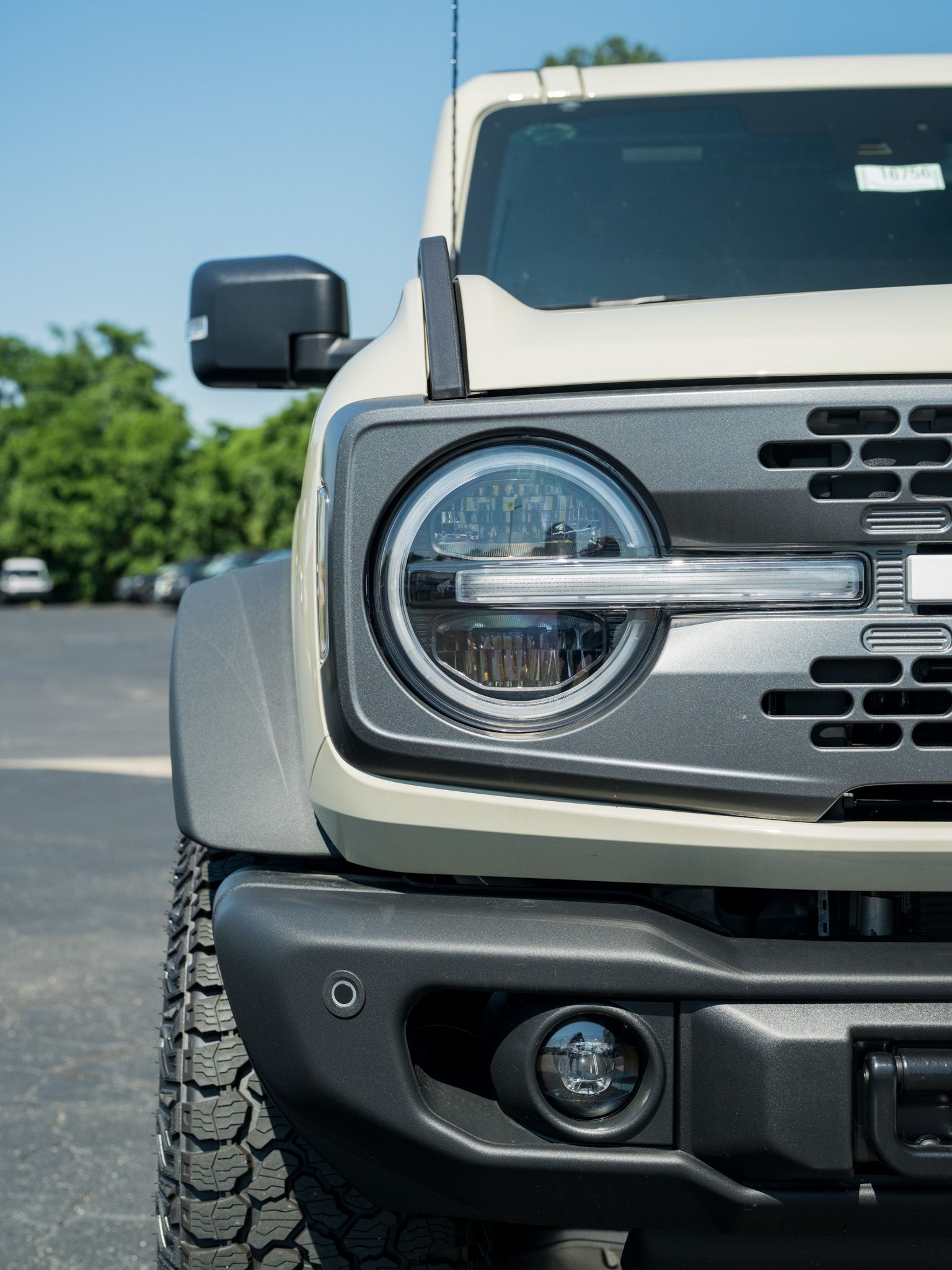
``` Open-Air Driving
Both Let You Remove the Roof
Bronco and Wrangler both deliver an open-air experience that most conventional SUVs cannot duplicate.
Bronco offers removable top configurations, including hard-top and soft-top choices depending on body style and equipment.
2-Door Bronco models use a removable hard top as the standard configuration, while 4-Door models commonly use a foldable soft top with hard-top choices available.
Wrangler also offers removable hard-top and soft-top configurations.
There is no reason to choose one vehicle solely because you want the roof off. Both deliver genuine open-air capability.
Bronco Removable Roof Guide
```
``` Wrangler Has One Open-Air Trick Bronco Does Not: The Windshield Folds Down
Jeep Wrangler's windshield can be folded forward for an even more exposed open-air experience when used according to Jeep's instructions.
Bronco's windshield does not fold down.
For most owners this will not determine the purchase, but it is a genuine Wrangler distinction and part of Jeep's traditional design philosophy.
If doors-off, roof-off and windshield-down driving is the specific experience you want, Wrangler goes one step farther.
```
``` Wrangler Wins Maximum Towing
Properly equipped 2026 Wrangler 4-Door Rubicon configurations can tow up to 5,000 pounds.
Conventional Bronco configurations with the 2.3L or 2.7L EcoBoost are rated up to 3,500 pounds.
Bronco Raptor increases Ford's maximum to 4,500 pounds.
Maximum Published Ratings
Wrangler 4-Door Rubicon:
Up to 5,000 lbs
Bronco Raptor:
Up to 4,500 lbs
Conventional Bronco:
Up to 3,500 lbs
Wrangler 2-Door:
Up to 2,000 lbs
Always verify the exact vehicle and required equipment.
```
``` Does Wrangler's Towing Advantage Make It the Better SUV?
Only if you actually need the additional towing capability.
A buyer pulling a 4,500-pound trailer should absolutely pay attention to Wrangler's applicable 5,000-pound rating.
A buyer who never plans to pull more than a small utility trailer or personal watercraft may get no practical benefit from that extra maximum.
Bronco Raptor's 4,500-pound rating also narrows the gap at the top of Ford's lineup.
If towing is one of the primary jobs, Wrangler deserves the win. If towing is occasional and within Bronco's limits, we would make the purchase based on the rest of the vehicle.
Ford Bronco Towing Guide ``` 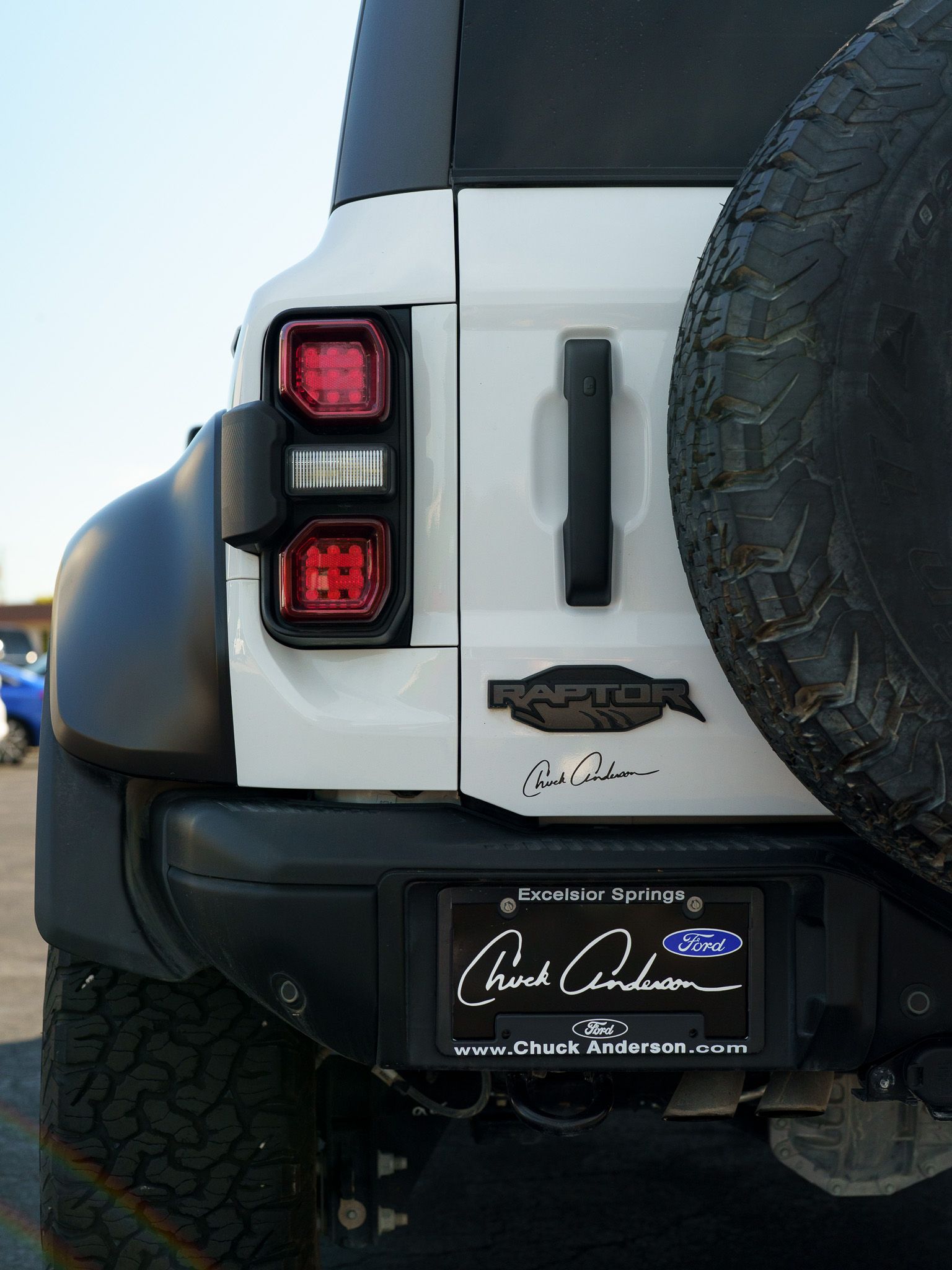
``` 
Everyday Ownership
Bronco Makes a Stronger Case When the Trail Ends
Very few Bronco or Wrangler owners spend seven days a week on a trail.
These vehicles commute to work, sit in traffic, make highway trips, take kids to school and navigate parking lots.
That is where Bronco's independent front suspension becomes one of its most important advantages.
Bronco was engineered to retain serious off-road capability while delivering a front-suspension layout more familiar to drivers of modern trucks and SUVs.
For a one-vehicle household, this is a major reason we lean Bronco.
```
``` Four-Door Bronco and Wrangler Are Surprisingly Close in Length
A standard 4-Door Bronco is approximately 189.4 inches long.
Jeep lists a standard 4-Door Wrangler at approximately 188.4 inches.
That is only about one inch of difference.
The 2-Door Difference Is Larger
A standard 2-Door Bronco is approximately 173.7 inches.
Jeep lists the 2-Door Wrangler at approximately 166.8 inches.
That makes the two-door Wrangler notably shorter for buyers prioritizing compact trail dimensions.
```
``` Four-Door Bronco Provides Serious Cargo Utility
Ford publishes up to approximately 77.6 cubic feet of cargo capacity behind the first row with the 4-Door hard top.
A soft-top 4-Door Bronco can provide up to approximately 83 cubic feet.
Behind the second row, Ford lists approximately 35.6 cubic feet with the hard top and 38.3 cubic feet with the soft top.
This gives 4-Door Bronco enough utility to function as a legitimate travel, camping and family vehicle rather than simply a dedicated recreational toy.
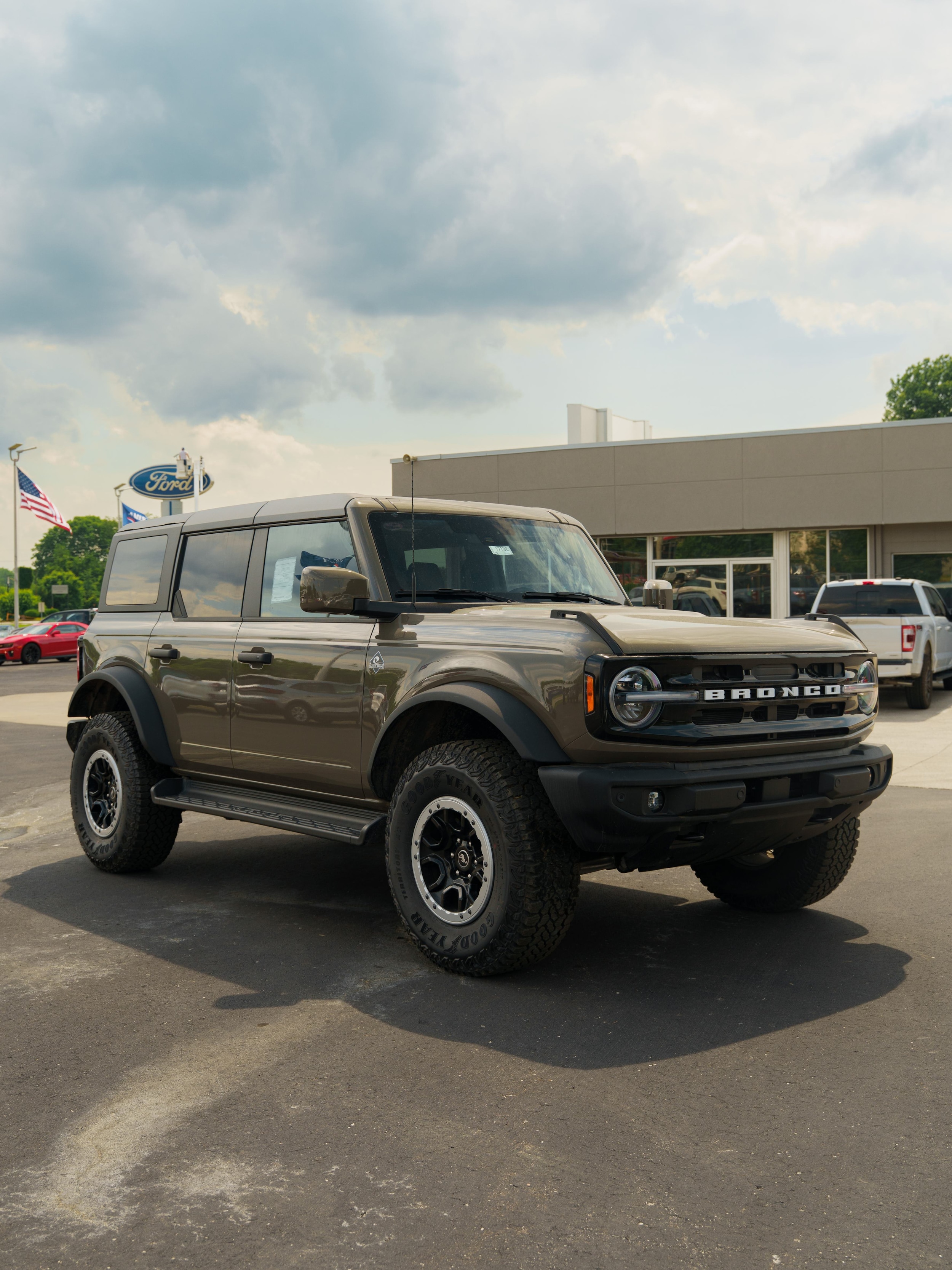
``` 
``` Winter Driving
Bronco vs. Wrangler in Snow
Both vehicles start from an excellent place because both offer serious 4x4 systems.
Bronco can be equipped with Ford's Advanced 4x4 system with Automatic On-Demand Engagement, while Wrangler offers multiple systems including available full-time 4x4 arrangements.
Either can provide excellent winter traction when configured and driven appropriately.
Tire selection remains extremely important. Large aggressive off-road tires do not automatically provide the best performance on every icy surface.
For Missouri winter use mixed with normal commuting, we again like Bronco's combination of available automatic 4x4 engagement and independent front suspension.
Is the Bronco Good in Snow?
```
``` Both Are Much More Modern Inside Than Their Shapes Suggest
Bronco and Wrangler may look deliberately old-school outside, but neither forces buyers to live with an old-school cabin.
Both offer modern infotainment, smartphone integration, driver-assistance technology, camera systems and available premium features.
Technology Matters Most Off Road
Bronco offers available trail-focused features such as Trail Control, Trail Turn Assist, Trail One-Pedal Drive and multiple G.O.A.T. Modes depending on configuration.
Wrangler offers its own off-road displays, trail guides and vehicle-control technology.
Both have evolved far beyond the basic utilitarian SUVs their styling references.
```
``` Bronco Gives Buyers a Huge Capability Ladder
You do not have to buy the most expensive Bronco to get legitimate four-wheel-drive capability.
Base & Big Bend
Strong starting points for buyers who want the essential Bronco formula and the ability to customize capability through packages.
Outer Banks
Better suited to drivers who want Bronco appearance and capability while placing more emphasis on comfort and technology.
Badlands
The technical off-road choice for buyers who genuinely plan to tackle difficult terrain and want specialized trail hardware.
Stroppe Edition & Raptor
Higher-performance configurations for buyers who want Baja-style speed, upgraded suspension and more aggressive factory hardware.
```
``` Where Wrangler Still Has the Better Argument
A fair Bronco comparison has to acknowledge that Wrangler still does several things exceptionally well.
Its solid-front-axle layout remains attractive for serious low-speed trail work and heavy modification.
Properly equipped 4-Door Rubicon models can tow up to 5,000 pounds, which is more than any current Bronco.
Wrangler also offers an available 470-horsepower HEMI V8 on select limited 392 configurations and retains the ability to fold the windshield down.
And no discussion of these vehicles should ignore Wrangler's decades of heritage and enormous aftermarket ecosystem.
If those specific Wrangler traits are the reasons you're shopping this category, Bronco doesn't need to "beat" them for Wrangler to be the correct choice.
```
``` Where Bronco Has the Better Argument
Bronco's greatest strength is how broad its usable capability envelope is.
You can configure one for relatively normal everyday driving, add Sasquatch for serious trail hardware, move into Badlands for more technical off-roading or jump all the way to Raptor.
Bronco Advantages
- Independent front suspension
- Up to 330 hp and 415 lb-ft in the mainstream 2.7L V6
- Up to 418 hp in Bronco Raptor
- Up to 37-inch factory tires
- Up to 13.1 inches of ground clearance
- Up to 37 inches of water-fording capability
- Body-mounted mirrors that remain when doors are removed
- Available Sasquatch across multiple configurations
- 7-speed manual with dedicated crawler gear
```
``` Bronco or Wrangler? Choose Based on What You Actually Do
These are specialized enough that the right answer depends heavily on the owner.
"This will be my only vehicle."
Bronco. Its suspension design gives Ford a compelling everyday-driving argument without giving up serious off-road capability.
"I want a dedicated rock crawler."
Wrangler Rubicon deserves a very hard look. Its solid front axle and Rock-Trac hardware remain a formidable traditional combination.
"I want the strongest mainstream V6 torque."
Bronco 2.7L. Up to 415 lb-ft gives it a large torque advantage over Wrangler's regular gas engines.
"I want a factory V8."
Wrangler. Select 392 models offer a 470-hp 6.4L HEMI.
"I need to tow close to 5,000 pounds."
Wrangler. Properly equipped 4-Door Rubicon configurations can reach 5,000 pounds.
"I want 35-inch tires without buying the flagship."
Bronco. The Sasquatch Package makes serious factory hardware available across multiple configurations.
"I want the doors off but need my mirrors."
Bronco. Its cowl-mounted mirrors stay on the vehicle when the doors are removed.
"I want the windshield down too."
Wrangler. Its fold-down windshield remains a distinctive Jeep feature.
"I want extreme desert-style performance."
Bronco Raptor. Its HOSS 4.0 suspension, 37-inch tires and wide-track chassis are designed around high-performance off-road driving.
"I want a manual transmission."
Either. Bronco pairs its 7-speed manual with the 2.3L EcoBoost, while Wrangler pairs a 6-speed manual with the 3.6L Pentastar V6 on applicable trims.
```
``` Family Use
Which Is Better for a Family?
If these vehicles are going to function as family transportation, we would lean toward the 4-Door Bronco.
Ford publishes approximately 36.3 inches of rear legroom and up to 77.6 cubic feet of maximum cargo space with a 4-Door hard top, or up to 83 cubic feet with the soft top.
More important than a single dimension is the overall suspension and everyday-driving approach.
Wrangler remains perfectly capable of family duty, but buyers should drive both over the same roads before assuming the differences are purely cosmetic.
Bring the child seats, stroller or teenagers on the test drive. These vehicles should be evaluated the way the household will actually use them.
```
``` Both Are Built to Be Customized
Bronco and Wrangler are two of the strongest vehicles in the market for owners who want to make the SUV their own.
Tires, bumpers, lighting, roof accessories, recovery equipment, storage, protection and suspension modifications are common on both platforms.
Factory Capability May Save You Money
Before modifying either SUV, look closely at what the factory can provide.
A Bronco ordered with Sasquatch, Badlands or Raptor hardware may already include many of the upgrades an owner would otherwise add later.
The same logic applies to Wrangler Rubicon and other factory off-road configurations.
Buying the right factory configuration can be cheaper and cleaner than buying the wrong one and rebuilding it.
```
``` Which SUV Wins Each Category?
There is no honest way to give every category to one vehicle.
Daily Driving
Bronco. Its independent front suspension gives it our preferred all-around chassis strategy.
Traditional Rock Crawling
Wrangler. Rubicon's solid axles and specialized low-range hardware remain extremely compelling.
Maximum Towing
Wrangler. Up to 5,000 pounds versus 4,500 pounds for Bronco Raptor and 3,500 for conventional Bronco.
Mainstream Engine Torque
Bronco. The available 2.7L EcoBoost delivers up to 415 lb-ft.
Peak Factory Horsepower
Wrangler. Select 392 configurations reach 470 horsepower.
Maximum Factory Tire Size
Bronco. Bronco Raptor comes with massive 37-inch tires.
Maximum Ground Clearance
Bronco. Bronco Raptor reaches approximately 13.1 inches.
Maximum Water Fording
Bronco. Ford publishes up to 37 inches for Bronco Raptor.
Doors-Off Mirror Design
Bronco. The mirrors remain mounted to the vehicle when the doors are removed.
Fold-Down Windshield
Wrangler. Bronco's windshield does not fold.
Manual Transmission
Tie. Both still offer a clutch pedal on applicable configurations.
Overall Pick
Bronco. We prefer its combination of everyday usability, powertrain choices and enormous factory capability range.
```
``` Our Verdict: Buy Bronco Unless a Specific Wrangler Advantage Matters More to You
Ford Bronco is our overall winner.
Not because Wrangler suddenly stopped being capable. It did not.
Wrangler still has outstanding rock-crawling credentials, available solid-axle hardware, more maximum towing capability in select 4-Door Rubicon configurations, a fold-down windshield and even an available HEMI V8 in select 392 models.
But Bronco's independent front suspension makes a strong case for the way many buyers really use these SUVs: commuting and traveling during the week, then heading off pavement when the opportunity arises.
Bronco also provides tremendous configuration flexibility. The 2.3L EcoBoost is available with a manual, the 2.7L provides 415 lb-ft of torque, Sasquatch brings 35-inch-tire capability across multiple models, Badlands targets technical trails and Raptor moves all the way to 37-inch tires and 13.1 inches of ground clearance.
Even the removable-door design shows Ford thought carefully about everyday usability: the mirrors remain on the Bronco when the doors come off.
If Wrangler's solid front axle, 5,000-pound towing maximum, fold-down windshield or available V8 is the feature you specifically want, buy the Wrangler.
If you simply want the off-road SUV we think offers the best overall balance of capability, performance and everyday ownership, start with the Ford Bronco.
```
``` Ford Bronco vs. Jeep Wrangler FAQs
Quick answers to common questions about America's two iconic open-air off-road SUVs.
Which is better, Ford Bronco or Jeep Wrangler?
We give Ford Bronco the overall advantage for buyers who want a serious off-road SUV that also works well as everyday transportation. Wrangler has important advantages for buyers who prioritize its solid-front-axle layout, higher available towing capacity, fold-down windshield or available V8.
Is Ford Bronco as capable as Jeep Wrangler off road?
Yes. Bronco offers legitimate factory off-road hardware including available front and rear electronic-locking axles, Sasquatch equipment, specialized HOSS suspension systems, available stabilizer-bar disconnect and the extreme Bronco Raptor.
Which is better for rock crawling, Bronco or Wrangler?
Wrangler Rubicon retains a particularly strong traditional rock-crawling setup with solid front and rear axles, Rock-Trac low-range gearing, available locking differentials and electronic sway-bar disconnect. Bronco Badlands is also highly capable and offers its own specialized trail hardware.
Does Bronco have a solid front axle?
No. Ford Bronco uses an independent front suspension and a solid rear axle. Jeep Wrangler uses solid front and rear axles.
Why does Bronco use independent front suspension?
Independent front suspension allows each front wheel to react more independently and helps Bronco balance off-road travel with everyday pavement and highway driving.
Which has more horsepower, Bronco or Wrangler?
At the extreme upper end, select Wrangler 392 configurations produce 470 horsepower from a 6.4L HEMI V8, while Bronco Raptor produces up to 418 horsepower from a 3.0L EcoBoost V6. Mainstream Bronco engines produce up to 300 or 330 horsepower depending on engine.
Which has more torque, Bronco or Wrangler?
Bronco Raptor produces up to 440 lb-ft, while select Wrangler 392 models produce 470 lb-ft. Bronco's available mainstream 2.7L EcoBoost produces up to 415 lb-ft, substantially more than the regular Wrangler 2.0L turbo or 3.6L V6.
Can you get Ford Bronco with a manual transmission?
Yes. Applicable 2026 Ford Bronco configurations with the 2.3L EcoBoost can be equipped with a 7-speed manual transmission that includes a dedicated crawler gear.
Can you get Jeep Wrangler with a manual transmission?
Yes. Applicable 2026 Wrangler configurations with the 3.6L Pentastar V6 can be equipped with a 6-speed manual transmission.
Which tows more, Bronco or Wrangler?
Wrangler has the higher maximum. Properly equipped 2026 Wrangler 4-Door Rubicon models can tow up to 5,000 pounds. Conventional Bronco configurations can tow up to 3,500 pounds, while Bronco Raptor can tow up to 4,500 pounds.
Can you take the doors off both Bronco and Wrangler?
Yes. Both vehicles offer removable doors. Bronco has body-mounted side mirrors that remain in place when the doors are removed.
Can you take the roof off Bronco and Wrangler?
Yes. Both Ford Bronco and Jeep Wrangler offer removable roof configurations, with exact top designs varying by body style and equipment.
Does the Ford Bronco windshield fold down?
No. Bronco's windshield remains fixed. Jeep Wrangler retains a fold-down windshield design.
Which has more ground clearance, Bronco or Wrangler?
Maximum clearance depends on configuration. Ford publishes up to approximately 13.1 inches for Bronco Raptor, while select 35-inch-tire Wrangler configurations can approach approximately 12.9 inches.
How deep can Ford Bronco drive through water?
Ford publishes up to 37 inches of maximum water-fording capability for Bronco Raptor. Other Bronco configurations have lower ratings. Drivers should always know water depth and follow the Owner's Manual before attempting a crossing.
Which has bigger tires, Bronco or Wrangler?
Bronco Raptor uses 37-inch factory tires. Sasquatch-equipped Broncos use 35-inch tires, similar in size to the largest tires available on applicable current Wrangler configurations.
Which is better for daily driving, Bronco or Wrangler?
We prefer Ford Bronco for mixed everyday and recreational use, largely because its independent front suspension creates a strong compromise between pavement behavior and off-road capability.
Which is better for a family, Bronco or Wrangler?
Both are available with four doors and five-passenger seating. We lean toward four-door Bronco for a household using the vehicle every day, but families should test rear-seat access, child seats, cargo and road behavior in both before deciding.
Does Jeep still make Wrangler 4xe?
Jeep states that Wrangler 4xe is no longer in production, although limited remaining inventory may still exist. The current 2026 Wrangler comparison therefore centers on the gasoline engine lineup.
Should I buy Bronco or Wrangler?
Buy Bronco if you want our preferred balance of everyday driving, turbocharged performance and serious factory off-road capability. Buy Wrangler if its solid-axle design, greater available towing capacity, fold-down windshield or available HEMI V8 are central to your decision.
```
``` Continue Your Ford Bronco Research
Compare Bronco trims, towing, reliability and open-air features before choosing your SUV.
```
``` Choosing Between a Ford Bronco and Jeep Wrangler?
Drive both on pavement before you worry about which one can climb the biggest rock.
Most owners spend far more time commuting, traveling and running errands than they spend on difficult trails. The suspension, engine and everyday usability differences therefore matter just as much as lockers and crawl ratios.
At Chuck Anderson Ford, we can help you compare Bronco Base, Big Bend, Outer Banks, Badlands, Heritage Edition, Stroppe Edition and Bronco Raptor, along with available Sasquatch and other off-road packages.
If you are coming from a Wrangler, tell us what you like about it. If the solid axle, manual transmission, doors-off experience or trail capability is what matters, we can help identify the Bronco configuration that comes closest to your priorities.
Visit Chuck Anderson Ford in Excelsior Springs, Missouri, serving Bronco shoppers from Liberty, Kearney, Lawson, Smithville and throughout the Kansas City Northland.
Chuck Anderson Ford
- 1910 W Jesse James Road
- Excelsior Springs, MO 64024
- Sales: 816-648-6419
- Service: 816-648-6424
- Parts: 816-648-6429
```
``` Ford Bronco and Jeep Wrangler specifications on this page reflect available 2026 model information at the time this comparison was prepared. Engines, horsepower, torque, transmissions, towing capacity, 4x4 systems, tire size, ground clearance, water-fording capability, body styles, removable-top equipment and off-road hardware vary by trim, package and configuration and are subject to change. Bronco horsepower and torque figures cited as maximums may require premium fuel. Wrangler 392 availability may be limited. Jeep states that Wrangler 4xe is no longer in production, though remaining inventory may exist. Maximum towing applies only to properly equipped vehicles. Off-road and water-fording activities involve inherent risks. Always verify current manufacturer specifications and the equipment and ratings of the exact vehicle before purchasing, towing or operating off road.