

F-350 vs F-450: which should I buy?
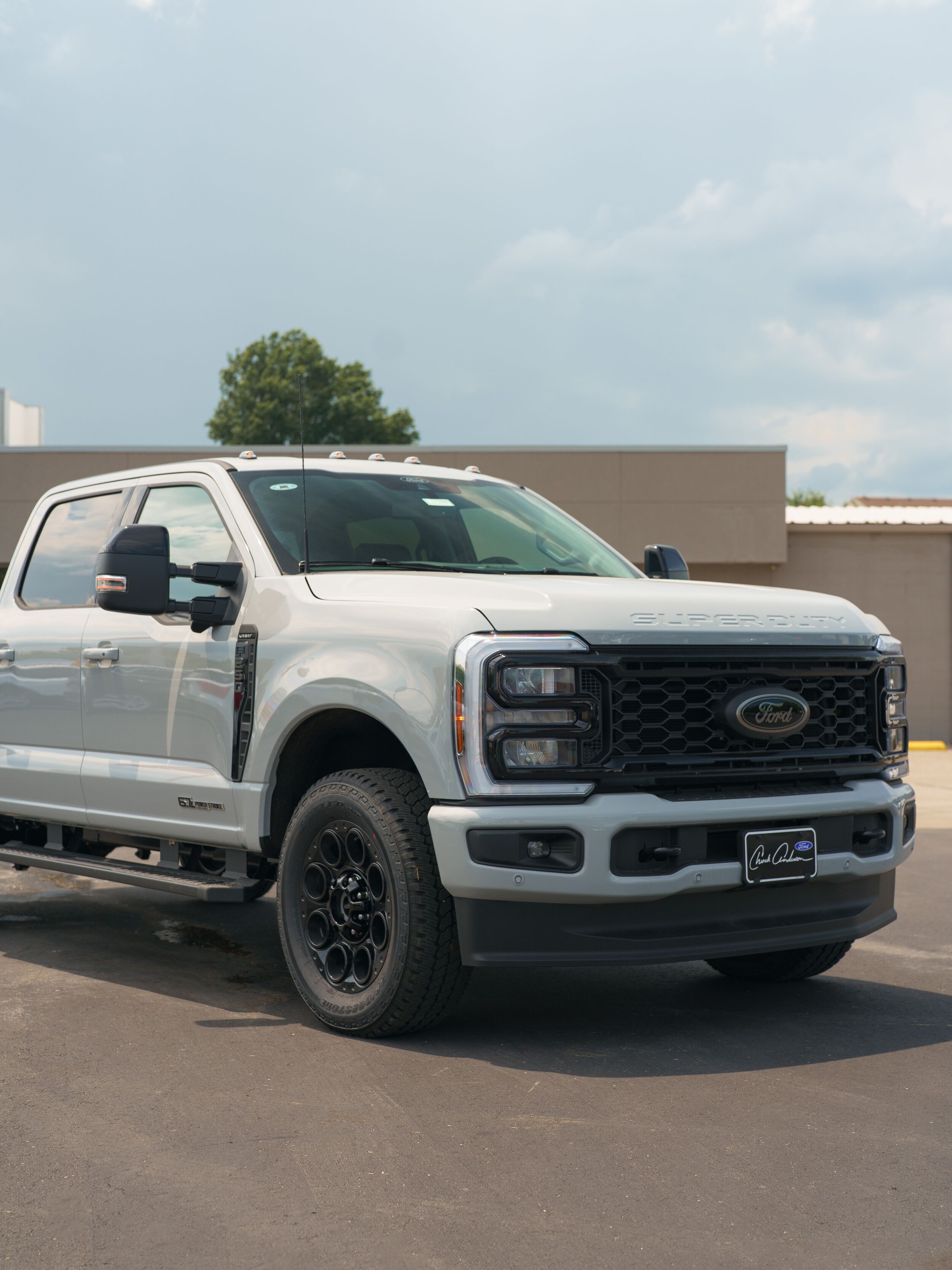
Ford Super Duty Comparison
``` F-350 vs F-450: Which Should I Buy?
The Ford F-350 and F-450 can both handle serious work, but they are not simply two versions of the same truck. The F-350 offers a wider range of configurations and can be an excellent choice for payload and heavy towing, while the F-450 is purpose-built around the demands of extremely heavy fifth-wheel, gooseneck and conventional trailers.
The Short Answer
Choose an F-350 when you need substantial towing and payload capability but do not require the F-450's specialized maximum-towing hardware. The F-350 is available in both single-rear-wheel and dual-rear-wheel configurations and can be the better fit when payload, versatility or everyday use is a major priority.
Choose an F-450 when your truck's primary job is towing an exceptionally heavy trailer. The F-450 pickup uses dual rear wheels, heavy-duty 19.5-inch wheels and tires, and a wide-track front axle designed around demanding towing applications.
One important point: a larger model number does not automatically mean greater payload. Certain F-350 configurations can carry more payload than an F-450. The F-450's major advantage is its ability to handle the highest trailer weights available within the Super Duty pickup lineup.
```Ford F-350 vs F-450 at a Glance

Ford F-350
The Versatile Heavy-Duty Choice
The F-350 covers an enormous range of jobs. Buyers can choose a single-rear-wheel truck for additional capability without going dually or move to an F-350 DRW for significantly greater load-carrying capability and heavy-trailer stability.
- Available as single rear wheel or dual rear wheel
- Gas and diesel availability varies by model year and configuration
- Excellent fifth-wheel and gooseneck capability
- Strong payload-focused configurations
- More configuration flexibility than F-450
- SRW models provide an easier everyday-driving option

Ford F-450
The Maximum-Towing Super Duty
The F-450 pickup is more specialized. It is a dual-rear-wheel truck engineered around extremely demanding towing applications and adds hardware specifically suited to controlling very heavy trailers.
- Dual rear wheels
- Power Stroke diesel power
- 19.5-inch commercial-style wheels and tires
- Wide-track front axle
- Highest available Super Duty pickup towing capability
- Designed around heavy fifth-wheel and gooseneck use
F-350 vs F-450 Comparison
| Category | Ford F-350 | Ford F-450 Pickup |
|---|---|---|
| Rear-Wheel Configuration | SRW or DRW | DRW |
| Primary Strength | Versatility, payload and heavy towing | Maximum heavy-trailer capability |
| Payload | Certain configurations can provide extremely high payload ratings | High capability, but not automatically higher than F-350 |
| Maximum Towing | Extremely capable in properly equipped configurations | Highest towing-capability ceiling in the Super Duty pickup lineup |
| Fifth-Wheel Towing | Excellent for many large fifth-wheel trailers | Designed for the heaviest fifth-wheel applications |
| Gooseneck Towing | Excellent capability depending on configuration | Best suited to maximum-weight gooseneck applications |
| Rear Wheels | Two tires total on SRW or four rear tires on DRW | Four rear tires |
| Wheels & Tires | Conventional Super Duty wheel and tire configurations | Heavy-duty 19.5-inch wheels and tires |
| Front Axle | Conventional Super Duty front-track configuration | Wide-track front axle with extended axle hardware |
| Daily Use | SRW version offers the greatest everyday flexibility | More specialized around heavy towing |
| Who Should Start Here? | Buyers balancing towing, payload and everyday use | Buyers whose primary requirement is an extremely heavy trailer |
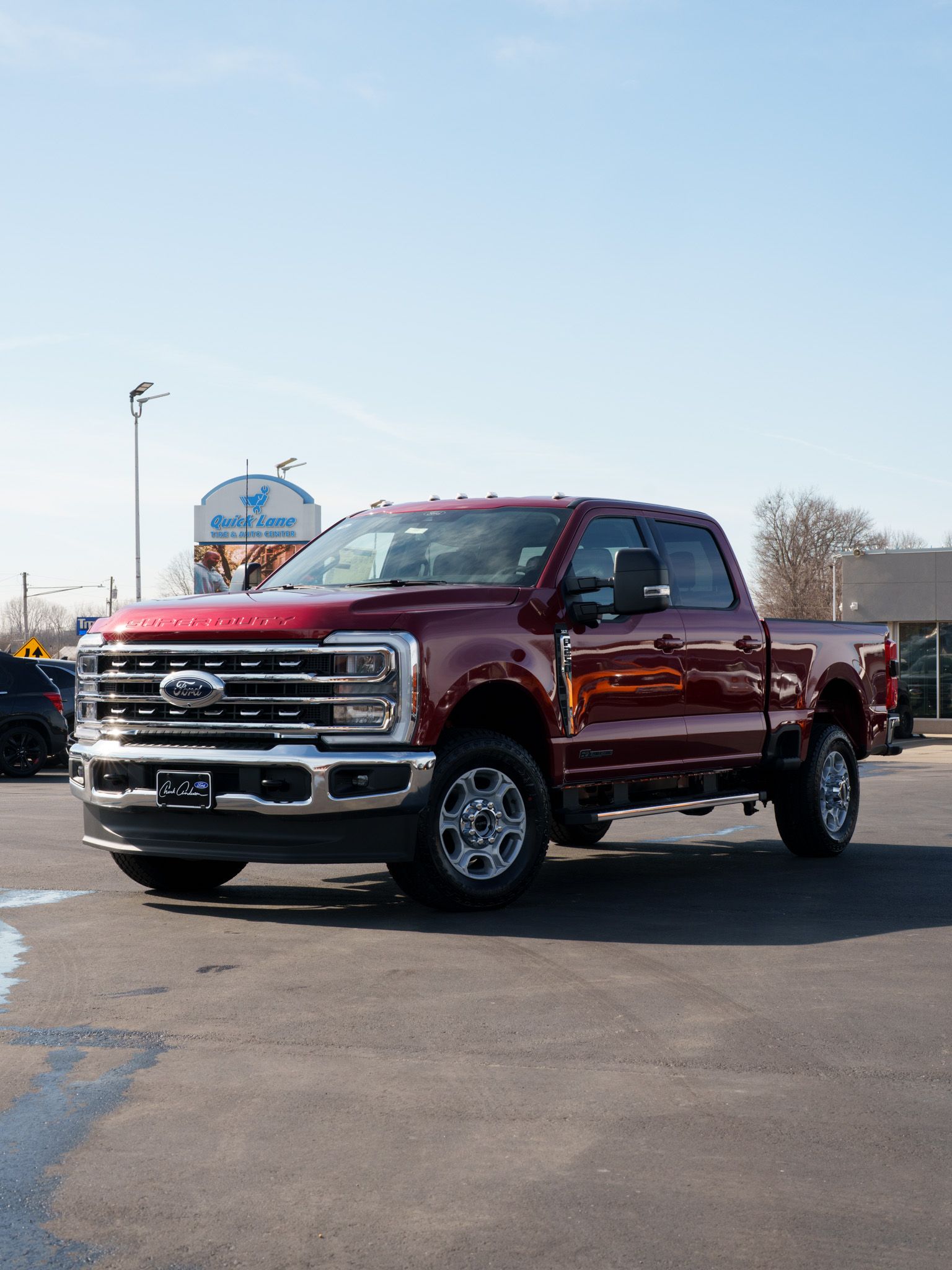
The Biggest Misconception
An F-450 Does Not Automatically Have More Payload
It seems logical that an F-450 should carry more weight in the bed than an F-350 simply because 450 is a larger number than 350. Heavy-duty trucks do not work quite that way.
Payload is calculated from the truck's gross vehicle weight rating and the actual weight of the truck. The heavier hardware used to give an F-450 its extreme towing capability also contributes to the truck's own weight.
As a result, certain F-350 configurations can provide a higher available payload rating than an F-450.
That makes the F-350 DRW especially important for buyers whose biggest concern is carrying weight, including fifth-wheel pin weight or substantial cargo in the bed.
Does an F-450 Tow More Than an F-350?
At the upper end of the Super Duty lineup, yes. Properly equipped F-450 pickups can provide greater maximum towing capability than F-350 pickups, particularly for exceptionally heavy fifth-wheel and gooseneck trailers.
The F-450 is built around that mission. Its heavier-duty wheel and tire package, wide-track front axle, dual rear wheels and towing-focused configuration distinguish it from the F-350.
That does not mean every buyer towing a large trailer needs an F-450. Properly configured F-350 trucks already provide substantial conventional, fifth-wheel and gooseneck capability.
The F-450 becomes most compelling when the trailer starts pushing toward the upper limits of what a Super Duty pickup can tow.
Remember: maximum advertised towing capacity represents specific properly equipped truck configurations. Engine, drivetrain, axle ratio, cab, wheelbase, equipment, payload, passengers and cargo can all affect the rating of an individual truck.
For model-specific towing information, see how much an F-350 can tow and how much an F-450 can tow.
```What If You Don't Want a Dually?
Then the decision is easy: look at an F-350 single-rear-wheel truck.
The F-450 pickup is designed around a dual-rear-wheel configuration. The F-350 gives buyers another option by offering substantial heavy-duty capability while retaining one rear wheel on each side of the axle.
An F-350 SRW can make sense for someone who needs more capability than an F-250 but still uses the truck frequently without a trailer attached. Its narrower rear body is easier to fit into parking spaces, garages and tighter roads than a dually.
If an F-350 SRW safely covers the trailer and payload you expect to carry, moving all the way to an F-450 may add capability you never use.
```F-350 DRW vs F-450: This Is the Real Comparison
Buyers considering an F-450 are usually better served comparing it with an F-350 DRW rather than an F-350 SRW.
Both trucks use four rear tires, giving them greater rear-axle load capability and trailer stability than an SRW truck. Both can be excellent tow vehicles for substantial fifth-wheel and gooseneck trailers.
The difference comes down to what you need the truck to prioritize.
F-350 DRW: Prioritize Payload & Versatility
Look closely at an F-350 DRW if you need a dually but payload is just as important as trailer weight. F-350 also gives buyers more powertrain and configuration flexibility depending on model year.
F-450: Prioritize Maximum Towing
Look closely at an F-450 if the truck exists primarily to move a very heavy fifth-wheel, gooseneck or conventional trailer and you want the most towing-focused pickup configuration Ford offers.
F-350 or F-450 for a Fifth-Wheel Camper?
Many large fifth wheels can be properly matched to an F-350. The important question is not simply the trailer's total weight—it is also how much pin weight the trailer places in the bed of the truck.
Pin weight consumes payload. Add the hitch, driver, passengers, cargo and accessories, and the payload requirement can become substantial before the trailer ever begins moving.
For many fifth-wheel owners, an F-350 DRW provides an excellent combination of payload capacity, rear-axle capability and trailer stability.
As the fifth wheel becomes exceptionally heavy, an F-450's additional towing-oriented hardware and higher maximum trailer capability become increasingly relevant.
Don't Choose by Trailer Length Alone
Two fifth wheels of similar length can have very different loaded weights and pin weights. Use the trailer's actual or realistically estimated loaded weight and pin weight rather than deciding that a certain length automatically requires an F-350 or F-450.
Continue with what is the best Ford truck for fifth-wheel towing?
```Why Does the F-450 Use Different Wheels and Tires?
One of the easiest ways to identify an F-450 pickup is its 19.5-inch wheel and tire package.
This commercial-style hardware is part of the F-450's towing-focused design. It is intended for the demanding loads associated with the truck's higher-capacity applications.
The tradeoff is that the F-450 is more specialized. Buyers should consider tire replacement cost, ride characteristics and how the truck will be used when it is not connected to a trailer.
If most of your driving is unloaded and your trailer fits comfortably within an F-350's ratings, that specialization may not provide much practical benefit.
```Which Is Easier to Live With Every Day?
An F-350 SRW is the clear everyday-oriented option because it avoids the wide rear fenders of a dually.
Once the comparison becomes F-350 DRW versus F-450, both trucks require the driver to account for the width of a dual-rear-wheel body.
The F-450 adds its wide-track front-end hardware and commercial-style wheel and tire package. Those features make sense when the truck's work requires them but can be unnecessary for someone whose towing needs are comfortably handled by an F-350.
If the truck will spend most of its life commuting, running errands or driving without a trailer, buy only as much truck as your loaded towing and payload requirements actually require.
```Should You Buy an F-350 or F-450?
Consider an F-350 If...
You need serious heavy-duty towing and hauling capability but want more flexibility in how the truck is configured.
An F-350 is particularly worth considering if you want an SRW truck, need substantial payload, tow a large but not extreme fifth wheel, carry heavy bed cargo or simply do not need the F-450's maximum towing hardware.
Consider an F-450 If...
Your trailer is extremely heavy and maximum towing capability is one of the primary reasons you're buying the truck.
The F-450 makes the most sense for buyers who routinely tow very heavy fifth-wheel or gooseneck trailers and can actually benefit from its DRW configuration, 19.5-inch wheels, wide-track front axle and maximum-towing capability.
Four Numbers to Know Before Choosing
1
Loaded Trailer Weight
Estimate what the trailer will actually weigh loaded—not simply its empty or dry weight.
2
Pin or Tongue Weight
Determine how much of the trailer's weight will be carried directly by the truck.
3
Truck Payload
Include passengers, hitch equipment, tools, cargo, accessories and trailer pin or tongue weight.
4
Truck Ratings
Verify GVWR, axle ratings, GCWR and the trailer rating of the exact truck you plan to buy.
Payload vs Maximum Trailer Weight
If your question is primarily, "Which truck gives me the capacity to carry a very heavy load on the truck itself?", look closely at F-350 DRW configurations.
If your question is primarily, "Which Super Duty pickup gives me the greatest capability for pulling an extremely heavy trailer?", the F-450 deserves a much closer look.
That's the distinction that matters far more than the number printed on the badge.
```More Ford Super Duty Questions
Choosing between F-350 and F-450 usually leads to questions about towing, fifth wheels, diesel power and dually configurations. Continue with these guides.
```F-350 vs F-450 FAQ
What is the main difference between an F-350 and F-450?
The F-350 offers a wider range of configurations and can be ordered as a single-rear-wheel or dual-rear-wheel truck. The F-450 pickup is a more specialized dual-rear-wheel truck designed around extremely heavy towing and uses equipment such as 19.5-inch wheels and a wide-track front axle.
Does an F-450 tow more than an F-350?
Properly configured F-450 pickups can provide greater maximum towing capability than F-350 pickups, particularly for fifth-wheel and gooseneck applications. Always verify the rating of the individual truck because configuration affects actual capability.
Does an F-450 have more payload than an F-350?
Not necessarily. Certain F-350 configurations can provide higher available payload than an F-450. F-450's primary advantage is its maximum heavy-trailer capability rather than automatically having the highest payload.
Is the F-450 a dually?
The F-450 pickup is configured with dual rear wheels. Buyers who want a single-rear-wheel Super Duty should compare F-250 and F-350 SRW models.
Is an F-350 available as a dually?
Yes. The F-350 is available in both single-rear-wheel and dual-rear-wheel configurations, making it one of the most versatile trucks in the Super Duty lineup.
Which is better for a fifth wheel, F-350 or F-450?
It depends on the trailer. An F-350 can be properly matched to many large fifth wheels, while the F-450 becomes more relevant as loaded trailer weight moves toward the upper end of Super Duty pickup towing capability. Pin weight and available payload should be evaluated along with total trailer weight.
Why would I buy an F-350 instead of an F-450?
An F-350 provides more configuration flexibility, offers an SRW option and can provide excellent payload and towing capability without requiring the F-450's specialized towing hardware. Certain F-350 configurations can also provide greater available payload.
Why would I buy an F-450 instead of an F-350?
An F-450 is worth considering when maximum trailer capability is a primary requirement. Its dual rear wheels, 19.5-inch wheel and tire package, wide-track front axle and heavy-duty towing hardware are designed around demanding fifth-wheel, gooseneck and heavy-trailer use.
The Bottom Line: F-350 for Versatility, F-450 for Extreme Towing
Don't choose an F-450 simply because it has the larger number on the badge. Start with what the truck actually has to carry and tow.
The F-350 covers an enormous range of applications and can be the better choice when payload, configuration flexibility or everyday use matters. The F-450 becomes the more compelling truck when extremely heavy trailer capability is the priority.
Match the truck to the loaded trailer, pin or tongue weight, passengers and cargo—and verify the ratings of the exact truck before towing.
Continue to the Ford Super Duty Research Center for more F-250, F-350 and F-450 comparisons, towing guides and ownership questions from Chuck Anderson Ford.
```