

F-250 vs F-350: what's the difference?
 ```
Ford Super Duty Comparison
``` F-250 vs F-350: What's the Difference?
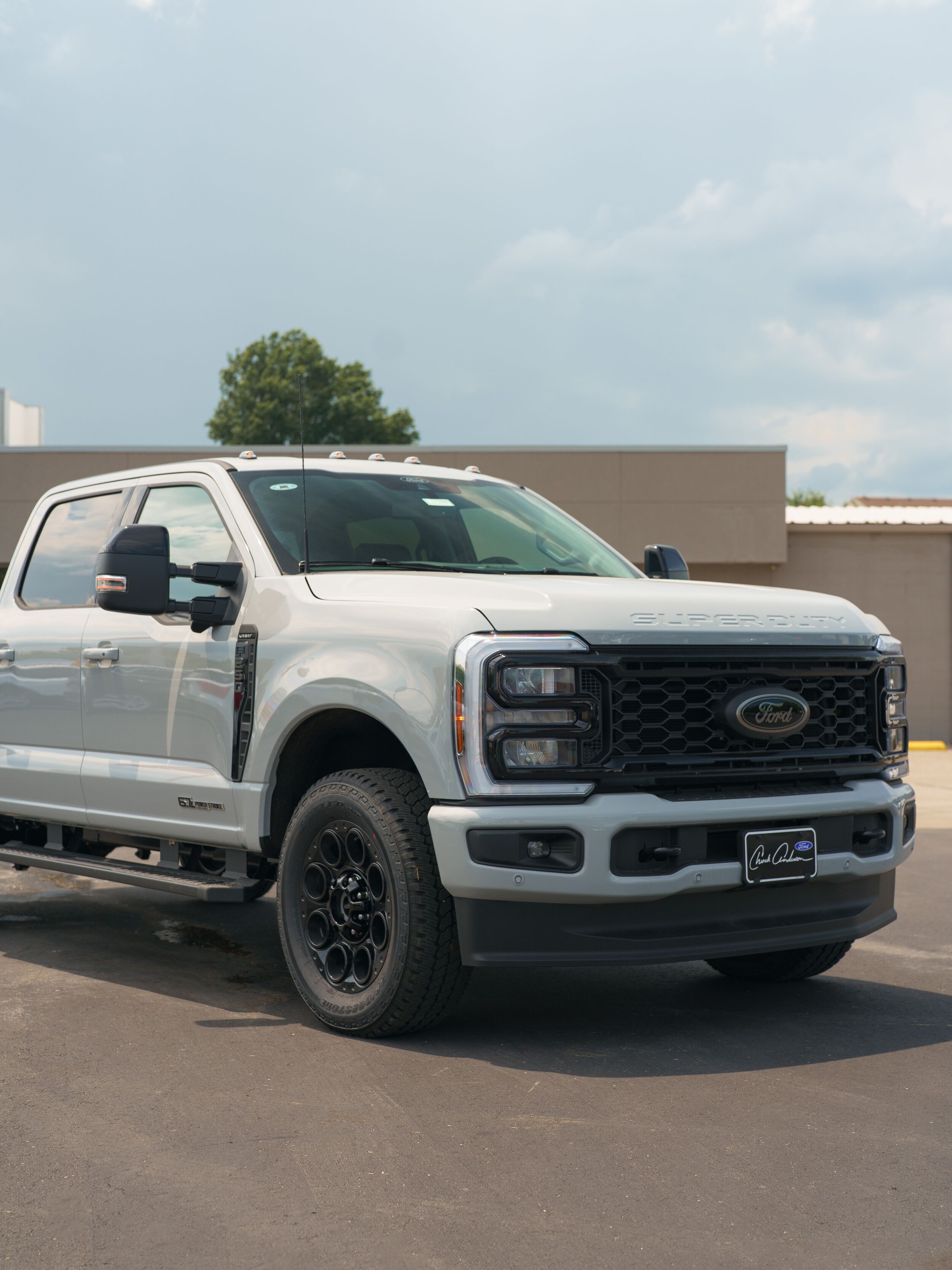
The Ford F-250 and F-350 share much of the same Super Duty DNA, but the F-350 is engineered to handle higher payload and towing demands and can also be configured with dual rear wheels. Here's how to determine which truck actually fits your needs.
The Short Answer
The biggest difference between the Ford F-250 and F-350 is capacity. An F-350 can offer higher GVWR, payload and towing capability than an F-250, depending on configuration. The F-350 can also be configured as a dual-rear-wheel truck, while the F-250 pickup is a single-rear-wheel truck.
If an F-250 comfortably handles your trailer, passengers and cargo, it may be all the Super Duty you need. If you're approaching the F-250's payload or towing limits—especially with a fifth wheel, gooseneck or heavy bed load—the F-350 deserves serious consideration.
```Ford F-250 vs F-350 at a Glance
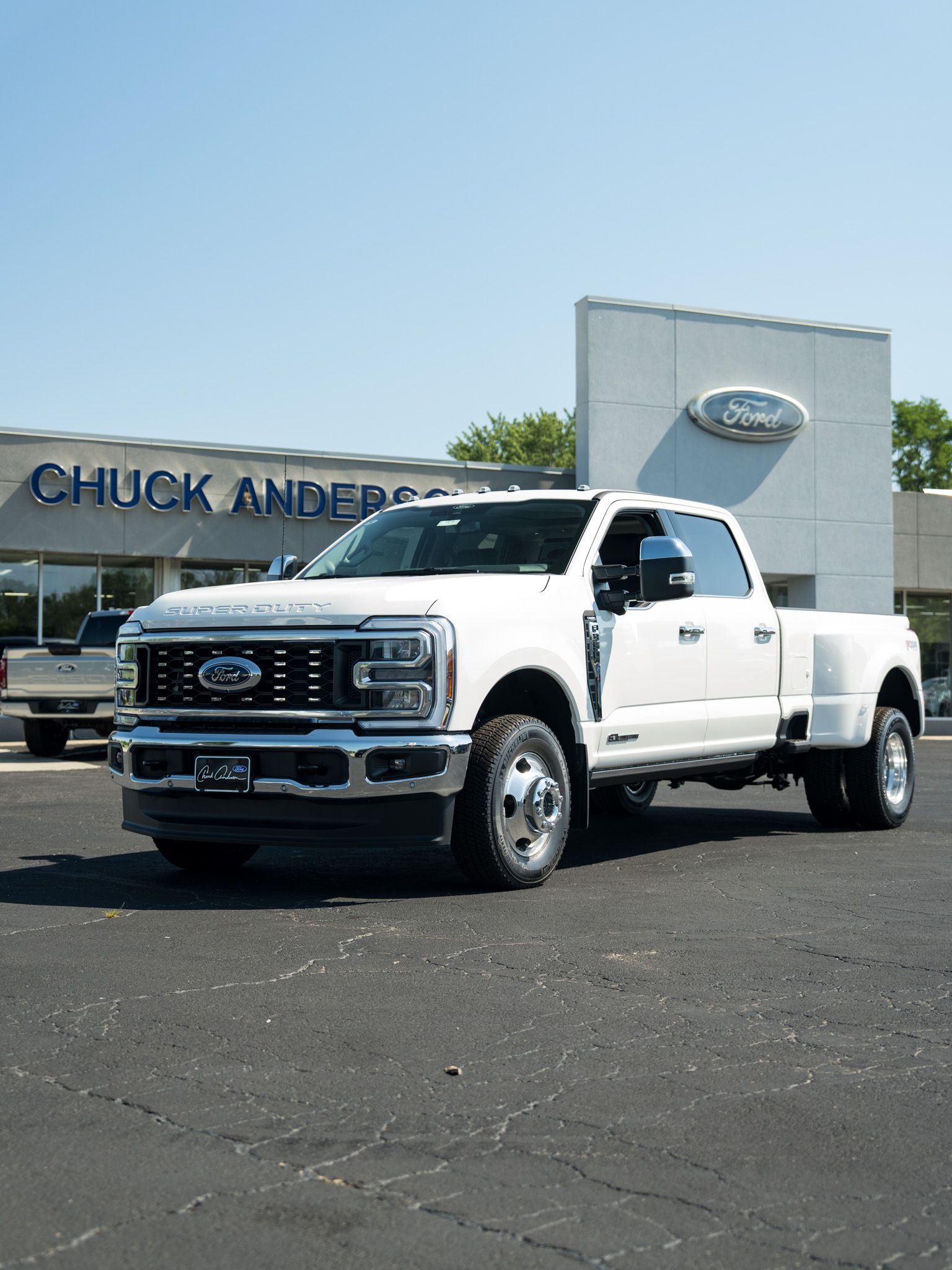
Ford F-250
The All-Around Super Duty
The F-250 is the starting point for many heavy-duty truck buyers. It provides serious towing and hauling capability while avoiding the additional width of a dual-rear-wheel truck.
- Single rear wheel
- Heavy-duty towing capability
- Strong payload capability
- Available gas and diesel powertrains depending on configuration and model year
- Well suited to work, recreational towing and everyday driving
- Often enough truck for buyers who do not need maximum Super Duty payload

Ford F-350
More Capacity When the Load Demands It
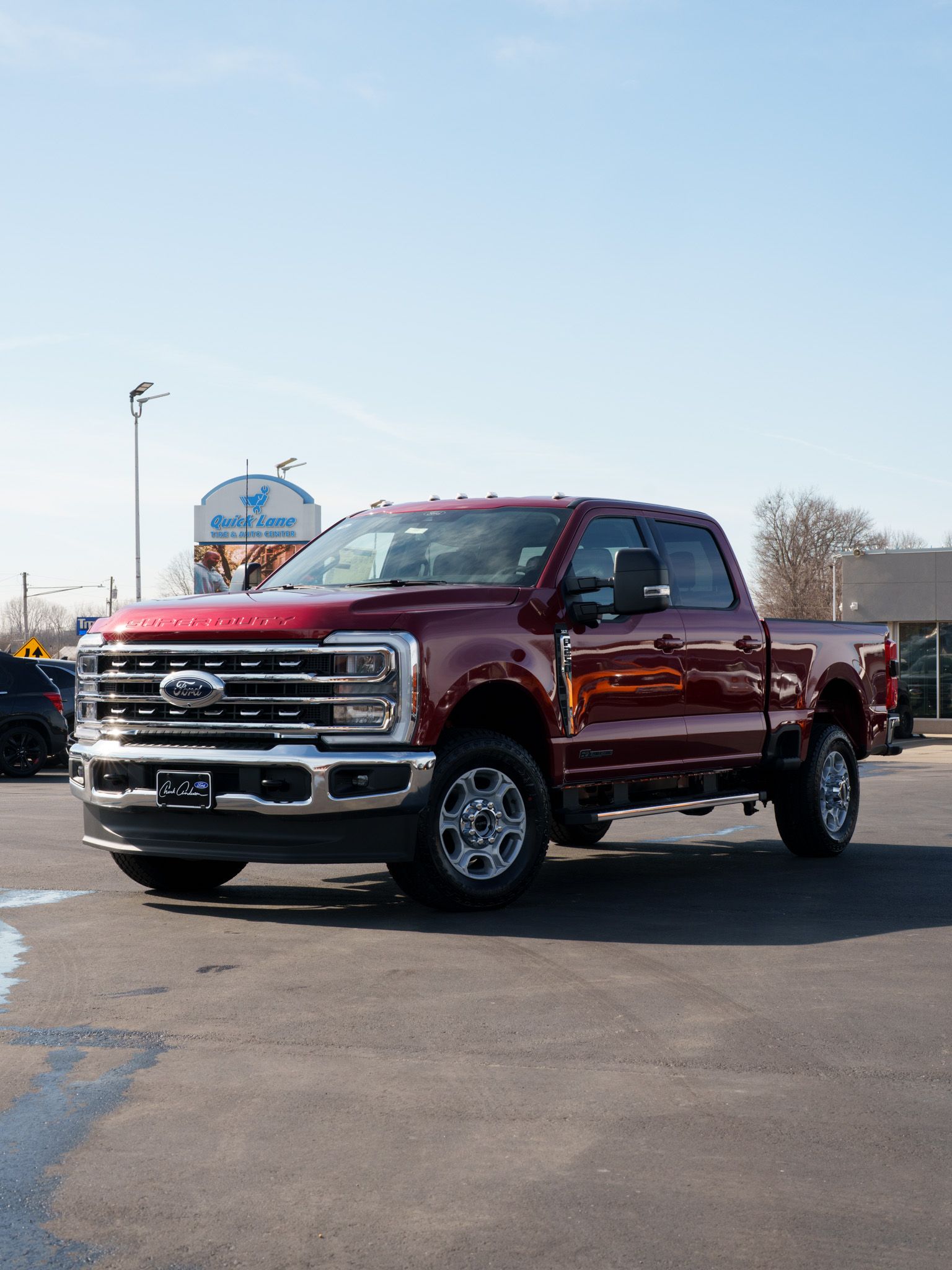
The F-350 moves the Super Duty capability ceiling higher. It is available in single-rear-wheel and dual-rear-wheel configurations, making it suitable for everything from higher-capacity SRW towing to substantial fifth-wheel, gooseneck and payload requirements.
- Available as SRW or DRW
- Higher available GVWR
- Higher available payload in many configurations
- Higher towing capability in properly equipped configurations
- Better suited to heavy pin weight and bed loads
- Greater range of heavy-trailer configurations
F-250 vs F-350 Comparison
| Category | Ford F-250 | Ford F-350 |
|---|---|---|
| Truck Class | Entry point to the Super Duty pickup lineup | Higher-capacity Super Duty pickup |
| Rear Wheels | Single rear wheel | Single rear wheel or dual rear wheel |
| GVWR | Lower maximum ratings depending on configuration | Higher available GVWR configurations |
| Payload | Strong heavy-duty payload capability | Higher available payload capability in many configurations |
| Towing | Capable of substantial conventional, fifth-wheel and gooseneck towing | Higher capability ceiling for demanding trailer applications |
| Fifth-Wheel Use | Can work well when trailer weight and pin weight remain within ratings | Often preferred as fifth-wheel size and pin weight increase |
| Dually Available? | No | Yes |
| Daily Driving | Heavy-duty truck dimensions without a dually rear end | SRW models remain similar in footprint; DRW models are substantially wider at the rear |
| Best Question to Ask | Does this truck comfortably cover my load? | Do I need the additional capacity? |
The Biggest Difference
Payload May Matter More Than Towing Capacity
Many buyers compare F-250 and F-350 by looking only at maximum towing capacity. That can miss the number that actually determines which truck you need: payload.
Payload is the amount of weight the truck itself can carry. That includes passengers, cargo, accessories, hitch equipment and the tongue or pin weight transferred from the trailer to the truck.
This becomes especially important with fifth-wheel and gooseneck trailers because a significant portion of the trailer's weight is placed directly over the truck's rear axle.
A trailer can potentially fall below a truck's maximum trailer rating while still causing the truck to exceed its available payload, GVWR or rear-axle rating.
Does an F-350 Tow More Than an F-250?
In many properly equipped configurations, yes. The F-350 has a higher capability ceiling and is available in configurations designed for loads beyond what an F-250 can accommodate.
But model name alone does not determine towing capacity. Two Super Duty trucks with different engines, cab styles, wheelbases, axle ratios, drivetrains, GVWR packages and towing equipment can have significantly different ratings even if they have the same badge.
Important: Never choose an F-250 or F-350 based solely on an advertised maximum tow rating. Verify the ratings of the exact truck configuration and account for passengers, cargo, accessories and trailer tongue or pin weight.
If you're researching maximum capacity in more detail, see how much an F-250 can tow and how much an F-350 can tow.
```One Major F-350 Advantage: You Can Get a Dually
One of the clearest differences between an F-250 and F-350 is that the F-350 can be configured with dual rear wheels.
A dual-rear-wheel F-350 places two tires on each side of the rear axle. That gives the truck a wider rear footprint and increases its ability to support substantial loads over the rear axle.
That can be particularly useful with large fifth wheels, gooseneck trailers and heavy bed payloads.
A dually isn't automatically the right choice, though. It is wider, takes up more room in parking spaces and may be unnecessary if an F-250 or F-350 SRW already provides sufficient ratings for the job.
For a deeper comparison, see single-rear-wheel vs dually: which do I need?
```F-250 or F-350 for a Fifth Wheel?
This is where the F-250 vs F-350 decision gets more interesting.
Fifth-wheel trailers transfer a substantial amount of their weight into the bed of the truck. That pin weight counts against available payload along with the driver, passengers, hitch, tools and other cargo.
An F-250 can be an appropriate fifth-wheel tow vehicle when the complete combination stays comfortably within the truck's ratings. As fifth-wheel weight and pin weight increase, the additional payload and GVWR available with certain F-350 configurations can become more important.
Very large fifth wheels can also move the conversation from an F-350 SRW to an F-350 DRW.
Read our full guide: Do I need an F-250 or F-350 for a fifth wheel?
```Is an F-250 Easier to Daily Drive Than an F-350?
Comparing an F-250 with an F-350 SRW is different from comparing an F-250 with an F-350 dually.
When cab, bed and drivetrain configurations are similar, an F-250 and F-350 SRW can have very similar exterior dimensions. The F-350's higher-capacity suspension and ratings are the more meaningful differences.
Moving to an F-350 DRW changes the equation. The wider rear fenders and four rear tires require more space, which can matter in parking lots, drive-throughs, garages and narrow streets.
If you need the capability, those compromises may be worthwhile. If you don't need the additional capacity, there is little reason to select a heavier-duty configuration solely because its model number is larger.
```Should You Buy an F-250 or F-350?
Consider an F-250 If...
Your trailer, tongue or pin weight, passengers and cargo fit comfortably within the ratings of the specific F-250 you're considering.
It's especially attractive when you want substantial Super Duty capability but do not need a dual-rear-wheel truck or the F-350's additional capacity.
Consider an F-350 If...
Your towing or payload requirements begin approaching the limits of an F-250, or you want additional capacity for future trailers, fifth-wheel pin weight or bed cargo.
The F-350 is also the choice to investigate if your application requires dual rear wheels.
Why Trailer Weight Alone Doesn't Answer the Question
Imagine two owners pulling trailers with similar total loaded weights. One uses a conventional bumper-pull trailer with relatively modest tongue weight. The other uses a large fifth wheel that places substantial pin weight directly into the bed.
Even though the trailers may weigh roughly the same, the trucks can face very different payload demands.
That's why there isn't a universal trailer weight where every buyer should automatically move from an F-250 to an F-350. The complete combination matters.
```Check These Numbers on the Actual Truck
Once you've narrowed the decision to an F-250 or F-350, verify the specifications of the individual truck rather than relying on a generic model-level number.
Payload
Account for passengers, cargo, accessories, hitch hardware and trailer tongue or pin weight.
GVWR
Verify how much the fully loaded truck is rated to weigh.
Rear GAWR
Especially important when carrying substantial fifth-wheel or gooseneck pin weight.
GCWR & Trailer Rating
Make sure the complete loaded truck-and-trailer combination stays within the manufacturer's ratings.
More Ford Super Duty Questions
Comparing F-250 and F-350 is only one part of choosing the right Super Duty. These guides can help you narrow the configuration further.
```F-250 vs F-350 FAQ
What is the main difference between an F-250 and F-350?
The primary difference is capability. Depending on configuration, the F-350 can offer higher GVWR, payload and towing capability than the F-250. The F-350 is also available with dual rear wheels.
Is an F-350 bigger than an F-250?
Not necessarily in overall exterior dimensions. Comparable F-250 and F-350 SRW trucks can share similar cab, bed and wheelbase dimensions. The more important differences are their ratings and capacity. An F-350 DRW is wider at the rear because of its dual rear wheels.
Does an F-350 tow more than an F-250?
Properly configured F-350 models can provide a higher towing-capability ceiling than F-250 models. Actual trailer ratings depend on the complete truck configuration, including engine, axle ratio, cab, drivetrain, wheelbase, equipment and trailer type.
Does an F-350 have more payload than an F-250?
F-350 configurations can provide higher available payload ratings than comparable F-250 configurations. This is one of the most important differences for buyers carrying heavy bed loads or towing fifth-wheel and gooseneck trailers.
Can you get an F-250 dually?
The F-250 pickup is a single-rear-wheel truck. Buyers who need a dual-rear-wheel Super Duty should compare F-350 DRW and F-450 configurations.
Do I need an F-350 to tow a fifth wheel?
Not automatically. An F-250 can tow many fifth-wheel trailers when the truck-and-trailer combination remains within all applicable ratings. As trailer and pin weight increase, the higher available payload and GVWR of certain F-350 configurations can become important.
Is an F-350 worth buying instead of an F-250?
It depends on the load. If an F-250 comfortably provides enough payload and towing capacity, additional capability may not be necessary. If your trailer, pin weight, passengers or cargo approach the F-250's limits, an F-350 provides additional configurations worth considering.
The Bottom Line: Buy the Truck the Load Requires
The F-250 and F-350 are closely related trucks, but the F-350 provides a higher capability ceiling. The question isn't simply whether the F-350 can carry or tow more—it can in the appropriate configuration. The real question is whether your trailer and payload require that additional capability.
Start with the real loaded weight of your trailer, calculate the weight the truck itself must carry and then compare those numbers with the ratings of the exact F-250 or F-350 you're considering.
Continue to the Ford Super Duty Research Center for more comparisons, towing guides and Super Duty ownership questions from Chuck Anderson Ford.
```