

Which Ford Super Duty is Best for Towing?
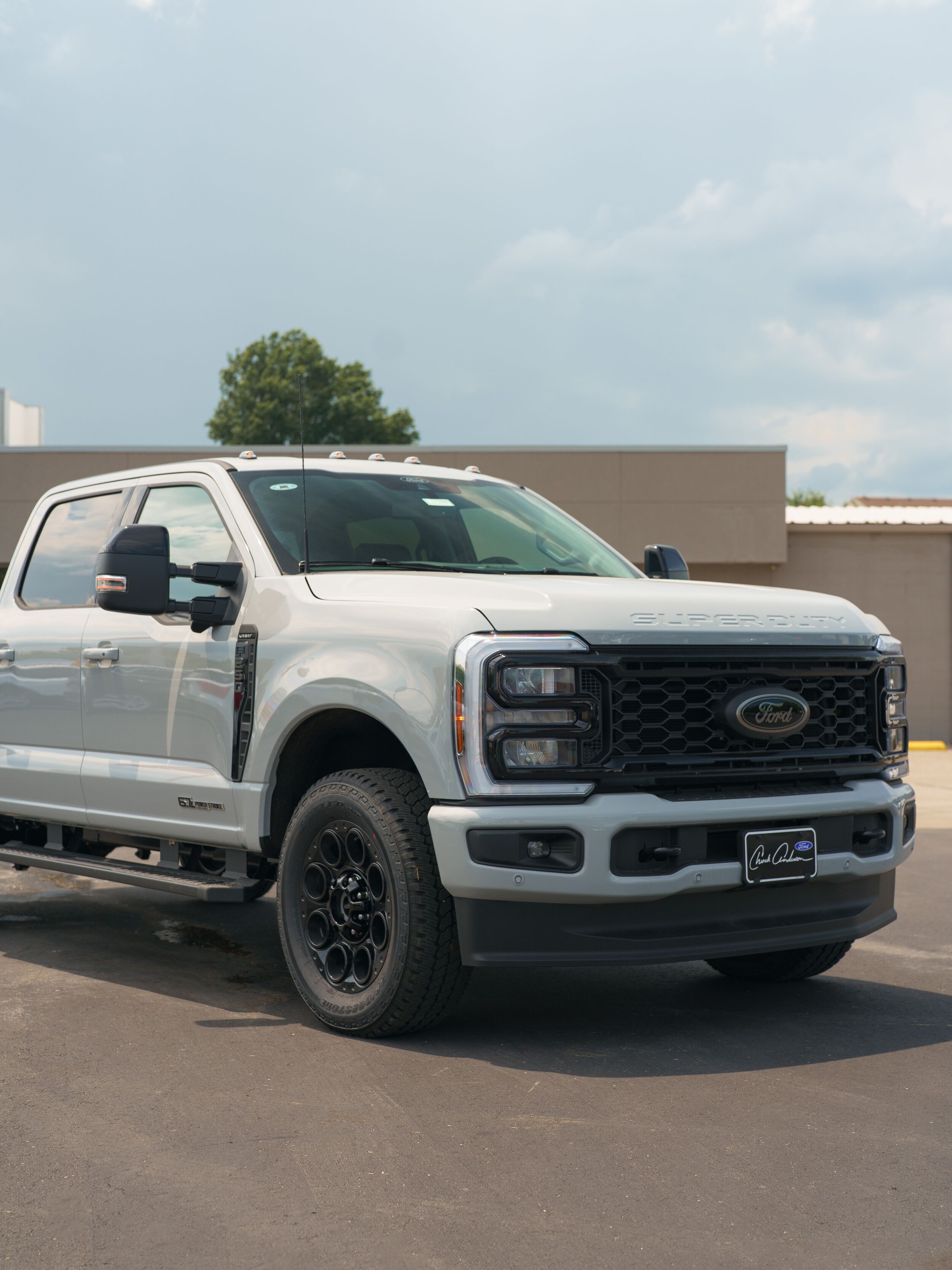
Ford Super Duty Towing Guide
``` Which Ford Super Duty Is Best for Towing?
The F-450 offers the highest maximum towing capacity in the Ford Super Duty pickup lineup, but that does not automatically make it the best tow vehicle for every owner. The right choice depends on trailer weight, tongue or pin weight, payload, towing frequency and whether you want a single-rear-wheel or dual-rear-wheel truck.
The Short Answer
If maximum towing capacity is your only priority, the F-450 is the most capable Ford Super Duty pickup. A properly equipped current F-450 can tow up to 40,000 pounds with a gooseneck trailer.
But the F-450 is not automatically the best choice for a 10,000-, 15,000- or even 20,000-pound trailer.
An F-250 can be an excellent choice for moderate and heavy trailers when its payload and towing ratings comfortably cover the load. An F-350 SRW increases capability without requiring a dually. An F-350 DRW is especially well suited to large fifth wheels, heavy pin weight and high payload. The F-450 DRW becomes most compelling when maximum trailer capability is the priority.
```Which Super Duty Fits Which Towing Job?
F-250 SRW
Serious Towing + Everyday Use
Up to 23,000 lbs.
Maximum current gooseneck towing capability when properly equipped.
A strong fit when you need real Super Duty capability but do not require the payload or rear-wheel capacity of a dually.
F-350 SRW
More Capacity Without a Dually
F-350 SRW raises the capability ceiling while retaining one rear wheel on each side.
It can be an excellent choice for substantial travel trailers, equipment trailers and many fifth wheels when the truck's specific ratings cover the load.
F-350 DRW
Heavy Fifth Wheels & Payload
Up to 38,000 lbs.
Maximum current gooseneck towing capability when properly equipped.
Four rear tires, high available payload and strong rear-axle capability make F-350 DRW especially attractive for heavy pin weight.
F-450 DRW
Maximum Super Duty Towing
Up to 40,000 lbs.
Maximum current gooseneck towing capability when properly equipped.
High-Output Power Stroke power, dual rear wheels, 19.5-inch wheels and a wide-track front axle make it Ford's specialized tow rig.
F-250 vs F-350 vs F-450 for Towing
| Category | F-250 | F-350 SRW | F-350 DRW | F-450 DRW |
|---|---|---|---|---|
| Rear Wheels | Single | Single | Dual | Dual |
| Primary Towing Role | Heavy towing + daily use | Higher-capacity SRW towing | Heavy fifth-wheel/gooseneck towing | Maximum trailer capability |
| Current Max Gooseneck | Up to 23,000 lbs. | Varies by configuration | Up to 38,000 lbs. in qualifying F-350 configurations | Up to 40,000 lbs. |
| Current Factory Receiver Capacity | Up to 22,000 lbs. | Up to 25,000 lbs. | Up to 28,000 lbs. | Up to 30,000 lbs. |
| Payload Emphasis | Strong | Higher SRW capacity | Excellent; highest-payload Super Duty configurations live here | Towing-focused |
| Fifth-Wheel Use | Moderate to substantial fifth wheels within ratings | Larger fifth wheels without going DRW | Very large fifth wheels and heavy pin weight | Extreme fifth-wheel and trailer applications |
| Daily Maneuverability | Best of the group | Very good for a high-capacity Super Duty | Wider rear body | DRW body plus specialized towing hardware |
| Best Question to Ask | Is this enough truck? | Can I stay SRW? | Do I need more payload/stability? | Am I approaching maximum trailer territory? |
F-250
When Is the F-250 Best for Towing?
The F-250 is often the logical starting point for buyers moving into a heavy-duty pickup.
Current properly equipped F-250 trucks can tow more than 20,000 pounds, which means an F-250 has enough trailer capability for many travel trailers, equipment trailers, boats, horse trailers and even certain fifth wheels.
Its biggest advantage is that you get substantial Super Duty towing capability without moving to a wider dual-rear-wheel truck.
The F-250 makes the most sense when the trailer's loaded weight, tongue or pin weight, passengers and cargo all fit comfortably within the truck's ratings.

F-350 SRW
When Is the F-350 SRW Best for Towing?
F-350 SRW fills an important gap in the lineup.
It gives buyers additional GVWR, payload and towing capability compared with many F-250 configurations while retaining the narrower single-rear-wheel footprint.
That makes it attractive to someone pulling a substantial trailer who still drives the truck unloaded frequently and does not want the width of a dually.
For many fifth-wheel owners, the F-350 SRW is the truck to evaluate before deciding that dual rear wheels are necessary.
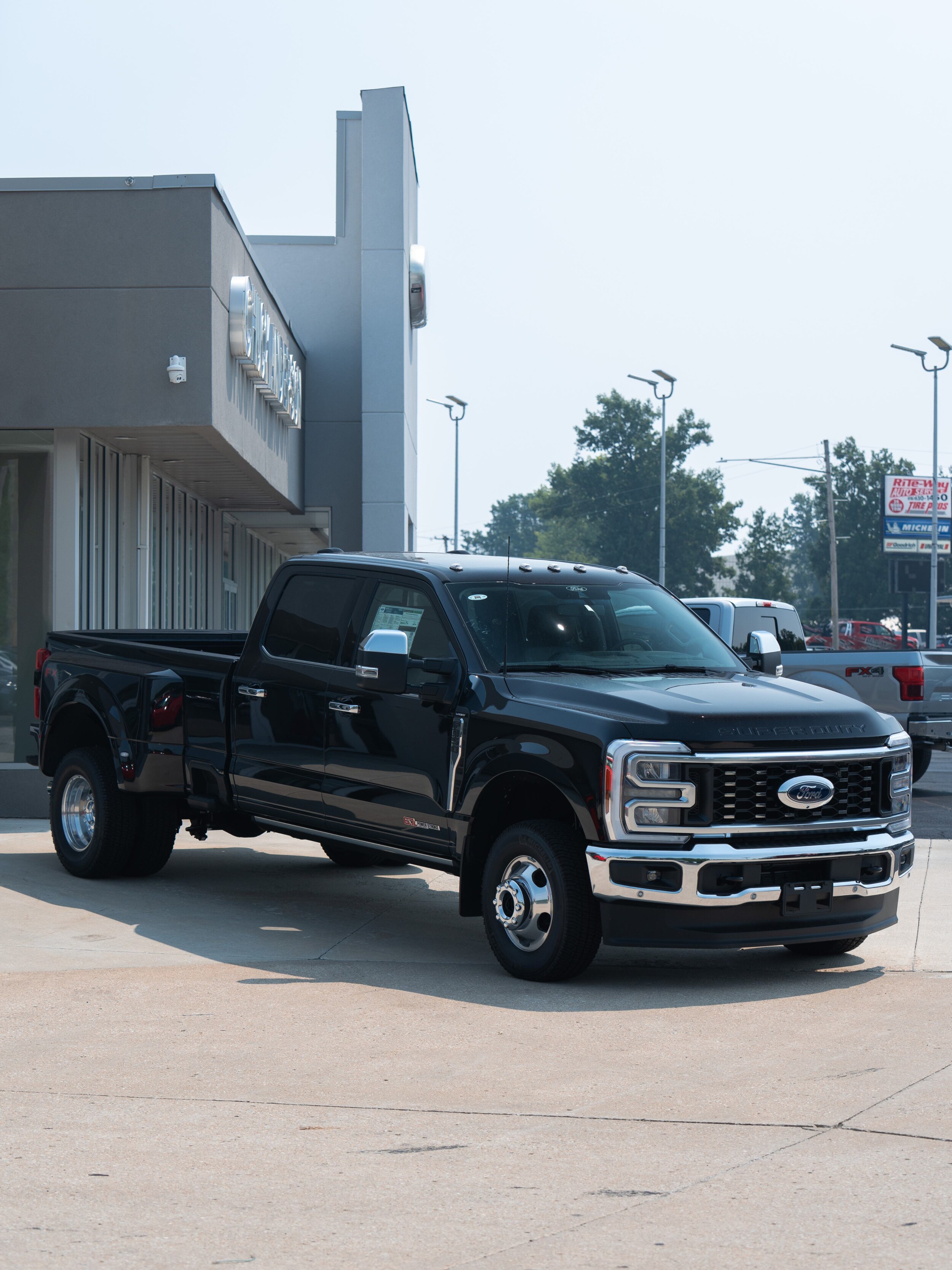
F-350 DRW
When Is the F-350 Dually Best for Towing?
F-350 DRW is one of the most capable all-around heavy-towing configurations in the Super Duty lineup.
The four rear tires provide a wider footprint and support high-capacity rear-axle, payload and towing configurations.
This becomes especially valuable with large fifth wheels because pin weight is carried directly by the truck.
F-350 DRW also deserves special consideration when payload is just as important as trailer weight. Certain F-350 configurations provide higher available payload than the F-450.

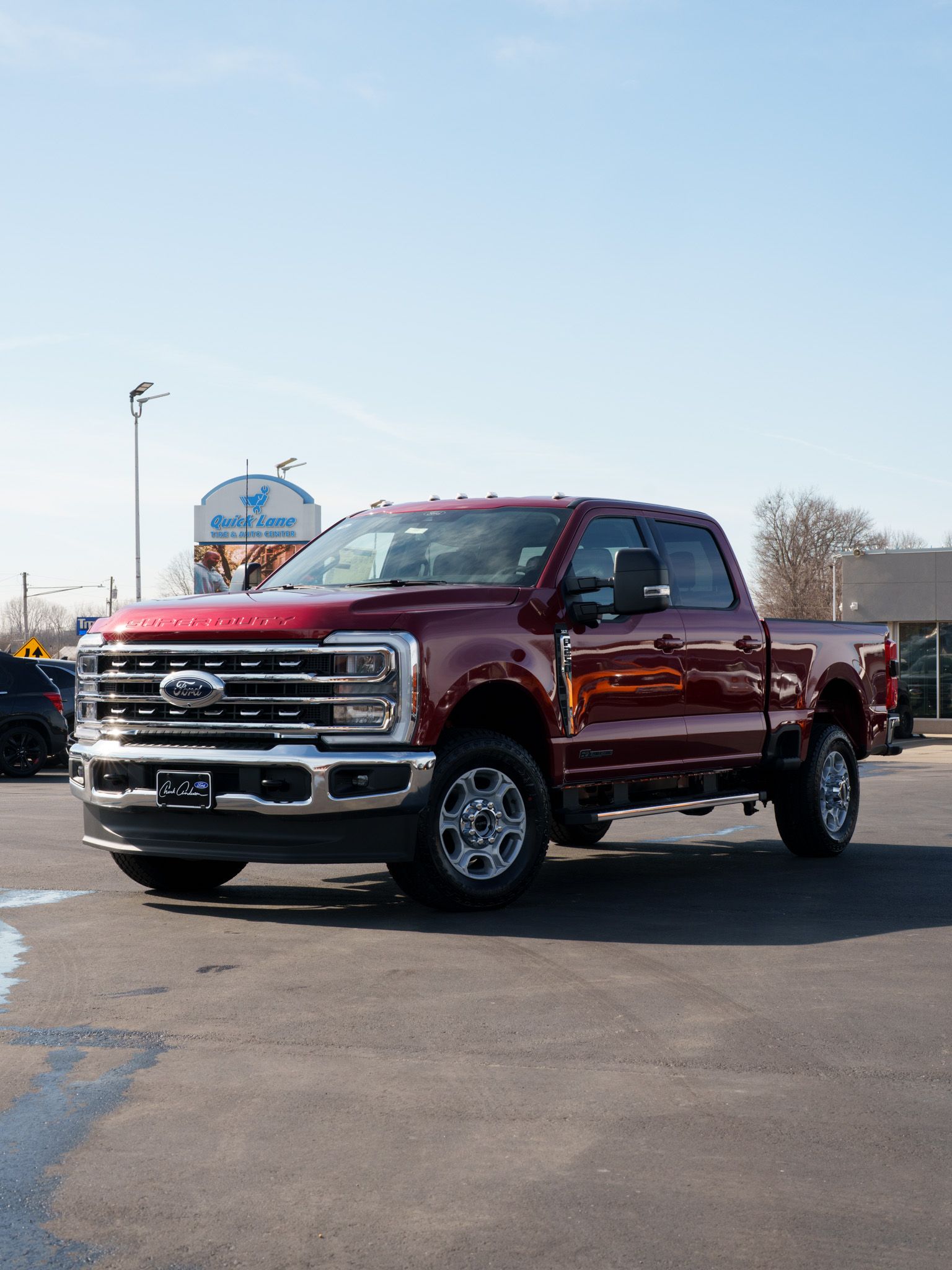
F-450 DRW
When Is the F-450 Best for Towing?
The F-450 is the Super Duty pickup to investigate when maximum trailer capability is the priority.
Current properly equipped F-450 trucks can tow up to 40,000 pounds with a gooseneck, making the F-450 the highest-capacity towing pickup in the current Super Duty lineup.
The truck also uses specialized hardware including dual rear wheels, 19.5-inch wheels and tires, a wide-track front axle and the High-Output Power Stroke diesel.
That specialization is valuable when you need it. If your trailer is comfortably within an F-250 or F-350's capability, however, an F-450 may add cost and everyday compromises without providing much practical benefit.
Which Super Duty Is Best for Different Types of Trailers?
Travel Trailers
Many travel trailers fall comfortably within F-250 capability. Larger bumper-pull trailers may justify an F-350 depending on tongue weight, passengers and cargo.
Fifth-Wheel Campers
F-250 can fit certain fifth wheels, but F-350 SRW and DRW become increasingly attractive as pin weight rises. Very large fifth wheels may justify an F-450.
Gooseneck Trailers
F-350 DRW and F-450 are especially strong choices for extremely heavy gooseneck applications. The F-450 provides the highest current maximum gooseneck rating.
Equipment Trailers
The right truck depends on the equipment's actual loaded weight. F-250 can cover many applications, while commercial and very heavy loads can push the decision toward F-350 or F-450.
Horse & Livestock Trailers
Calculate loaded trailer weight carefully. Animals, tack, feed, water and equipment can increase actual weight substantially beyond the trailer's empty rating.
Commercial Heavy Towing
High towing frequency, substantial annual mileage and consistently heavy trailers make F-350 DRW and F-450 configurations especially relevant.
Payload Can Matter More Than Maximum Towing Capacity
The biggest truck is not always selected because of total trailer weight. Sometimes the deciding factor is the amount of weight the trailer places on the truck.
A fifth wheel or gooseneck transfers pin weight directly into the pickup bed. Conventional trailers place tongue weight on the rear hitch.
That weight is added to:
Passengers
Driver and passenger weight uses part of the truck's available payload.
Hitch Equipment
Fifth-wheel hitches and other towing equipment can add meaningful weight before the trailer is connected.
Tools & Cargo
Generators, tools, luggage, coolers and other bed cargo reduce remaining payload.
Trailer Pin or Tongue Weight
The portion of the trailer carried by the truck can become the largest single payload item.
This Is Why F-350 DRW Is So Important
A buyer may not need the F-450's 40,000-pound maximum tow rating but may still need a dually because a large fifth wheel places substantial pin weight on the truck. F-350 DRW can be especially attractive in that situation.
When Do You Need Dual Rear Wheels?
A dually is not automatically required simply because you tow a fifth wheel or heavy trailer.
F-250 and F-350 SRW configurations can handle substantial loads. The decision changes when pin weight, payload and trailer weight move beyond what a single-rear-wheel truck can properly support.
Dual rear wheels provide four rear tires instead of two. That increases available rear-tire capacity and creates a wider footprint under the back of the truck.
The tradeoff is a wider body, more tires to replace and less convenient maneuvering in parking lots, garages and drive-throughs.
```Gas or Diesel for Super Duty Towing?
Gas and diesel Super Duty trucks can both be excellent tow vehicles.
A gas engine can make sense when towing is less frequent, trailer weight remains comfortably within the truck's capability and the buyer values a lower initial powertrain cost and simpler ownership.
The Power Stroke diesel becomes increasingly attractive as trailer weight, towing frequency and annual towing mileage increase.
Its massive low-rpm torque and diesel exhaust brake are especially useful with heavy fifth wheels and goosenecks.
Compare them: Ford 6.7 Power Stroke vs 7.3 gas: which is better?
```What Super Duty Should You Consider Based on Trailer Weight?
Trailer weight alone cannot choose the truck because tongue or pin weight, passengers, cargo and configuration also matter. But these categories can help narrow the search.
| Loaded Trailer Weight | Super Duty Models to Investigate | What to Watch |
|---|---|---|
| Under 10,000 lbs. | F-250 may provide considerably more capacity than required | Make sure a Super Duty is actually necessary for the application |
| 10,000–15,000 lbs. | F-250 is a logical starting point | Check tongue/pin weight and payload |
| 15,000–20,000 lbs. | F-250 or F-350 depending on configuration | Fifth-wheel pin weight can push the decision toward F-350 |
| 20,000–25,000 lbs. | F-350 deserves close consideration | SRW vs DRW becomes increasingly important |
| 25,000–30,000 lbs. | F-350 DRW or F-450 | Payload, pin weight, hitch type and usage become critical |
| 30,000+ lbs. | F-350 DRW and F-450 | Verify the exact configuration and all vehicle ratings carefully |
These weight ranges are shopping guidance, not towing ratings. Always verify the exact Ford rating for the individual truck and compare it with the trailer's actual loaded weight and pin or tongue weight.
Start With the Trailer and Work Backward
1
Loaded Trailer Weight
Use realistic loaded weight rather than relying only on empty or dry trailer weight.
2
Pin or Tongue Weight
Determine how much of the trailer's weight will actually be supported by the truck.
3
Passengers & Cargo
Add the driver, passengers, hitch, tools, luggage and anything else the truck will carry.
4
Choose the Truck
Select an F-250, F-350 or F-450 configuration with appropriate towing, payload, GVWR, axle and combined-weight ratings.
Two Trucks With the Same Badge Can Have Different Tow Ratings
Saying "an F-350 can tow it" is not enough.
Towing capacity can change with:
Engine & Axle Ratio
Powertrain and gearing affect Gross Combined Weight Rating and maximum trailer capability.
Cab & Wheelbase
Different cab and bed combinations change truck weight and available ratings.
2WD vs 4WD
Four-wheel-drive components add weight and can change payload and trailer ratings.
SRW vs DRW
Rear-wheel configuration dramatically changes the capability ceiling of an F-350.
Should You Buy More Super Duty Than You Need?
Some extra capacity can provide useful flexibility, particularly if you expect to upgrade trailers later.
But moving from an F-250 to an F-350 DRW or F-450 also comes with tradeoffs.
A dually is wider. It has additional tires. An F-450 uses specialized 19.5-inch wheels and tires. Heavy-duty configurations may ride differently when unloaded and may cost more to purchase and operate.
The goal should not be to buy the biggest Super Duty available. It should be to buy enough truck to handle your realistic loaded trailer and payload requirements with appropriate capacity.
```More Ford Super Duty Towing Questions
How Much Can an F-250 Tow? How Much Can an F-350 Tow? How Much Can an F-450 Tow? F-250 vs F-350: What's the Difference? F-350 vs F-450: Which Should I Buy? Do I Need an F-250 or F-350 for a Fifth Wheel? Single-Rear-Wheel vs Dually Best Ford Truck for Fifth-Wheel Towing What Ford Truck Can Tow 20,000 Pounds? Ford Super Duty Research Center
``` Best Ford Super Duty for Towing FAQ
Which Ford Super Duty has the highest towing capacity?
The F-450 has the highest maximum towing capacity in the current Ford Super Duty pickup lineup. A properly equipped current F-450 can tow up to 40,000 pounds with a gooseneck trailer.
Is an F-250 good for towing?
Yes. Properly equipped current F-250 trucks can tow more than 20,000 pounds, making them suitable for many heavy travel trailers, equipment trailers and fifth wheels. Actual capability depends on configuration.
Is an F-350 better than an F-250 for towing?
An F-350 offers higher-capacity configurations and can be ordered with dual rear wheels, making it better suited to heavier trailers and greater pin or tongue weight. If an F-250 comfortably covers the load, however, the additional F-350 capacity may not be necessary.
Is an F-450 better than an F-350 for towing?
The F-450 offers a higher maximum towing ceiling and specialized heavy-towing hardware. F-350 DRW can still be the better fit when payload and versatility matter more than absolute maximum trailer weight.
Which Super Duty is best for a fifth wheel?
It depends on the fifth wheel's loaded weight and pin weight. F-250 can handle some fifth wheels, F-350 SRW works for many larger trailers, F-350 DRW is especially useful for heavy pin weights and large fifth wheels, and F-450 is designed for the heaviest towing applications.
Which Super Duty is best for a gooseneck trailer?
F-350 DRW and F-450 are especially well suited to very heavy gooseneck trailers. The current F-450 provides the highest maximum gooseneck rating at up to 40,000 pounds when properly equipped.
Do I need a dually for towing?
Not automatically. F-250 and F-350 SRW trucks can tow substantial trailers. Dual rear wheels become more relevant as trailer weight, pin weight and payload requirements move beyond the ratings of an appropriate SRW configuration.
Which Super Duty is best for towing 20,000 pounds?
Certain properly equipped F-250 trucks can tow 20,000 pounds or more, while F-350 provides additional capacity that may be useful when the trailer has substantial tongue or pin weight. The exact truck should be selected using the complete loaded combination rather than trailer weight alone.
Which Super Duty is best for towing 30,000 pounds?
F-350 DRW and F-450 are the primary Super Duty configurations to investigate for trailers around 30,000 pounds. Exact capability depends on hitch type, engine, drivetrain, axle ratio, payload and other configuration details.
Is gas or diesel better for Super Duty towing?
Gas engines can provide substantial towing capability and can be a good fit for intermittent towing. The Power Stroke diesel becomes increasingly attractive as trailer weight, towing frequency and annual towing mileage increase because of its high low-rpm torque and diesel exhaust brake.
Should I buy an F-450 just because it can tow the most?
Not necessarily. If an F-250 or F-350 comfortably handles the loaded trailer, payload, passengers and cargo, the additional F-450 capability may not be necessary. The best towing truck is the configuration that appropriately matches the actual load.
The Bottom Line: F-450 Tows the Most, but the Best Super Duty Depends on the Trailer
If maximum factory towing capacity is the goal, the F-450 sits at the top of the Super Duty pickup lineup with up to 40,000 pounds of current gooseneck capability.
For many buyers, though, an F-250 or F-350 is the better match. F-250 provides serious towing capability without requiring a dually. F-350 SRW adds capacity while retaining a narrower footprint. F-350 DRW provides the payload and rear-axle capability needed for many large fifth wheels and heavy trailers.
Start with the trailer's actual loaded weight and pin or tongue weight. Add the passengers, hitch and cargo the truck must carry. Then choose the Super Duty configuration with ratings appropriate for the complete load.
Continue to the Ford Super Duty Research Center for more F-250, F-350, F-450, Power Stroke and towing research from Chuck Anderson Ford.
```