

How Much Can an F-450 Tow?

Ford F-450 Towing Guide
``` How Much Can an F-450 Tow?
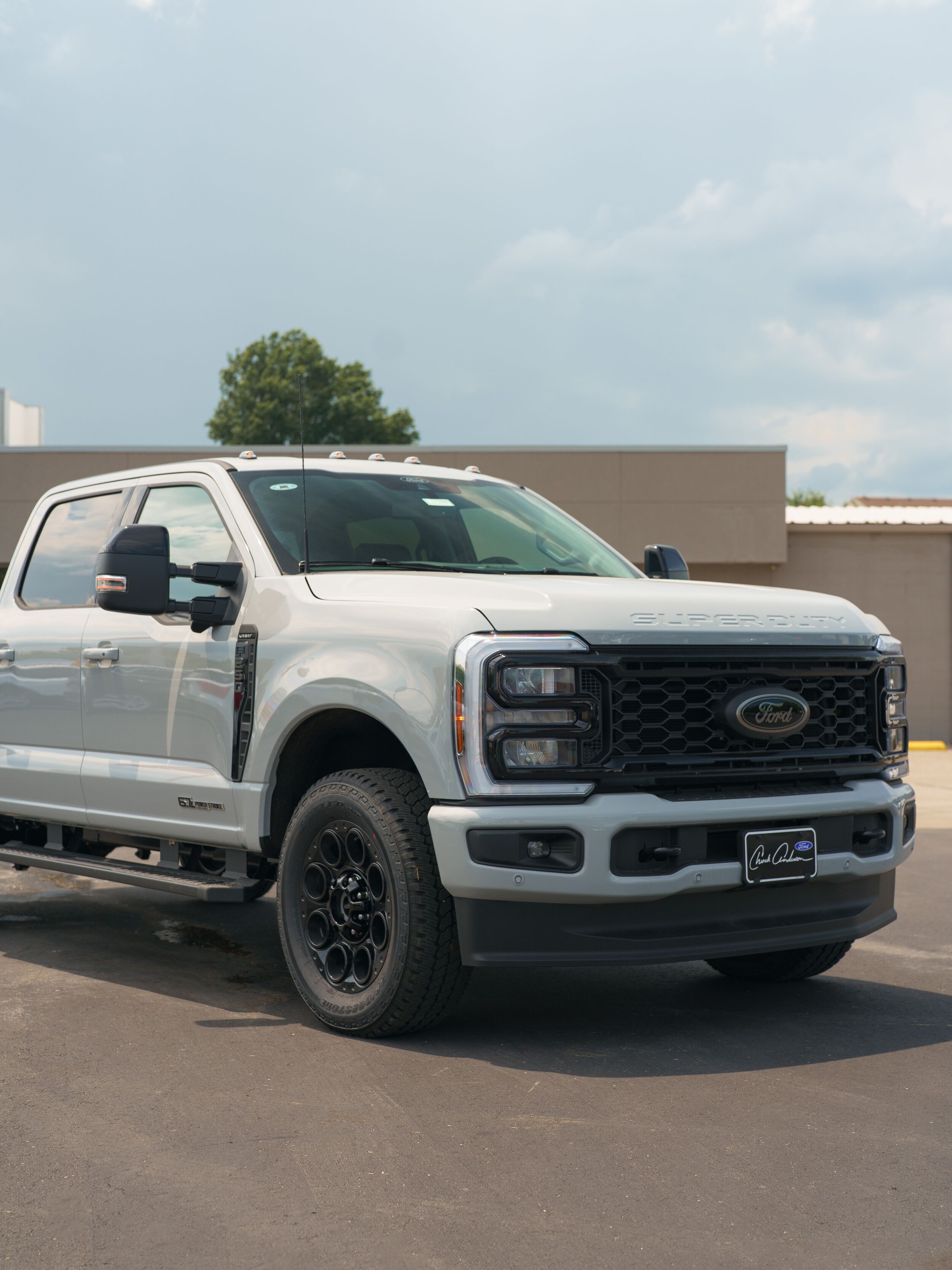
The Ford F-450 is the maximum-towing pickup in the Super Duty lineup. A properly equipped current F-450 can tow as much as 40,000 pounds with a gooseneck trailer, but conventional, fifth-wheel and gooseneck ratings differ—and the exact truck configuration still matters.
The Short Answer
For the current 2027 model year, a properly equipped Ford F-450 can tow up to 30,000 pounds conventionally, 35,000 pounds with a fifth-wheel trailer and 40,000 pounds with a gooseneck trailer.
The F-450 pickup is a dual-rear-wheel truck and comes standard with Ford's High-Output 6.7L Power Stroke V8 Turbo Diesel. Current output is 500 horsepower and 1,200 lb-ft of torque.
Those headline towing numbers still represent specific properly equipped trucks. Cab, drivetrain, axle ratio, equipment, passengers, cargo and trailer pin or tongue weight all affect what an individual F-450 can properly tow.
```2027 Ford F-450 Maximum Towing Capacity
30,000 lbs.
Conventional Towing
Maximum available current F-450 towing capacity using a conventional receiver-hitch trailer.
35,000 lbs.
Fifth-Wheel Towing
Maximum available current F-450 fifth-wheel towing capacity when properly equipped.
40,000 lbs.
Gooseneck Towing
Maximum available current F-450 gooseneck towing capacity and the highest available rating in the Super Duty pickup lineup.
Towing ratings change by model year. Owners of older F-450 trucks should use Ford's towing guide for the specific model year and exact truck configuration rather than applying current-model ratings to an older vehicle.
```
What Makes It Different?
The F-450 Is Built Around Maximum Towing
An F-450 is not simply an F-350 with a different badge. Ford equips the F-450 pickup with hardware specifically suited to moving very heavy trailers.
Current F-450 pickups use dual rear wheels, a High-Output Power Stroke diesel, 19.5-inch wheels and tires and a wide-track front suspension with an extended axle.
Those components help explain why the F-450 occupies a specialized position in the Super Duty lineup.
If the truck's primary job is towing an exceptionally heavy fifth-wheel, gooseneck or conventional trailer, the F-450 is the Super Duty designed around that mission.
What Determines F-450 Towing Capacity?
Cab Configuration
Regular Cab and Crew Cab trucks have different curb weights and wheelbases, which can affect maximum trailer ratings.
4x2 vs 4x4
Drivetrain configuration changes truck weight and can affect the maximum rating of an individual F-450.
Axle Ratio
Axle gearing affects GCWR and the mechanical advantage available when moving extremely heavy loads.
Trailer Type
Conventional, fifth-wheel and gooseneck trailers use different hitch locations and produce different maximum ratings.
Passengers & Cargo
People, tools, luggage, accessories and bed cargo all add weight to the truck and reduce remaining payload.
Pin or Tongue Weight
A portion of the trailer's weight is carried by the truck and must remain within payload, axle, tire and GVWR limits.
How Much Can an F-450 Tow Conventionally?
A properly equipped current Ford F-450 can tow up to 30,000 pounds with a conventional trailer.
Conventional towing uses the receiver hitch behind the rear bumper rather than a hitch mounted inside the pickup bed.
Heavy equipment trailers, large enclosed trailers and other commercial trailers can use this type of connection, although many of the heaviest F-450 applications move to a gooseneck or fifth-wheel hitch.
The F-450's factory receiver can support extremely high ratings in the correct configuration, but the hitch rating does not override the truck's individual maximum trailer weight, GCWR, GVWR or axle ratings.
30,000 pounds is a maximum, not a universal F-450 rating. Always verify the exact truck configuration and installed towing equipment before connecting a trailer.
Fifth-Wheel Towing
How Much Can an F-450 Tow With a Fifth Wheel?
A properly equipped current F-450 can tow up to 35,000 pounds with a fifth-wheel trailer.
Fifth-wheel hitches mount in the pickup bed and transfer a substantial portion of trailer weight directly over or near the rear axle.
That configuration is common with large RVs because it provides a stable connection for substantial trailers.
Total trailer weight is only part of the calculation. A large fifth wheel may place several thousand pounds of pin weight onto the truck, which must be added to passengers, hitch equipment and cargo when checking the F-450's actual loaded weight.
How Much Can an F-450 Tow With a Gooseneck?
The maximum available current F-450 rating is 40,000 pounds with a gooseneck trailer.
That is the headline maximum towing figure for the current Ford Super Duty pickup family.
A gooseneck trailer connects to a ball mounted in the truck bed and is widely used for heavy equipment, livestock and commercial hauling.
Because the trailer connection sits near the rear axle, the truck can control substantially more trailer weight than a typical rear receiver-hitch arrangement when properly configured.
Can an F-450 Really Tow 40,000 Pounds?
Yes, but only a properly configured F-450 with the required equipment achieves the 40,000-pound maximum. It should never be assumed that every F-450 has that rating simply because it carries the F-450 badge.
What Engine Does the F-450 Use for Maximum Towing?
The current F-450 pickup comes standard with Ford's 6.7L High-Output Power Stroke V8 Turbo Diesel.
For the current model year, it produces 500 horsepower and 1,200 lb-ft of torque.
The large torque output arrives at relatively low engine speed, which is particularly valuable when starting and maintaining momentum with a very heavy trailer.
Diesel exhaust braking also helps control truck-and-trailer speed during descents, reducing reliance on the service brakes when towing in hilly or mountainous terrain.
Learn more about the engine in is the 6.7 Power Stroke reliable?
```Is Every F-450 a Dually?
The current Ford F-450 pickup uses a dual-rear-wheel configuration.
Instead of one tire on each side of the rear axle, a dually uses two, creating four rear tires in total.
For extreme towing, those additional rear tires provide greater load capacity and a wider footprint under the rear of the truck.
The tradeoff is width. An F-450 requires more space in parking lots, drive-throughs, garages and narrow roads than an F-350 SRW.
If your trailer does not require a dually, an F-350 SRW may provide a better balance between capability and everyday usability.
```Why Does the F-450 Have 19.5-Inch Wheels?
The F-450's 19.5-inch wheels and commercial-style tires are one of the most visible differences between it and an F-350 DRW.
They are part of a package of heavier-duty hardware designed around the load and towing demands of the F-450.
Buyers should also understand the tradeoff. Commercial-style tires may ride differently when the truck is unloaded, and replacement options and costs differ from the more conventional tire sizes used on other Super Duty pickups.
If the truck spends most of its life attached to a substantial trailer, the F-450's specialization makes sense. If it spends most of its time empty, that hardware may provide capability you rarely use.
```What Is the F-450 Wide-Track Front Axle?
The F-450 uses a wide-track front suspension with an extended axle. That is another important difference between the F-450 and most F-350 configurations.
The design supports the F-450's heavy-duty mission and also allows additional steering angle, which can help a long heavy-duty pickup maneuver more tightly than its size may suggest.
That can be particularly useful when backing large fifth-wheel and gooseneck trailers into campsites, equipment yards or loading areas.
```Does an F-450 Have More Payload Than an F-350?
Not automatically.
This is one of the most important distinctions in the Super Duty lineup. The F-450 has the highest available trailer capability, but certain F-350 DRW configurations can provide more available payload.
Payload is based partly on how much the truck itself weighs. The F-450's heavy-duty axles, wheel and tire package and towing hardware add weight before passengers or cargo are loaded.
If your primary challenge is supporting a very heavy fifth-wheel pin weight or bed payload rather than maximizing total trailer weight, compare F-350 DRW and F-450 ratings carefully.
```When Does an F-450 Make More Sense Than an F-350?
Consider an F-350 DRW If...
You need serious fifth-wheel or gooseneck capability but also place a major emphasis on payload, bed cargo or configuration flexibility.
An F-350 DRW already offers extremely high trailer capability and may be all the truck many heavy-towing owners need.
Consider an F-450 If...
Maximum trailer capability is one of your primary requirements and the truck's normal job involves an exceptionally heavy fifth-wheel, gooseneck or conventional trailer.
The F-450 adds the High-Output Power Stroke as standard equipment, 19.5-inch wheels and tires and the wide-track front axle.
Read the complete comparison: F-350 vs F-450: which should I buy?
```Do You Need an F-450 for a Large Fifth Wheel?
Not automatically.
Many substantial fifth-wheel campers can be properly matched with an F-350 SRW or F-350 DRW. The F-450 becomes more relevant as total trailer weight moves toward the upper end of Super Duty capability.
The first number to determine is the fifth wheel's realistic loaded weight. The second is its loaded pin weight.
Pin weight counts directly against the truck's available payload along with passengers, cargo and hitch equipment.
This is why a buyer should not choose an F-350 or F-450 based on trailer length alone.
Continue with: what is the best Ford truck for towing a fifth wheel?
```Can an F-450 Tow a 40,000-Pound Trailer?
A properly configured current F-450 can carry a maximum available 40,000-pound gooseneck trailer rating.
That does not mean a driver can simply connect any trailer with a 40,000-pound GVWR and assume the combination is appropriate.
The truck must still remain within its Gross Combined Weight Rating, Gross Vehicle Weight Rating, axle ratings, tire ratings, hitch limits and available payload.
The loaded weight of the actual truck matters too. Passengers, cargo and installed accessories reduce the amount of capacity remaining.
At this weight level, configuration details are critical. Verify the individual F-450's Ford towing chart and vehicle labels before attempting to tow anywhere near the maximum rating.
How Do You Determine Your F-450's Actual Towing Capacity?
1
Identify the Truck
Record the model year, cab, drivetrain, wheelbase, axle ratio and installed towing equipment.
2
Check Vehicle Labels
Verify GVWR, front and rear GAWR and available payload information on the truck itself.
3
Use Ford's Towing Guide
Match the truck's exact configuration to the conventional, fifth-wheel or gooseneck chart for its model year.
4
Add Real Weight
Include passengers, cargo, hitch equipment and actual trailer tongue or pin weight before comparing the combination with its ratings.
Important F-450 Towing Numbers
| Rating | What It Means | Why It Matters |
|---|---|---|
| Maximum Trailer Weight | The maximum loaded trailer rating for the specific truck and hitch type. | Your loaded trailer should remain within this rating. |
| Payload | The amount of weight the truck itself can carry. | Passengers, cargo, hitch hardware and pin or tongue weight consume payload. |
| GVWR | Gross Vehicle Weight Rating. | The fully loaded F-450 should not exceed this number. |
| Rear GAWR | The maximum rated load supported by the rear axle. | Especially important with heavy fifth-wheel and gooseneck pin weight. |
| GCWR | Gross Combined Weight Rating. | The loaded F-450 and loaded trailer together must remain within this limit. |
| Hitch Rating | The rated capacity of the installed hitch components. | The hitch itself must safely support the intended trailer and pin or tongue load. |
Do You Actually Need 40,000 Pounds of Towing Capacity?
For many Super Duty buyers, no.
An F-250 or F-350 can already handle trailers that would have required a much larger truck not many years ago.
The F-450 starts to make the most sense when the truck regularly operates with very large fifth wheels, heavy equipment trailers, goosenecks or commercial loads that take advantage of its specialized towing hardware.
Buying more truck than the job requires can add width, weight, tire cost and everyday-driving compromises without adding much practical value.
Start with the trailer and work backward. If an F-350 comfortably covers the real load, it may be enough. If the trailer pushes toward the top of Super Duty capability, that is where the F-450 earns its place.
```More Ford Super Duty Towing Questions
```Ford F-450 Towing Capacity FAQ
What is the maximum towing capacity of a Ford F-450?
For the current 2027 model year, a properly equipped Ford F-450 can tow up to 40,000 pounds with a gooseneck trailer, 35,000 pounds with a fifth-wheel trailer and 30,000 pounds conventionally.
How much can an F-450 tow conventionally?
A properly equipped current F-450 can tow up to 30,000 pounds using a conventional receiver-hitch trailer.
How much can an F-450 tow with a fifth wheel?
A properly equipped current F-450 can tow up to 35,000 pounds with a fifth-wheel trailer. The truck must also remain within payload, GVWR, rear-axle, tire and hitch ratings.
How much can an F-450 tow with a gooseneck?
A properly configured current F-450 can tow up to 40,000 pounds with a gooseneck trailer, the highest available towing rating in the current Super Duty pickup lineup.
Can an F-450 tow 40,000 pounds?
Yes. Certain properly configured current F-450 trucks have a maximum available gooseneck rating of 40,000 pounds. The complete combination must still remain within all applicable truck, axle, tire, hitch and combined-weight ratings.
Is the F-450 a dually?
Yes. The current F-450 pickup is configured with dual rear wheels, giving it four rear tires in total.
What engine is in the Ford F-450?
The current F-450 pickup comes standard with Ford's High-Output 6.7L Power Stroke V8 Turbo Diesel, which produces 500 horsepower and 1,200 lb-ft of torque for the 2027 model year.
Does an F-450 tow more than an F-350?
At the upper end of the range, yes. The current F-450 reaches up to 40,000 pounds of gooseneck towing compared with up to 38,000 pounds for the current F-350. Actual ratings depend on configuration and trailer type.
Does an F-450 have more payload than an F-350?
Not necessarily. Certain F-350 DRW configurations can offer greater available payload. The F-450's primary advantage is maximum trailer capability and specialized heavy-towing hardware.
Why does an F-450 have 19.5-inch wheels?
The F-450 uses commercial-style 19.5-inch wheels and tires as part of its heavy-duty, towing-focused configuration. They distinguish it from most F-350 pickup configurations and support its specialized workload.
Is an F-450 good for fifth-wheel towing?
Yes. The F-450 is designed for extremely heavy fifth-wheel and gooseneck towing. Whether it is necessary depends on the trailer's actual loaded weight, pin weight and the capability of alternative F-350 configurations.
Where can I find my F-450's exact towing capacity?
Identify the model year, cab, drivetrain, axle ratio, wheelbase and installed towing equipment, then match that configuration to Ford's towing guide. Also verify the truck's GVWR, axle and payload labels and account for passengers, cargo and actual trailer pin or tongue weight.
The Bottom Line: The F-450 Is Ford's Maximum-Towing Super Duty Pickup
A properly equipped current Ford F-450 can tow up to 30,000 pounds conventionally, 35,000 pounds with a fifth wheel and 40,000 pounds with a gooseneck trailer.
Its High-Output Power Stroke diesel, dual rear wheels, 19.5-inch wheels and tires and wide-track front axle make it a specialized truck built around extremely heavy towing.
That does not mean every heavy-trailer owner automatically needs an F-450. An F-350 DRW already provides substantial towing and may offer advantages when maximum payload is the greater priority.
Start with the real loaded trailer weight, pin or tongue weight and truck payload requirement. If those numbers push toward the top of the Super Duty pickup range, the F-450 is where Ford's maximum factory towing capability lives.
Continue to the Ford Super Duty Research Center for more F-250, F-350, F-450, Power Stroke and heavy-towing research from Chuck Anderson Ford.
```